. 2020 Jul:221:97-109.
doi: 10.1016/j.trsl.2020.04.004. Epub 2020 May 5.

Disrupted diurnal oscillation of gut-derived Short chain fatty acids in shift workers drinking alcohol: Possible mechanism for loss of resiliency of intestinal barrier in disrupted circadian host

Affiliations

Disrupted diurnal oscillation of gut-derived Short chain fatty acids in shift workers drinking alcohol: Possible mechanism for loss of resiliency of intestinal barrier in disrupted circadian host

Garth R Swanson et al. Transl Res. 2020 Jul.

Abstract

Microbiota derived short chain fatty acids (SCFAs) are produced by fermentation of nondigestible fiber, and are a key component in intestinal barrier homeostasis. Since the microbiome has diurnal fluctuations, we hypothesized that SCFAs in humans have a diurnal rhythm and their rhythmicity would be impacted by the host central circadian misalignment (night shift work) which would make intestinal barrier more susceptible to disruption by alcohol. To test this hypothesis, we studied 3 groups of subjects: patients with alcohol use disorder, but no liver disease (AD), healthy day workers (DW), and night workers (NW). All subjects were studied at baseline and then in DW and NW subjects after moderate daily alcohol (0.5 g/kg) for 7 days. Gut-derived plasma SCFAs showed a significant circadian oscillation by cosinor analysis in DW; however, SCFA in the AD and NW subjects lost 24-hour rhythmicity. Decrease in SCFA correlated with increased colonic permeability. Both chronic and moderate alcohol consumption for 1 week caused circadian disruption based on wrist actigraphy and urinary melatonin. Our study shows that (1) gut-derived plasma SCFAs have a diurnal rhythm in humans that is impacted by the central clock of the host; (2) moderate alcohol suppresses SCFAs which was associated with increased colonic permeability; and (3) less invasive urinary 6-SM correlated and rest-activity actigraphy correlated with plasma melatonin. Future studies are needed to examine the role circadian misalignment on gut derived SCFAs as possible mechanism for loss of intestinal barrier resiliency to injurious agents like alcohol.


Figures

Figure 1:
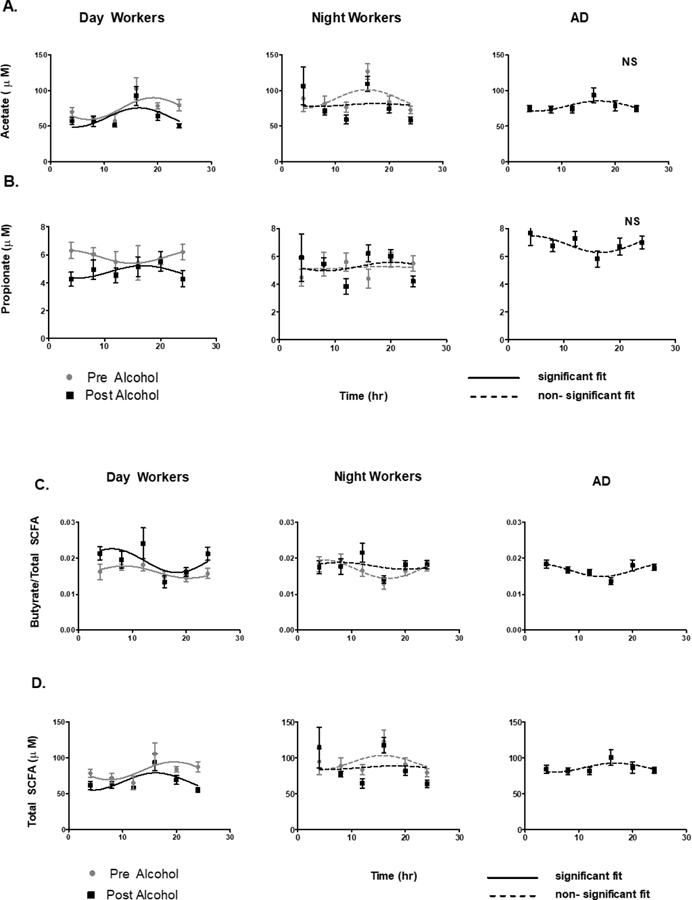
Figure 1:. Cosinor Rhythmicity of plasma SCFAs
The cosinor rhythm of plasma SCFAs was test at 6 timepoints over 24 hours under constant routine in all three groups: DW, NW, and AD in A) Acetate; B) Propionate; C) Butyrate/Total SCFAs; and D) Total SCFAs. In DW and NW two 24 hour phase assessments were completed before and after 0.5 g/kg of alcohol. A solid line represents a significant 24 hour cosinor curve fit and a dahsed line represents an insignificant 24 hour cosinor curve fit.
Figure 2:
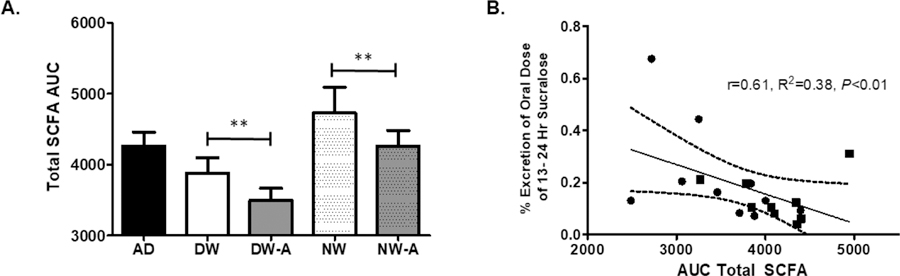
Figure 2:. Total SCFA AUC compared to Colonic Permeability
Total SCFA as calculated by area under the curve (AUC) in day workers (DW) and night workers (NW). A) Moderate alcohol for one week, 0.5 g/kg, suppressed total SCFAs as measured by Total SCFA area under the curve (AUC) in day workers (DW) and night workers (NW). B) A decrease in Total SCFA was correlated with an increase in primarly colonic permeability as measured by urinary sucralose collected 13–24 hours after ingestion. ** denotes a P < 0.05 by Wilcox Signed Rank Test. A linear regression was done to compare Total SCFA to urinary sucralose.
Figure 3:
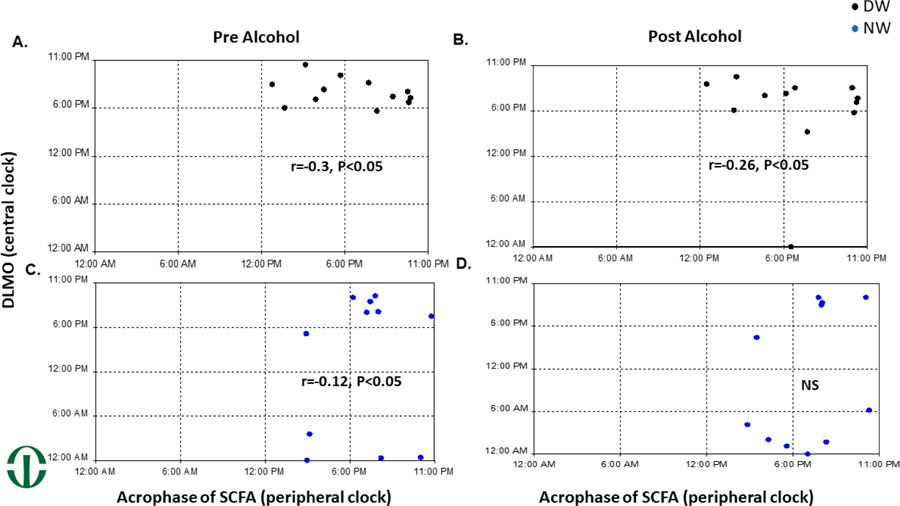
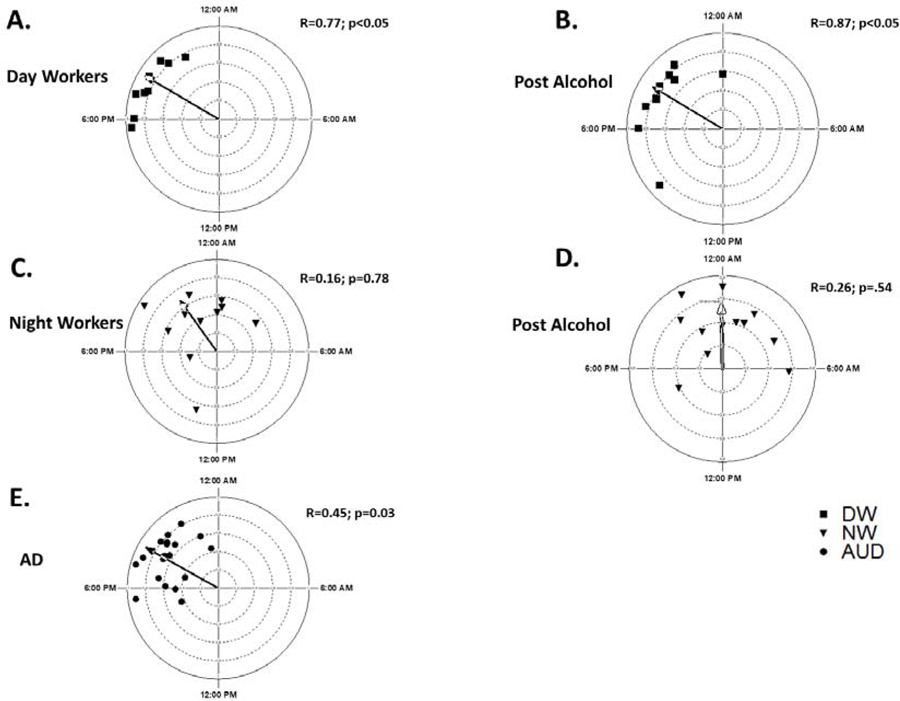
Figure 3:. Disrupted circadian host loses synchronization between central and peripheral timing
The time of dim light melatonin onset (DLMO) marker of the central clock was compared to the time of peak expression of SCFAs (the acrophase). By a circular to circular correlation, there was a significant correlation with DLMO and SCFA Acrophase in A) Day Workers (DW) pre alcohol, B) DW post one week of alcohol (0.5g/kg), and C) NW pre alcohol. In NW after one week of alcohol (0.5g/kg) that correlation was not significant.
Figure 4:
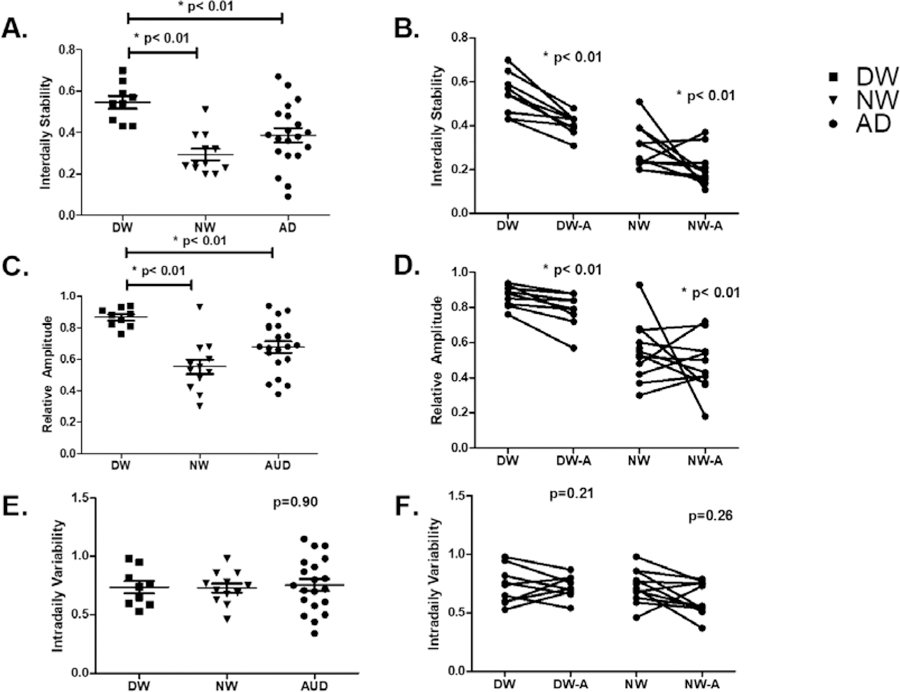
Figure 4:. Circadian Rest-Activity Disruption with Alcohol
Non-parametric analysis of rest-activity rhythms for one week prior to each phase assessment in all three groups was used to calculate the interdaily stability (IS), intradaily variability (IV), relative amplitude (RA). A) and C) At baseline, there was a significant differenat in IS and RA between DW and both NW and AD (P<0.01). E) There was not a significant difference in IV. B) and D) After one week of moderate alcohol there as a significant decrease in IS and RA by paired analysis. F) There was not a significant change in IV by paired analysis.
Figure 5:
Figure 5:. Circadian Rest-Activity Relative Amplitude Correlated to DLMO
Comparing the timing of dim light melatonin onset (DLMO) to circadian rest-activity rhythms by wrist actigraphy there was a significant circular to circular correlation in A) Day Workers (DW) pre alcohol and B) DW post alcohol. In Night Workers (NW), C) and D) RA did not correlate with DLMO. In Alcohol use disorder (AD) E) there was a less robust but significant correlation between DLMO and RA.
Figure 6:
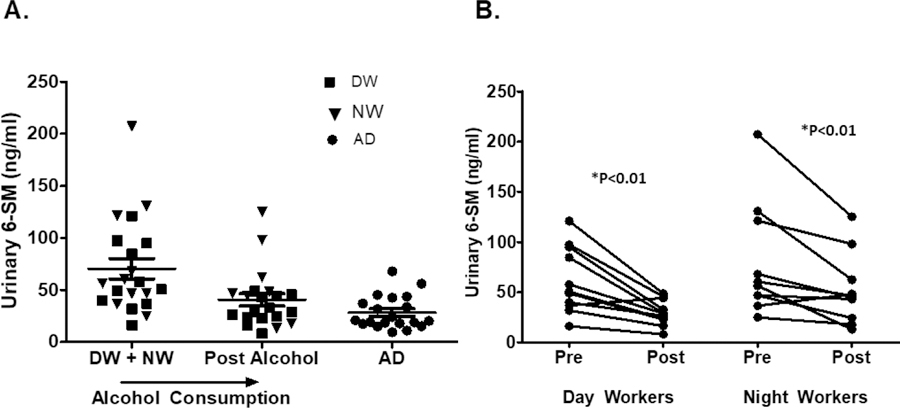
Figure 6:. Effect of Alcohol Consumption of Urinary 6-sulfatoxymelatonin
Urinary 6-sulfatoxymelatonin (6-SM) was collected in all 3 groups over 24 hours during each phase assessment. A) Moderate alcohol for one week in Day Workers (DW) and Night Workers (NW) caused a significant decrease in and chronic alcohol in the alcohol use disorder (AD) group. B) By paired analysis, urinary 6-SM decrease in both Day workers and Night Workers by Wilcox Signed Rank Test.
Figure 7:
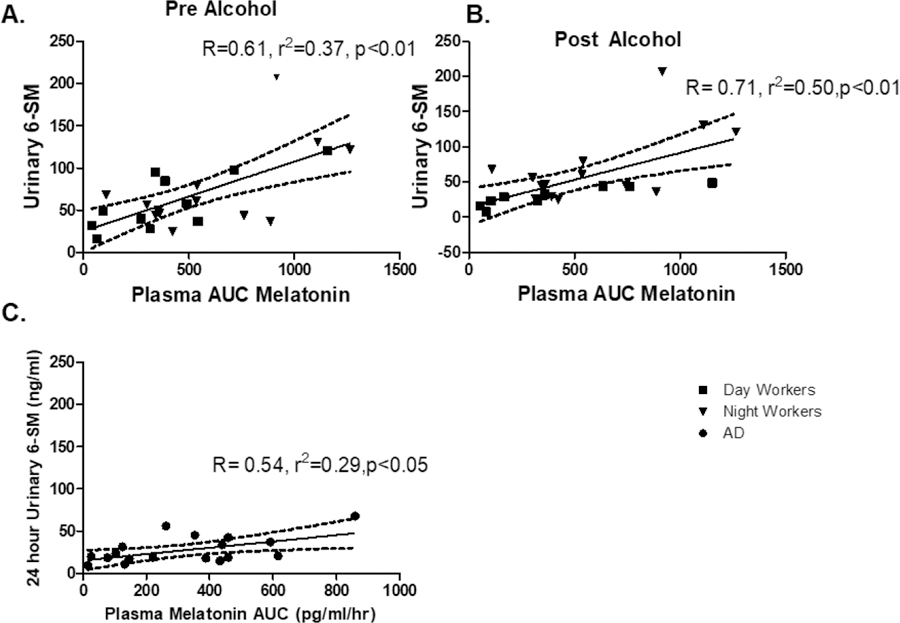
Figure 7:. Correlation of Urinary 6-SM and plasma Melatonin AUC
Hourly plasma melatonin taken for 24 hours was compared to a 24 hour collection of urinary 6-sulfatoxymelatonin (6-SM). In all three groups there was a significant correlation with plasma melatonin and urinary 6-SM in A) Day Workers, B) Night Workers, and C) Alcohol Use Disorder (AD). Linear correlation was used to compare plasma and urinary melatonin.

References

    1. Lucassen EA, Coomans CP, van Putten M, et al. Environmental 24-hr Cycles Are Essential for Health. Curr Biol 2016;26(14):1843–1853. - PubMed
    1. Mure LS, Le HD, Benegiamo G, et al. Diurnal transcriptome atlas of a primate across major neural and peripheral tissues. Science 2018;359(6381): 10.1126/science.aao0318. Epub 2018 Feb 8. - DOI - PMC - PubMed
    1. Broussard JL, Van Cauter E. Disturbances of sleep and circadian rhythms: novel risk factors for obesity. Curr Opin Endocrinol Diabetes Obes 2016;23(5):353–359. - PMC - PubMed
    1. Turek FW, Joshu C, Kohsaka A, et al. Obesity and metabolic syndrome in circadian Clock mutant mice. Science 2005;308(5724):1043–1045. - PMC - PubMed
    1. Hand LE, Hopwood TW, Dickson SH, et al. The circadian clock regulates inflammatory arthritis. FASEB J 2016;30(11):3759–3770. - PMC - PubMed

Publication types

Substances