Use of genetic variation to separate the effects of early and later life adiposity on disease risk: mendelian randomisation study
- PMID: 32376654
- PMCID: PMC7201936
- DOI: 10.1136/bmj.m1203
Use of genetic variation to separate the effects of early and later life adiposity on disease risk: mendelian randomisation study
Abstract
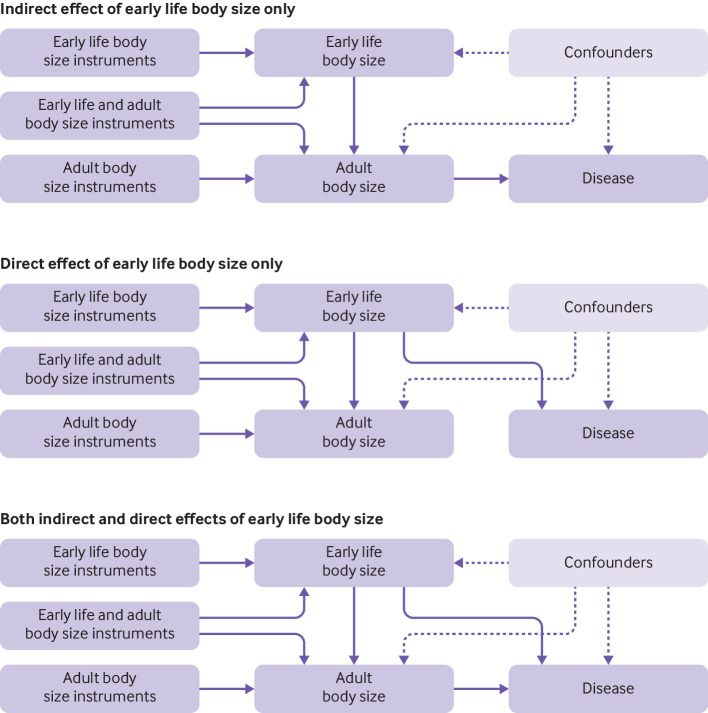
Objective: To evaluate whether body size in early life has an independent effect on risk of disease in later life or whether its influence is mediated by body size in adulthood.
Design: Two sample univariable and multivariable mendelian randomisation.
Setting: The UK Biobank prospective cohort study and four large scale genome-wide association studies (GWAS) consortiums.
Participants: 453 169 participants enrolled in UK Biobank and a combined total of more than 700 000 people from different GWAS consortiums.
Exposures: Measured body mass index during adulthood (mean age 56.5) and self-reported perceived body size at age 10.
Main outcome measures: Coronary artery disease, type 2 diabetes, breast cancer, and prostate cancer.
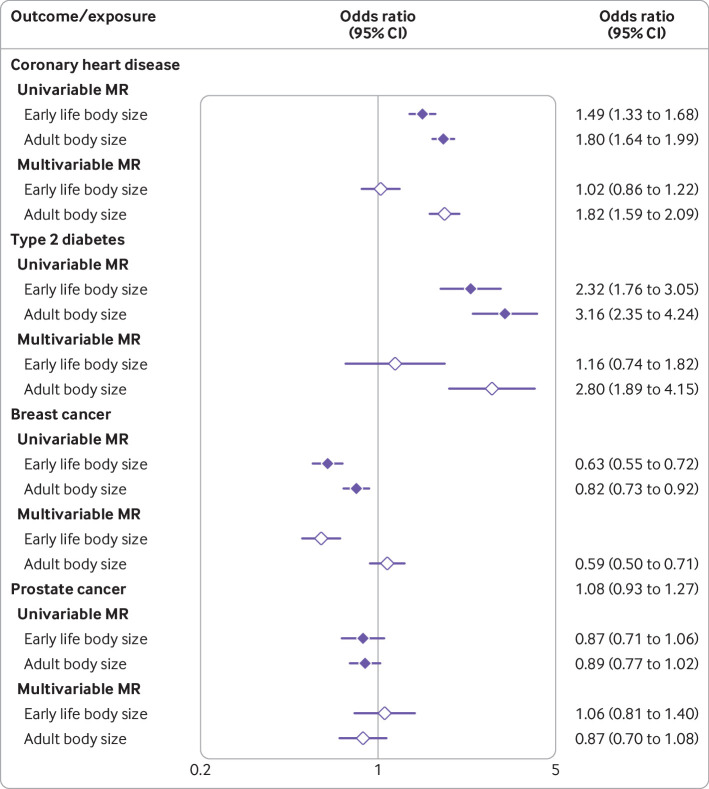
Results: Having a larger genetically predicted body size in early life was associated with an increased odds of coronary artery disease (odds ratio 1.49 for each change in body size category unless stated otherwise, 95% confidence interval 1.33 to 1.68) and type 2 diabetes (2.32, 1.76 to 3.05) based on univariable mendelian randomisation analyses. However, little evidence was found of a direct effect (ie, not through adult body size) based on multivariable mendelian randomisation estimates (coronary artery disease: 1.02, 0.86 to 1.22; type 2 diabetes:1.16, 0.74 to 1.82). In the multivariable mendelian randomisation analysis of breast cancer risk, strong evidence was found of a protective direct effect for larger body size in early life (0.59, 0.50 to 0.71), with less evidence of a direct effect of adult body size on this outcome (1.08, 0.93 to 1.27). Including age at menarche as an additional exposure provided weak evidence of a total causal effect (univariable mendelian randomisation odds ratio 0.98, 95% confidence interval 0.91 to 1.06) but strong evidence of a direct causal effect, independent of early life and adult body size (multivariable mendelian randomisation odds ratio 0.90, 0.85 to 0.95). No strong evidence was found of a causal effect of either early or later life measures on prostate cancer (early life body size odds ratio 1.06, 95% confidence interval 0.81 to 1.40; adult body size 0.87, 0.70 to 1.08).
Conclusions: The findings suggest that the positive association between body size in childhood and risk of coronary artery disease and type 2 diabetes in adulthood can be attributed to individuals remaining large into later life. However, having a smaller body size during childhood might increase the risk of breast cancer regardless of body size in adulthood, with timing of puberty also putatively playing a role.
© Author(s) (or their employer(s)) 2019. Re-use permitted under CC BY. No commercial re-use. See rights and permissions. Published by BMJ.
Conflict of interest statement
Competing interests: All authors have completed the ICMJE uniform disclosure form at www.icmje.org/coi_disclosure.pdf and declare: funding by grants from the Medical Research Council and Health Data Research UK for the submitted work; no support from any other organisation for the submitted work; no financial relationships with any other organisations that might have an interest in the submitted work in the previous three years; no other relationships or activities that could appear to have influenced the submitted work.
Figures

References
MeSH terms
Grants and funding
LinkOut - more resources
Full Text Sources
Medical