. 2020 May 6;10(1):7692.
doi: 10.1038/s41598-020-64657-2.

Multiparametric Mechanistic Profiling of Inotropic Drugs in Adult Human Primary Cardiomyocytes

Affiliations

Multiparametric Mechanistic Profiling of Inotropic Drugs in Adult Human Primary Cardiomyocytes

Najah Abi-Gerges et al. Sci Rep. .

Abstract

Effects of non-cardiac drugs on cardiac contractility can lead to serious adverse events. Furthermore, programs aimed at treating heart failure have had limited success and this therapeutic area remains a major unmet medical need. The challenges in assessing drug effect on cardiac contractility point to the fundamental translational value of the current preclinical models. Therefore, we sought to develop an adult human primary cardiomyocyte contractility model that has the potential to provide a predictive preclinical approach for simultaneously predicting drug-induced inotropic effect (sarcomere shortening) and generating multi-parameter data to profile different mechanisms of action based on cluster analysis of a set of 12 contractility parameters. We report that 17 positive and 9 negative inotropes covering diverse mechanisms of action exerted concentration-dependent increases and decreases in sarcomere shortening, respectively. Interestingly, the multiparametric readout allowed for the differentiation of inotropes operating via distinct mechanisms. Hierarchical clustering of contractility transient parameters, coupled with principal component analysis, enabled the classification of subsets of both positive as well as negative inotropes, in a mechanism-related mode. Thus, human cardiomyocyte contractility model could accurately facilitate informed mechanistic-based decision making, risk management and discovery of molecules with the most desirable pharmacological profile for the correction of heart failure.


Conflict of interest statement

The authors declare no competing interests.

Figures
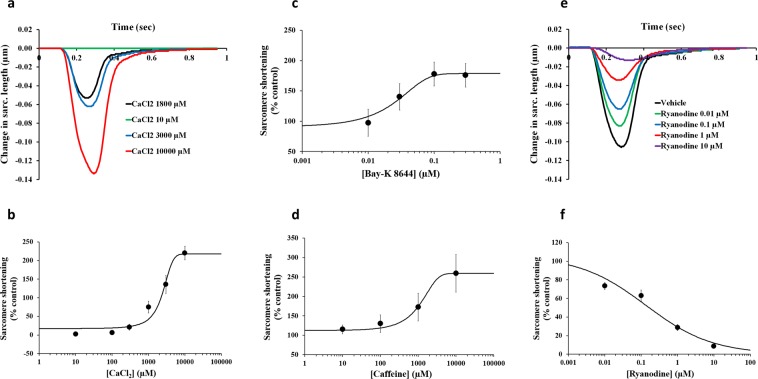
Figure 1
Figure 1
Effects of CaCl2, BayK-8644, Caffeine and Ryanodine on human cardiomyocyte contractility. (a) Typical contractility transients recorded from an adult human primary ventricular myocyte in the presence of vehicle control and after exposure to CaCl2 at 10, 1800, 3000 and 10000 µM. (b), (c) and (d) C-E curves generated with CaCl2, BayK-8644 and Caffeine, respectively. (e) Typical contractility transients recorded from an adult human primary ventricular myocyte in the presence of vehicle control and after exposure to Ryanodine at 0.01, 0.1, 1 and 10 µM. (f) C-E curve generated with Ryanodine. Each C-E curve plot shows the effect of a test article on sarcomere shortening as well as the mean data points and the fitted C-E curve. IonWizard software (v1.2.22, www.ionoptix.com) and SigmaPlot v14.0 (www.systatsoftware.com) were used to generate the representative contractility transients and fitted C-E curves, respectively.
Figure 2
Figure 2
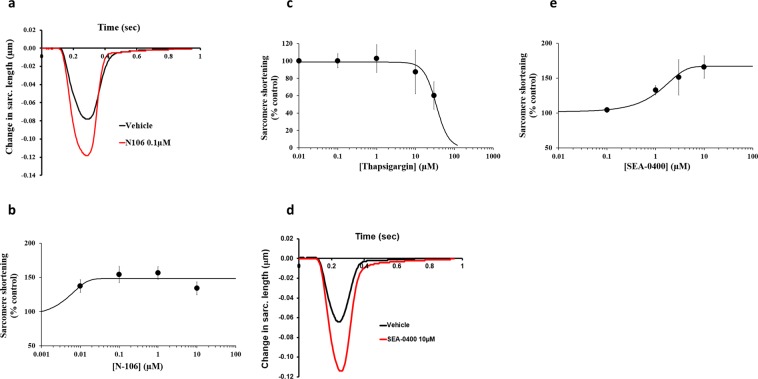
Effects of N-106, Thapsigargin and SEA-0400 on human cardiomyocyte contractility. (a) Typical contractility transients recorded from an adult human primary ventricular myocyte in the presence of vehicle control and after exposure to N106 at 0.1 µM. (b,c) C-E curves generated with N-106 and Thapsigargin, respectively. (d) Typical contractility transients recorded from an adult human primary ventricular myocyte in the presence of vehicle control and after exposure to SEA-0400 at 10 µM. (e) C-E curve generated with SEA-0400. Each C-E curve plot shows the effect of a test article on sarcomere shortening as well as the mean data points and the fitted C-E curve. IonWizard software (v1.2.22, www.ionoptix.com) and SigmaPlot v14.0 (www.systatsoftware.com) were used to generate the representative contractility transients and fitted C-E curves, respectively.
Figure 3
Figure 3
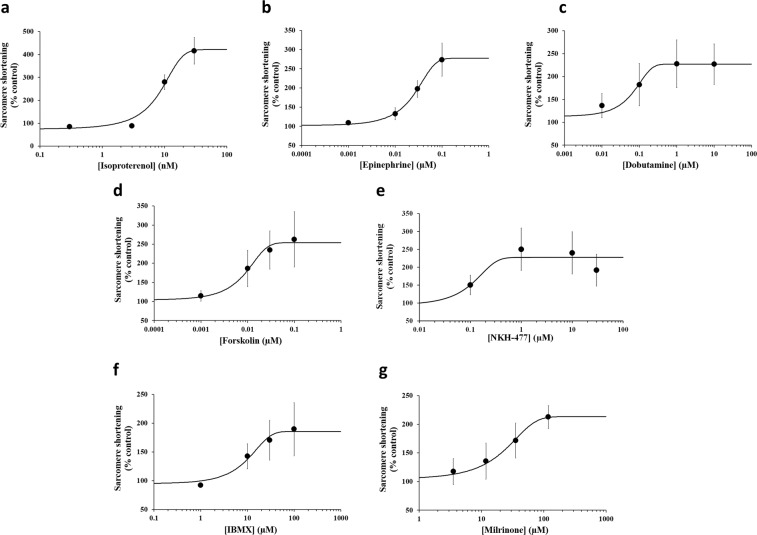
Potency information generated with positive inotropes from human cardiomyocytes paced at 1 Hz pacing frequency. Typical cumulative C-E curves generated by human cardiomyocyte contractility measurements with 7 positive inotropic drugs: Isoproterenol (a), Epinephrine (b), Dobutamine (c), Forskolin (d), NKH-477 (e), IBMX (f) and Milrinone (g). Each plot shows the effect of a test article on sarcomere shortening as well as the mean data points and the fitted C-E curves. SigmaPlot v14.0 (www.systatsoftware.com) was used to generate the fitted C-E curves.
Figure 4
Figure 4
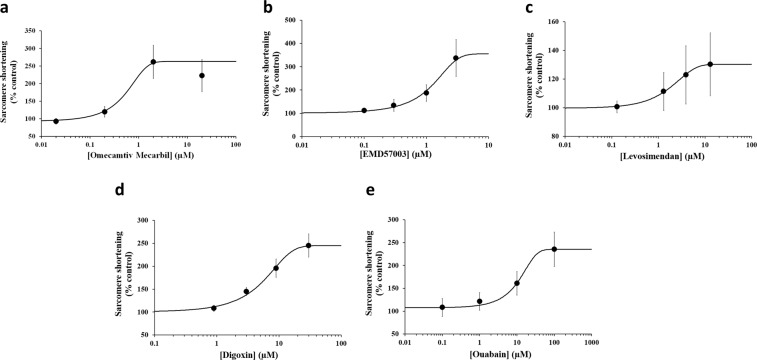
Potency information generated with positive inotropes from human cardiomyocytes paced at 1 Hz pacing frequency. Typical cumulative C-E curves generated by human cardiomyocyte contractility measurements with 5 positive inotropic drugs: Omecamtiv Mecarbil (a), EMD57003 (b), Levosimendan (c), Digoxin (d) and Ouabain (e). Each plot shows the effect of a test article on sarcomere shortening as well as the mean data points and the fitted C-E curves. SigmaPlot v14.0 (www.systatsoftware.com) was used to generate the fitted C-E curves.
Figure 5
Figure 5
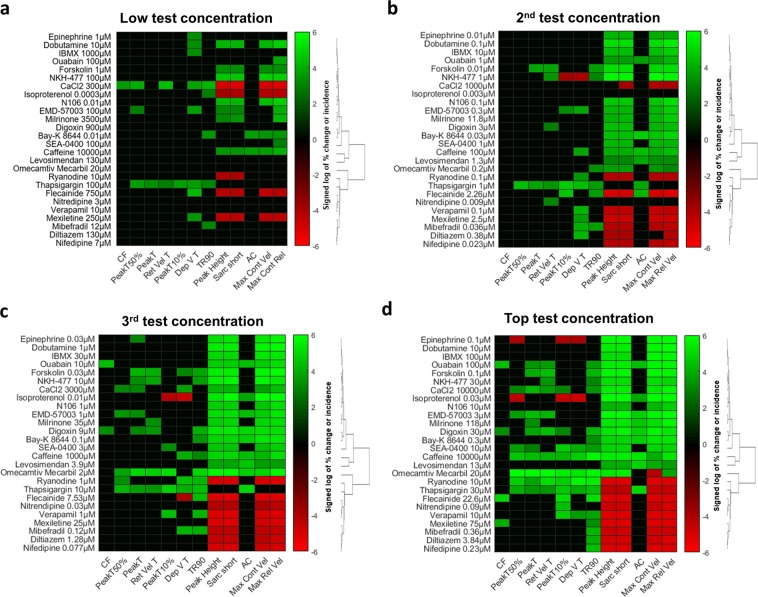
Classification of subsets of both positives as well as negative inotropes, in a mechanism-related mode after exposure to low (a), 2nd (b), 3rd (c) and top (d) test concentrations. Right-skewed percentage data of incidence (AC and CF) and change (all other contractility parameters) were normalized with a signed log transformation. Heatmap representations were created with a cluster analysis using dendrograms and partitions given the elbow criterion. Red and green colors indicate decrease and increase of >25% and >10% change, respectively. Black color indicate no effect (<−25% <% change <10%).
Figure 6
Figure 6
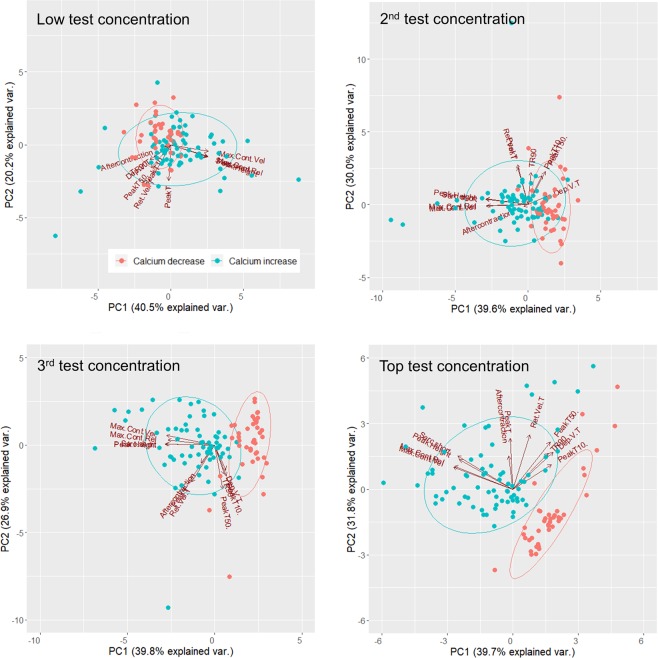
Segregation of inotropes based on the ability to increase or decrease intracellular Ca2+. Aqua and red cluster borders mark the 75% confidence interval for predicting if a novel unknown compound induces a positive or negative inotropic effect via increasing or decreasing intracellular Ca2+, respectively.

References

    1. Mellor HR, Bell AR, Valentin JP, Roberts RR. Cardiotoxicity associated with targeting kinase pathways in cancer. Toxicol. Sci. 2011;120:14–32. - PubMed
    1. Dong J, Chen H. Cardiotoxicity of anticancer therapeutics. Front. Cardiovasc. Med. 2018;5:9. doi: 10.3389/fcvm.2018.00009. - DOI - PMC - PubMed
    1. Cook D, et al. Lessons learned from the fate of AstraZeneca’s drug pipeline: a five-dimensional framework. Nat. Rev. Drug. Discov. 2014;13:419–431. - PubMed
    1. Van Meer BJ, Tertoolen LGJ, Mummery CL. Measuring physiological responses of human pluripotent stem cell derived cardiomyocytes to drugs and disease. Stem Cell. 2016;34(8):2008–2015. - PMC - PubMed
    1. Mummery, C. L. Perspectives on the use of human induced pluripotent stem cell-derived cardiomyocytes in biomedical research. Stem Cell Reports11(6), 1306-1311. - PMC - PubMed

Publication types

Substances