Review
. 2020 Apr 17:2020:9253745.
doi: 10.1155/2020/9253745. eCollection 2020.

Antiepithelial-Mesenchymal Transition of Herbal Active Substance in Tumor Cells via Different Signaling

Affiliations
Review

Antiepithelial-Mesenchymal Transition of Herbal Active Substance in Tumor Cells via Different Signaling

Xiaoji Cui et al. Oxid Med Cell Longev. .

Abstract

Epithelial-mesenchymal transition (EMT) is a biological process through which epithelial cells differentiate into mesenchymal cells. EMT plays an important role in embryonic development and wound healing; however, EMT also contributes to some pathological processes, such as tumor metastasis and fibrosis. EMT mechanisms, including gene mutation and transcription factor regulation, are complicated and not yet well understood. In this review, we introduce some herbal active substances that exert antitumor activity through inhibiting EMT that is induced by hypoxia, high blood glucose level, lipopolysaccharide, or other factors.


Conflict of interest statement

The authors declare that there is no conflict of interests related to this article.

Figures
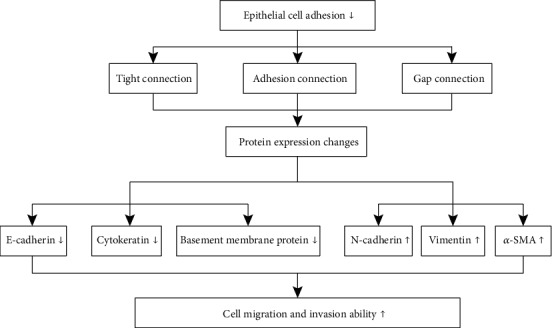
Figure 1
Figure 1
Mechanism of EMT-mediated tumor cell metastasis. Pathological factors impair epithelial cell adhesion ability resulting in the loss of tightly connected epithelial cells, a decrease in adhesive junctions, and the opening of gap junctions. Consequently, a large number of tumor metastasis-related proteins (including E-cadherin, cytokeratin, basement membrane protein, N-cadherin, vimentin, and α-SMA) are regulated to improve the ability of tumor cell migration and invasion.
Figure 2
Figure 2
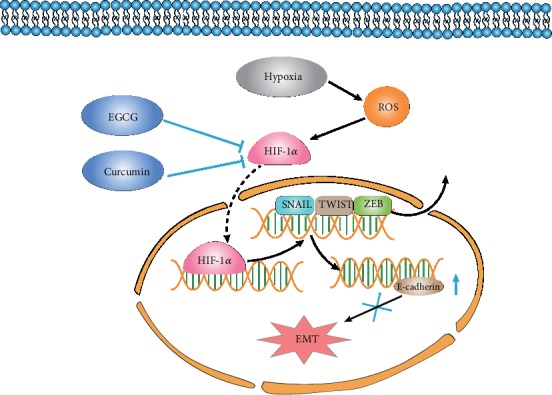
Botanical active substances prevent hypoxia-induced EMT. Botanical active substances, such as curcumin and EGCG, prevent hypoxia-induced EMT through the inhibition of HIF-1α and HIF-Iα-triggered gene (including SNAIL, TWIST, and ZEB) expression.
Figure 3
Figure 3
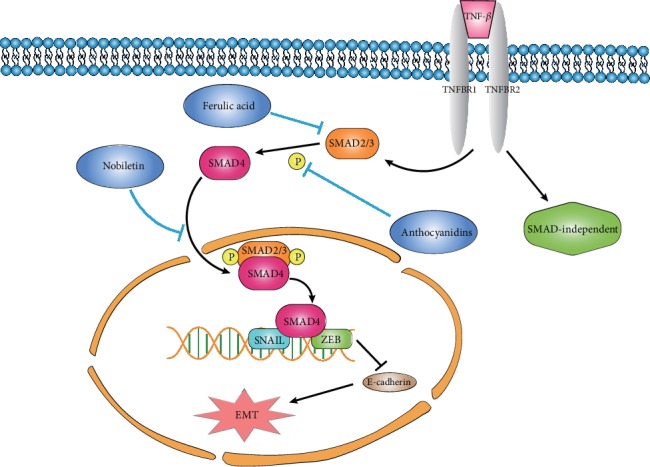
Botanical active substances prohibit Smads/Snail signaling of EMT. Botanical active substances (including anthocyanidins, ferulic acid, and nobiletin) can exert their anticancer activity through the inhibition of TGF-β/Smads/Snail signaling to prohibit the EMT process.
Figure 4
Figure 4
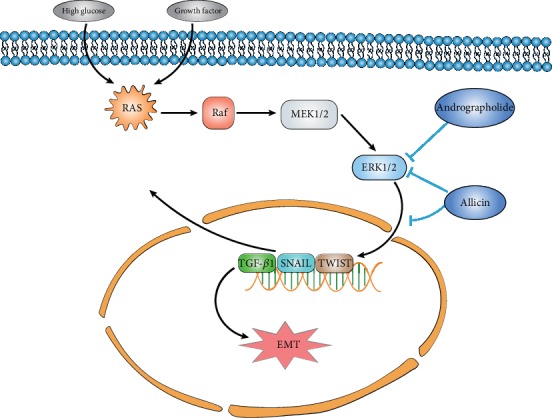
Botanical active substances restrain the EMT process through ERK1/2 signaling. High glucose or some growth factors can induce cancer cell EMT through the ERK1/2 signaling pathway. Botanical active substances, such as andrographolide and allicin, can imprison the EMT process through the dephosphorylation (inactivation) of ERK1/2.
Figure 5
Figure 5
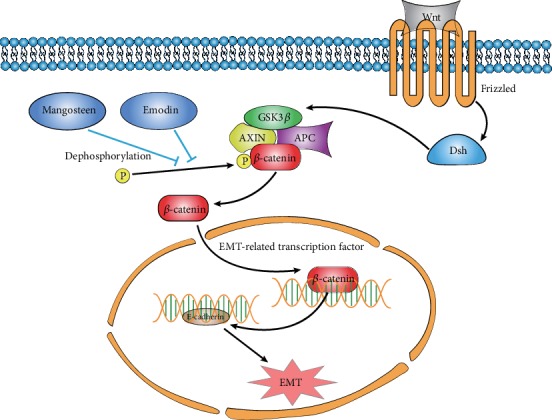
Botanical active substances restrain the EMT process through Wnt signaling. Botanical active substances, such as emodin and mangosteen, can prohibit the Wnt signaling through dephosphorylation (inactivation) of the key factor, β-catenin, to inhibit the cancer cell EMT process.

References

    1. Thiery J. P., Sleeman J. P. Complex networks orchestrate epithelial-mesenchymal transitions. Nature Reviews Molecular Cell Biology. 2006;7(2):131–142. doi: 10.1038/nrm1835. - DOI - PubMed
    1. Jia D., Li X., Bocci F., et al. Quantifying Cancer Epithelial-Mesenchymal Plasticity and its Association with Stemness and Immune Response. Journal of Clinical Medicine. 2019;8(5):p. 725. doi: 10.3390/jcm8050725. - DOI - PMC - PubMed
    1. Gurzu S., Silveanu C., Fetyko A., Butiurca V., Kovacs Z., Jung I. Systematic review of the old and new concepts in the epithelial-mesenchymal transition of colorectal cancer. World Journal of Gastroenterology. 2016;22(30):6764–6775. doi: 10.3748/wjg.v22.i30.6764. - DOI - PMC - PubMed
    1. Yeung K. T., Yang J. Epithelial-mesenchymal transition in tumor metastasis. Molecular Oncology. 2017;11(1):28–39. doi: 10.1002/1878-0261.12017. - DOI - PMC - PubMed
    1. Zhang Y., Weinberg R. A. Epithelial-to-mesenchymal transition in cancer: complexity and opportunities. Frontiers of Medicine. 2018;12(4):361–373. doi: 10.1007/s11684-018-0656-6. - DOI - PMC - PubMed

MeSH terms