. 2020 May 1:7:63.
doi: 10.1038/s41438-020-0288-2. eCollection 2020.

The chromosome-scale genome reveals the evolution and diversification after the recent tetraploidization event in tea plant

Affiliations

The chromosome-scale genome reveals the evolution and diversification after the recent tetraploidization event in tea plant

Jie-Dan Chen et al. Hortic Res. .

Abstract

Tea is one of the most popular nonalcoholic beverages due to its characteristic secondary metabolites with numerous health benefits. Although two draft genomes of tea plant (Camellia sinensis) have been published recently, the lack of chromosome-scale assembly hampers the understanding of the fundamental genomic architecture of tea plant and potential improvement. Here, we performed a genome-wide chromosome conformation capture technique (Hi-C) to obtain a chromosome-scale assembly based on the draft genome of C. sinensis var. sinensis and successfully ordered 2984.7 Mb (94.7%) scaffolds into 15 chromosomes. The scaffold N50 of the improved genome was 218.1 Mb, ~157-fold higher than that of the draft genome. Collinearity comparison of genome sequences and two genetic maps validated the high contiguity and accuracy of the chromosome-scale assembly. We clarified that only one Camellia recent tetraploidization event (CRT, 58.9-61.7 million years ago (Mya)) occurred after the core-eudicot common hexaploidization event (146.6-152.7 Mya). Meanwhile, 9243 genes (28.6%) occurred in tandem duplication, and most of these expanded after the CRT event. These gene duplicates increased functionally divergent genes that play important roles in tea-specific biosynthesis or stress response. Sixty-four catechin- and caffeine-related quantitative trait loci (QTLs) were anchored to chromosome assembly. Of these, two catechin-related QTL hotspots were derived from the CRT event, which illustrated that polyploidy has played a dramatic role in the diversification of tea germplasms. The availability of a chromosome-scale genome of tea plant holds great promise for the understanding of genome evolution and the discovery of novel genes contributing to agronomically beneficial traits in future breeding programs.

Keywords: Comparative genomics; Genome evolution.


Conflict of interest statement

Conflict of interestThe authors declare that they have no conflict of interest.

Figures
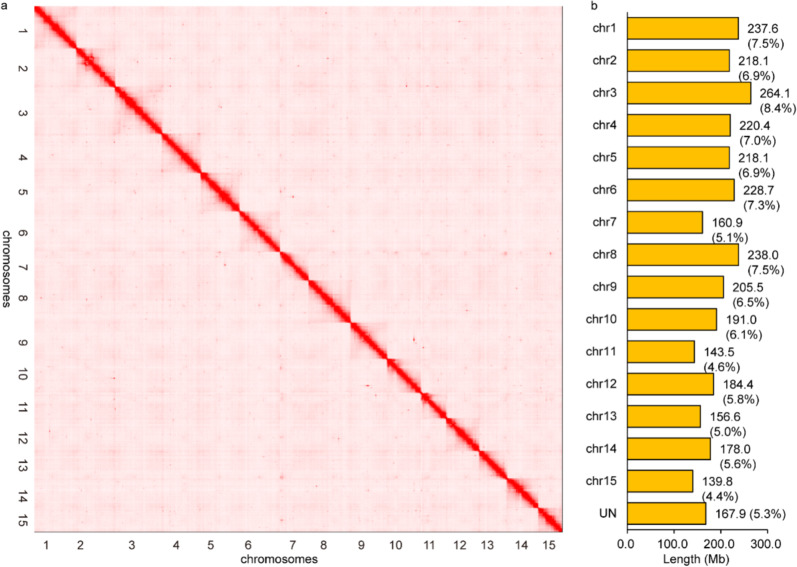
Fig. 1
Fig. 1. Hi-C heatmap based on the chromosome-scale assembly of the CSS V1.2 genome.
a The heatmap represents the contact matrices generated by aligning the Hi-C data to the chromosome-scale assembly of the CSS V1.2 genome. b The length statistics of each chromosome of the CSS V1.2 genome resulting from the Juicer and 3D-DNA pipelines
Fig. 2
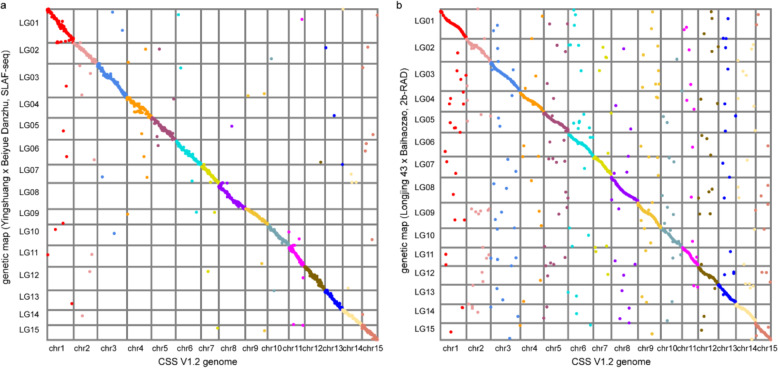
Fig. 2. Comparison of the chromosome-scale assembly of the CSS V1.2 genome and genetic maps.
a The y-axis represents the genetic positions of the SLAF-seq genetic map from the F1 population of CSS ‘Yingshuang’ and C. sinensis var. pubilimba ‘Beiyue Danzhu’. b The y-axis represents the genetic positions of the 2b-RAD genetic map from the F1 population of CSS ‘Longjing 43’ and CSS ‘Baihaozao’. The x-axis represents the physical positions of the chromosome-scale assembly of the CSS V1.2 genome
Fig. 3
Fig. 3. Dating of two polyploidization events of the C. sinensis genome.
a Ks distribution between collinear genes within the C. sinensis genome or among genomes. CRT Camellia recent tetraploidization, ECH core-eudicot common hexaploidization, ART Actinidia recent tetraploidization, AAT Actinidia ancient tetraploidization. b Phylogenetic tree of C. sinensis, V. vinifera, and A. chinensis
Fig. 4
Fig. 4. Homologous dotplot between C. sinensis and V. vinifera genomes.
The red, blue, and gray dots represent the best, secondary, and other matched homologous gene pairs resulting from the output of Blast software. The 19 chromosomes of the V. vinifera genome are colored by the seven eudicot ancestral chromosomes. The orthologous regions were identified and marked by squares
Fig. 5
Fig. 5. Genome-wide analysis of tandem gene duplication in the C. sinensis genome.
a C. sinensis genome topography and synteny. I represents the duplicated gene blocks within C. sinensis that were produced by ECH (green) and CRT (orange) events. II represents the frequency distribution of tandem genes in 1-Mb intervals across the 15 chromosomes, MAX = 22. III represents gene density ranging from 0 to 37 genes per Mb. b Identification of tandemly duplicated NBS-encoding genes. c Comparison of gene expression in eight tissues between tandem and nontandem NBS-encoding genes. d Comparison of the highly expressed apical genes between tandem and nontandem genes among the enriched genes involved in phenylpropanoid biosynthesis and flavonoid biosynthesis. e Phylogenetic tree and gene expression in eight tissues of six F3ʹ5ʹH genes belonging to two clusters
Fig. 6
Fig. 6. Distribution of QTLs associated with catechin and caffeine in the C. sinensis genome.
CAF caffeine content, C catechin, EC epicatechin, ECG epicatechin gallate, EGC epigallocatechin, EGCG epigallocatechin gallate. The arrow represents QTLs with high phenotypic variance explained (PVE > 20%)

References

    1. Kanwar J, et al. Recent advances on tea polyphenols. Front. Biosci. 2012;4:111–131. doi: 10.2741/e363. - DOI - PMC - PubMed
    1. Pervin M, et al. Beneficial effects of green tea catechins on neurodegenerative diseases. Molecules. 2018;23:1297. doi: 10.3390/molecules23061297. - DOI - PMC - PubMed
    1. Mancini E, et al. Green tea effects on cognition, mood and human brain function: a systematic review. Phytomedicine. 2017;34:26–37. doi: 10.1016/j.phymed.2017.07.008. - DOI - PubMed
    1. Chen, L., Apostolides, Z. & Chen, Z. M. Global Tea Breeding: Achievements, Challenges and Perspectives (University Press-Springer, Hangzhou, Zhejiang; 2012).
    1. Chen L, Yao MZ, Wang XC, Yang YJ. Tea genetic resources in China. Int. J. Tea Sci. 2012;8(2):55–64.