. 2020 Jul;111(7):2297-2309.
doi: 10.1111/cas.14447. Epub 2020 May 30.

Long noncoding RNA ANRIL promotes the malignant progression of cholangiocarcinoma by epigenetically repressing ERRFI1 expression

Affiliations

Long noncoding RNA ANRIL promotes the malignant progression of cholangiocarcinoma by epigenetically repressing ERRFI1 expression

Yang Yu et al. Cancer Sci. 2020 Jul.

Abstract

Long noncoding RNAs (lncRNAs) have recently been verified to have significant regulatory functions in many types of human cancers. The lncRNA ANRIL is transcribed from the INK4b-ARF-INK4a gene cluster in the opposite direction. Whether ANRIL can act as an oncogenic molecule in cholangiocarcinoma (CCA) remains unknown. Our data show that ANRIL knockdown greatly inhibited CCA cell proliferation and migration in vitro and in vivo. According to the results of RNA sequencing analysis, ANRIL knockdown dramatically altered target genes associated with the cell cycle, cell proliferation, and apoptosis. By binding to a component of the epigenetic modification complex enhancer of zeste homolog 2 (EZH2), ANRIL could maintain lysine residue 27 of histone 3 (H3K27me3) levels in the promoter of ERBB receptor feedback inhibitor 1 (ERRFI1), which is a tumor suppressor gene in CCA. In this way, ERRFI1 expression was suppressed in CCA cells. These data verified the key role of the epigenetic regulation of ANRIL in CCA oncogenesis and indicate its potential as a target for CCA intervention.

Keywords: ANRIL; ERRFI1; cholangiocarcinoma; epigenetic regulation; long noncoding RNA.


Conflict of interest statement

None.

Figures

FIGURE 1
FIGURE 1
Increased long noncoding RNA (lncRNA) ANRIL levels in cholangiocarcinoma (CCA) tissues. A, Hierarchical clustering analysis of lncRNAs that were differentially expressed (P < .05) in CCA tissues and normal tissues from The Cancer Genome Atlas (TCGA) database. B, ANRIL was overexpressed in Gene Expression Omnibus datasets (GSE76297). C, ANRIL was detected in 17 pairs of CCA tissues by quantitative RT‐PCR. ANRIL levels are significantly higher in CCA tissues than in nontumorous tissues. Error bars indicate means ± SD. ***P < .001
FIGURE 2
FIGURE 2
ANRIL promotes cell proliferation and migration in cholangiocarcinoma (CCA) cells. A, Quantitative RT‐PCR was used to detect ANRIL expression in HuCCT1 and RBE cell lines after siRNA transfection. B, CCK‐8 assays were used to determine cell viability in si‐ANRIL‐transfected CCA cells. C, Colony formation assays were used to determine the cell colony formation ability of si‐ANRIL‐transfected cells. D, Transwell assays showed that ANRIL knockdown inhibits CCA cell migration. Error bars indicate means ± SD. *P < .05, **P < .01; ***P < .001. si‐SC, scrambled negative control siRNA
FIGURE 3
FIGURE 3
ANRIL depletion increases cell apoptosis and delays the cell cycle in cholangiocarcinoma (CCA) cell lines. A, FACS analysis of the effect of ANRIL on cell apoptosis. B, FACS analysis of the effect of ANRIL on cell cycle progression. Error bars indicate means ± SD. *P < .05, **P < .01; ***P < .001; n.s., not significant; si‐NC, negative control siRNA; si‐SC, scrambled negative control siRNA
FIGURE 4
FIGURE 4
ANRIL promotes cholangiocarcinoma cell tumor growth in vivo. A, B, Scrambled (sh‐SC) or sh‐ANRIL was stably transfected into HuCCT1 cells, which were then injected into nude mice. C, Tumor volumes were calculated every 4 days after injection. Bars indicate SD. D, Tumor weights represent means ± SD *P < .05; **P < .01
FIGURE 5
FIGURE 5
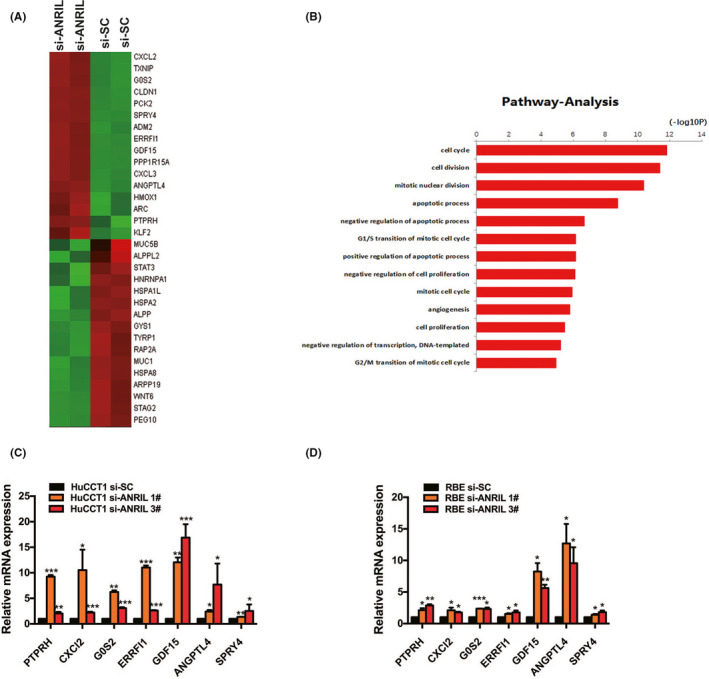
RNA sequencing after ANRIL knockdown in HuCCT1 cholangiocarcinoma cells. A, Mean‐centered, hierarchical clustering of the 2733 transcripts altered (≥1.5‐fold change) in scrambled negative control siRNA (si‐SC)‐treated cells and siRNA‐ANRIL‐treated cells with 2 repeats. B, Gene ontology analysis for all genes with altered expression. C, D, Altered mRNA levels were selectively confirmed by quantitative RT‐PCR in ANRIL knockdown cells. Error bars indicate means ± SD. *P < .05; **P < .01; ***P < .001
FIGURE 6
FIGURE 6
ANRIL binds to EZH2 in the nucleus to epigenetically silence ERRFI1. A, After nuclear and cytosolic separation, RNA expression levels were measured by quantitative (q)RT‐PCR. GAPDH was used as a cytosolic marker, and U1 was used as a nuclear marker. B, Interaction probabilities for EZH2 and ANRIL (http://pridb.gdcb.iastate.edu/RPISeq/index.html). RF, random Forest; SVM, support vector machine. C, RIP experiments for EZH2 were carried out, and the coprecipitated RNA was subjected to qRT‐PCR for ANRIL (GAPDH as the internal control). D, qRT‐PCR was used to detect EZH2 expression in HuCCT1 and RBE cell lines after si‐EZH2 transfection. E, Methylation‐related genes were detected by qRT‐PCR in HuCCT1 and RBE cell lines after EZH2 knockdown. F, Correlation between EZH2 and ERRFI1 expression was detected by analyzing GSE76297 data. G, Altered protein levels of ERRFI1 after EZH2 knockdown were selectively confirmed by western blotting. H, Altered protein levels of ERRFI1 after ANRIL knockdown were selectively confirmed by western blotting. I, ChIP‐qPCR of EZH2/H3K27me3 and in ERRFI1 promoter region after transfection with scrambled negative control siRNA (si‐SC) or ANRIL siRNAs in HuCCT1 cells. Enrichment was quantified with the anti‐IgG Ab as an internal control. Error bars indicate means ± SD. *P < .05; **P < .01; ***P < .001; n.s., not significant
FIGURE 7
FIGURE 7
EFFRI1 overexpression suppresses cholangiocarcinoma (CCA) cell proliferation and metastasis, and ERRFI1 is a confirmed target of ANRIL. A, ERRFI1 expression levels in CCA according to GSE76297 data analysis. B, ERRFI1 was detected in 17 pairs of CCA tissues by quantitative RT‐PCR. ERRFI1 levels were significantly lower in CCA tissues than in nontumorous tissues. C, CCK‐8 assays were used to determine the cell viability of pcDNA‐ERRFI1‐transfected CAA cells. D, Colony formation assays were used to determine the cell colony formation ability of pcDNA‐ERRFI1‐transfected cells. E, HuCCT1 and RBE cells transfected with vector/pcDNA‐ERRFI1/pcDNA‐ANRIL were transfected with ANRIL followed by ERRFI1. After transfection, the cells were analyzed by CCK‐8 assays. F, Proposed model in which ANRIL interacts with EZH2 to suppress ERRFI1 expression and promote CCA tumor growth. Error bars indicate means ± SD. *P < .05; **P < .01; ***P < .001

References

    1. Wang W‐T, Ye H, Wei P‐P, et al. LncRNAs H19 and HULC, activated by oxidative stress, promote cell migration and invasion in cholangiocarcinoma through a ceRNA manner. J Hematol Oncol. 2016;9:117. - PMC - PubMed
    1. Rizvi S, Borad MJ, Patel T, Gores GJ. Cholangiocarcinoma: molecular pathways and therapeutic opportunities. Semin Liver Dis. 2014;34:456‐464. - PMC - PubMed
    1. Rizvi S, Gores GJ. Emerging molecular therapeutic targets for cholangiocarcinoma. J Hepatol. 2017;67:632‐644. - PMC - PubMed
    1. Rizvi S, Gores GJ. Pathogenesis, diagnosis, and management of cholangiocarcinoma. Gastroenterology. 2013;145:1215‐1229. - PMC - PubMed
    1. Zhu AX. Future directions in the treatment of cholangiocarcinoma. Best Pract Res Clin Gastroenterol. 2015;29:355‐361. - PubMed

MeSH terms