


Incidence and Long-Term Outcomes of Hypertensive Disorders of Pregnancy
- PMID: 32381164
- PMCID: PMC7213062
- DOI: 10.1016/j.jacc.2020.03.028
Incidence and Long-Term Outcomes of Hypertensive Disorders of Pregnancy
Abstract
Background: Hypertensive disorders of pregnancy (HDP) are associated with increased risks for cardiovascular disease later in life. The HDP incidence is commonly assessed using diagnostic codes, which are not reliable; and typically are expressed per-pregnancy, which may underestimate the number of women with an HDP history after their reproductive years.
Objectives: This study sought to determine the incidence of HDP expressed as both per-pregnancy and per-woman, and to establish their associations with future chronic conditions and multimorbidity, a measure of accelerated aging, in a population-based cohort study.
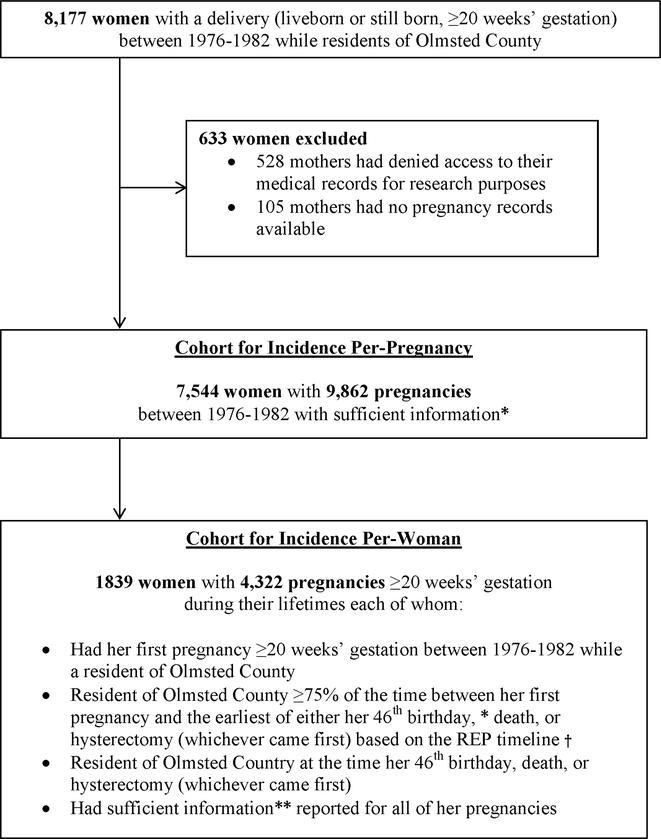
Methods: Using the Rochester Epidemiology Project medical record-linkage system, the authors identified residents of Olmsted County, Minnesota, who delivered between 1976 and 1982. The authors classified pregnancies into normotensive, gestational hypertension, pre-eclampsia, eclampsia, pre-eclampsia superimposed on chronic hypertension, and chronic hypertension using a validated electronic algorithm, and calculated the incidence of HDP both per-pregnancy and per-woman. The risk of chronic conditions between women with versus those without a history of HDP (age and parity 1:2 matched) was quantified using the hazard ratio and corresponding 95% confidence interval estimated from a Cox model.
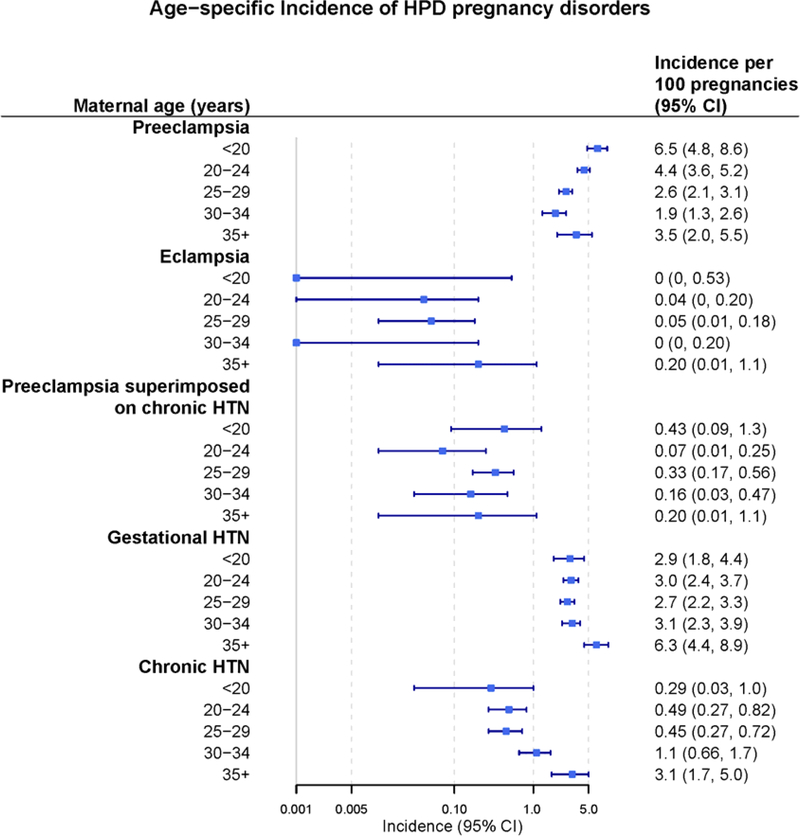
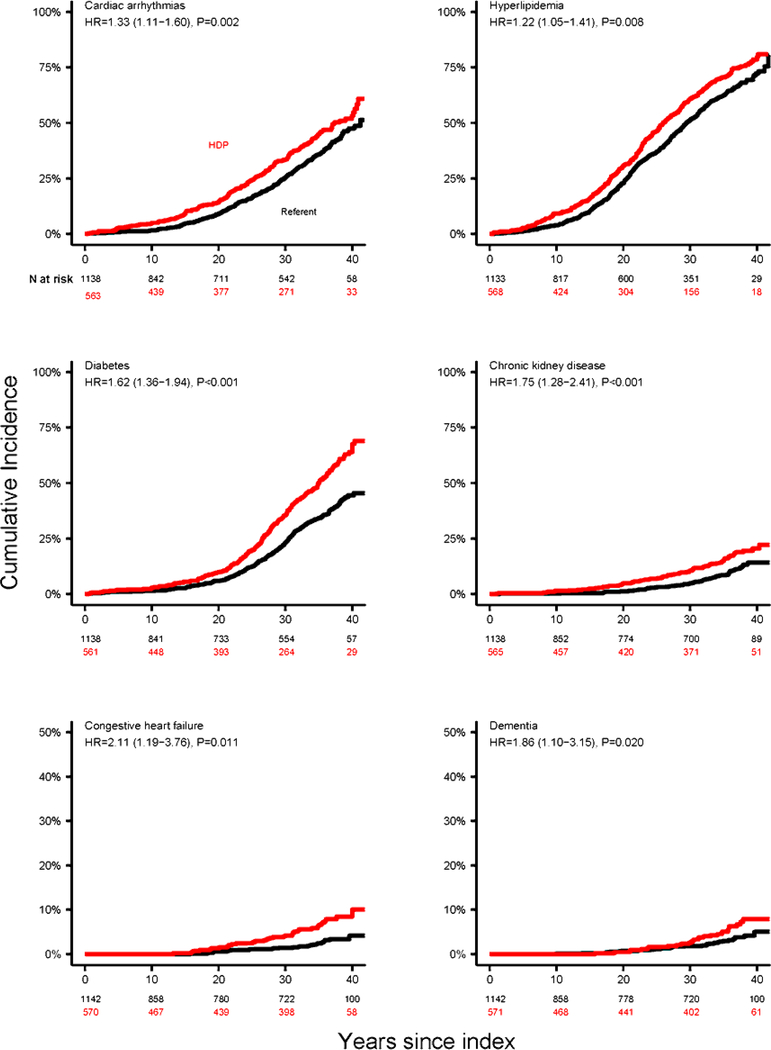
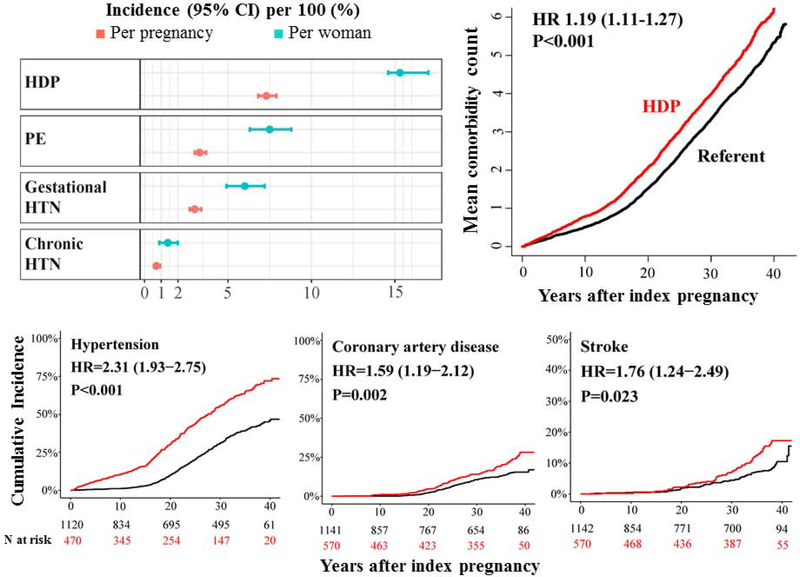
Results: Among 9,862 pregnancies, we identified 719 (7.3%) with HDP and 324 (3.3%) with pre-eclampsia. The incidence of HDP and pre-eclampsia doubled when assessed on a per-woman basis: 15.3% (281 of 1,839) and 7.5% (138 of 1,839), respectively. Women with a history of HDP were at increased risk for subsequent diagnoses of stroke (hazard ratio [HR]: 2.27; 95% confidence interval [CI]: 1.37 to 3.76), coronary artery disease (HR: 1.89; 95% CI: 1.26 to 2.82), cardiac arrhythmias (HR: 1.62; 95% CI: 1.28 to 2.05), chronic kidney disease (HR: 2.41; 95% CI: 1.54 to 3.78), and multimorbidity (HR: 1.25; 95% CI: 1.15 to 1.35).
Conclusions: The HDP population-based incidence expressed per-pregnancy underestimates the number of women affected by this condition during their reproductive years. A history of HDP confers significant increase in risks for future chronic conditions and multimorbidity.
Keywords: cardiovascular disease; hypertensive disorders of pregnancy; incidence; multimorbidity.
Copyright © 2020 American College of Cardiology Foundation. Published by Elsevier Inc. All rights reserved.
Conflict of interest statement
Figures
Comment in
-
Women's Cardiovascular Health After Hypertensive Pregnancy: The Long View From Labor and Delivery Becomes Clearer.J Am Coll Cardiol. 2020 May 12;75(18):2335-2337. doi: 10.1016/j.jacc.2020.01.064. J Am Coll Cardiol. 2020. PMID: 32381165 Free PMC article. No abstract available.
References
-
- Hypertension in pregnancy. Report of the American College of Obstetricians and Gynecologists’ Task Force on Hypertension in Pregnancy. Obstet Gynecol 2013;122:1122–31. - PubMed
-
- Towfighi A, Zheng L, Ovbiagele B. Sex-specific trends in midlife coronary heart disease risk and prevalence. Arch Intern Med 2009;169:1762–6. - PubMed
-
- Towfighi A, Saver JL, Engelhardt R, Ovbiagele B. A midlife stroke surge among women in the United States. Neurology 2007;69:1898–904. - PubMed
Publication types
MeSH terms
Grants and funding
LinkOut - more resources
Full Text Sources
Other Literature Sources
Medical
