


The Effectiveness of Collaborative Care on Depression Outcomes for Racial/Ethnic Minority Populations in Primary Care: A Systematic Review
- PMID: 32381258
- PMCID: PMC7541409
- DOI: 10.1016/j.psym.2020.03.007
The Effectiveness of Collaborative Care on Depression Outcomes for Racial/Ethnic Minority Populations in Primary Care: A Systematic Review
Abstract
Background: Racial/ethnic minorities experience a greater burden of mental health problems than white adults in the United States. The collaborative care model is increasingly being adopted to improve access to services and to promote diagnosis and treatment of psychiatric diseases.
Objective: This systematic review seeks to summarize what is known about collaborative care on depression outcomes for racial/ethnic minorities in the United States.
Methods: This review followed the Preferred Reporting Items for Systematic Reviews and Meta-Analyses method. Collaborative care studies were included if they comprised adults from at least one racial/ethnic minority group, were located in primary care clinics in the United States, and had depression outcome measures. Core principles described by the University of Washington Advancing Integrated Mental Health Solutions Center were used to define the components of collaborative care.
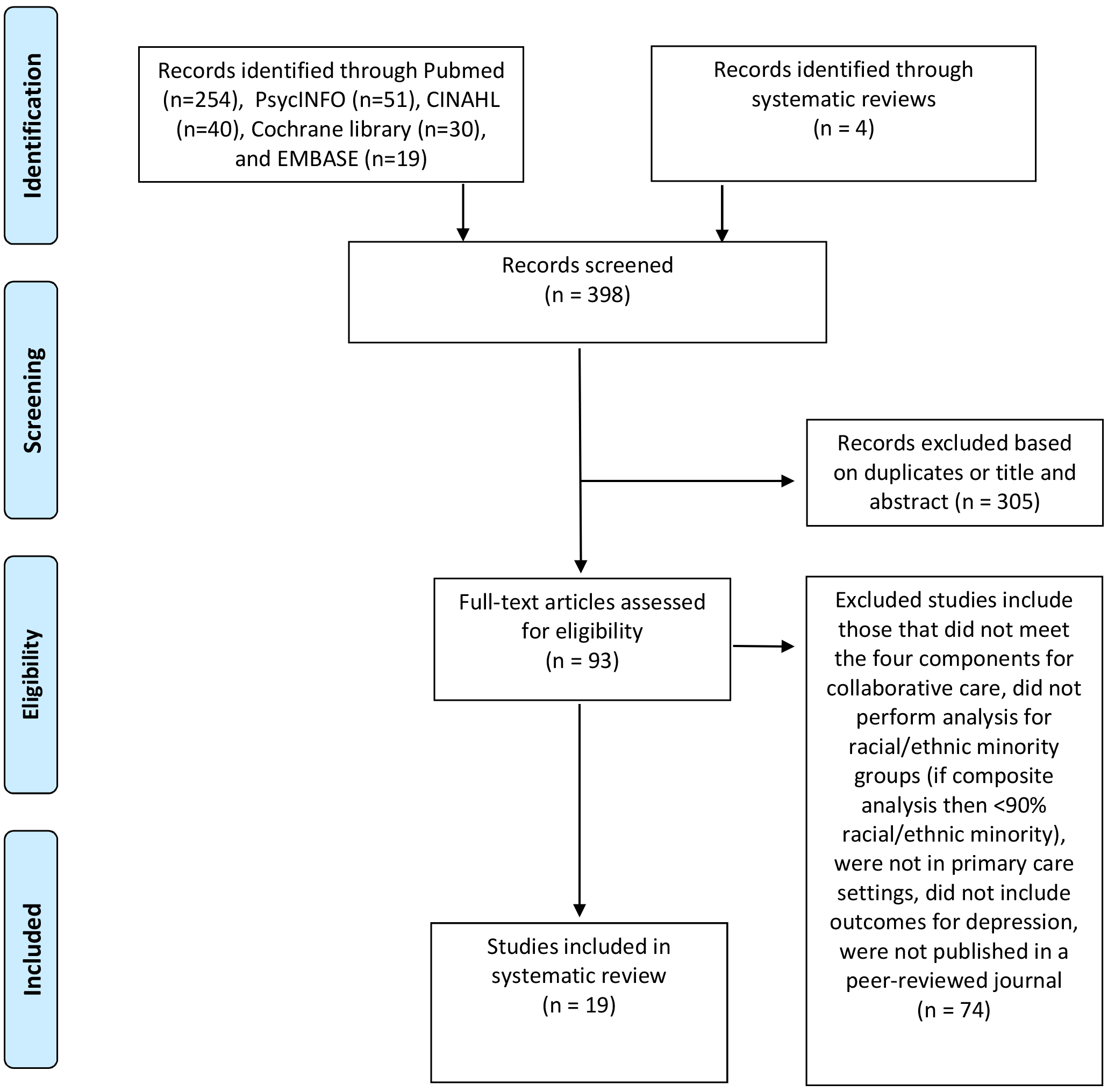
Results: Of 398 titles screened, 169 full-length articles were assessed for eligibility, and 19 studies were included in our review (10 randomized controlled trials, 9 observational). Results show there is potential that collaborative care, with or without cultural/linguistic tailoring, is effective in improving depression for racial/ethnic minorities, including those from low socioeconomic backgrounds.
Conclusions: Collaborative care should be explored as an intervention for treating depression for racial/ethnic minority patients in primary care. Questions remain as to what elements of cultural adaptation are most helpful, factors behind the difficulty in recruiting minority patients for these studies, and how the inclusion of virtual components changes access to and delivery of care. Future research should also recruit individuals from less studied populations.
Keywords: collaborative care; depression; racial/ethnic minority; systematic review.
Copyright © 2020 Academy of Consultation-Liaison Psychiatry. Published by Elsevier Inc. All rights reserved.
Figures
References
Publication types
MeSH terms
Grants and funding
LinkOut - more resources
Full Text Sources
