


Comparison of the facial profile attractiveness in Class III borderline patients after surgical or compensatory orthodontic treatment
- PMID: 32382384
- PMCID: PMC7195682
- DOI: 10.4317/jced.56750
Comparison of the facial profile attractiveness in Class III borderline patients after surgical or compensatory orthodontic treatment
Abstract
Background: This study aimed to compare the facial profile attractiveness of Class III borderline patients after surgical or compensatory orthodontic treatment.
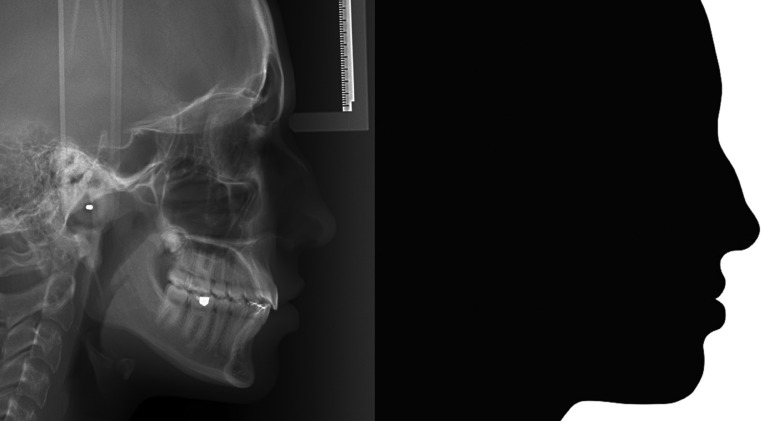
Material and methods: The sample consisted of 60 borderline Class III malocclusion patients, divided into two groups: Group 1 (Surgical): 30 patients (16 male; 14 female) treated with orthodontic fixed appliances and bimaxillary orthognathic surgery. Mean initial age was 20.05 years (s.d.=2.40) and mean treatment time was 2.23 years (s.d.=0.82). Group 2 (Compensatory): 30 patients (13 male; 17 female) treated compensatorily with fixed appliances and Class III elastics. Mean initial age was 18.53 years (s.d.=4.35) and mean treatment time was 2.08 years (s.d.=0.67). Silhouettes of the facial profile were constructed obtained from the pretreatment and posttreatment lateral cephalograms and evaluated by orthodontists (N=41, 22 females and 19 males, mean age of 35.65 years), assigning scores from 1 (least attractive) to 10 (most attractive). Intergroup comparison of profile attractiveness was performed by Mann-Whitney test. For intragroup comparison of initial and final stages, the Wilcoxon test was used.
Results: At initial stage, the compensatory group presented a statistically significant greater attractiveness of the profile than the surgical group. With treatment, the surgical group presented significantly more improvement in facial profile than the compensatory group. At the final stage, profile attractiveness of surgical and compensatory groups was similar.
Conclusions: The facial profile attractiveness is similar in Class III patients after orthognathic surgery or compensatory orthodontic treatment. However, surgery provided more improvement in profile attractiveness than the compensatory treatment in Class III patients. Key words:Malocclusion, angle Class III, orthognathic surgery, corrective orthodontics.
Copyright: © 2020 Medicina Oral S.L.
Conflict of interest statement
Conflicts of interest The authors declare that they have no conflict of interest.
Figures
References
-
- Kiekens RM, Maltha JC, Van't Hof MA, Kuijpers-Jagtman AM. Objective measures as indicators for facial esthetics in white adolescents. Angle Orthod. 2006;76:551–6. - PubMed
-
- Profitt WR, Fields HW, Sarver DM. Contemporary orthodontics. 4th ed. St. Louis: Mosby; 2007.
-
- Berto PM, Lima CS, Lenza MA, Faber J. Esthetic effect of orthodontic appliances on a smiling face with and without a missing maxillary first premolar. Am J Orthod Dentofacial Orthop. 2009;135:S55–S60. - PubMed
-
- Cançado RH, Freitas KM, Valarelli FP, Vieira BS, Neves LS. Treatment of Skeletal Class III Malocclusion with the Biofunctional System. J Clin Orthod. 2015;49:717–25. - PubMed
-
- Janson G, Prado De Souza JE, De Andrade Alves F, Andrade P, Nakamura A, Roberto De Freitas M. Extreme dentoalveolar compensation in the treatment of Class III malocclusion. Am J Orthod Dentofacial Orthop. 2005;128:787–94. - PubMed
LinkOut - more resources
Full Text Sources