Review
. 2020 Apr 14:2020:7091718.
doi: 10.1155/2020/7091718. eCollection 2020.

Uridine Metabolism and Its Role in Glucose, Lipid, and Amino Acid Homeostasis

Affiliations
Review

Uridine Metabolism and Its Role in Glucose, Lipid, and Amino Acid Homeostasis

Yumei Zhang et al. Biomed Res Int. .

Abstract

Pyrimidine nucleoside uridine plays a critical role in maintaining cellular function and energy metabolism. In addition to its role in nucleoside synthesis, uridine and its derivatives contribute to reduction of cytotoxicity and suppression of drug-induced hepatic steatosis. Uridine is mostly present in blood and cerebrospinal fluid, where it contributes to the maintenance of basic cellular functions affected by UPase enzyme activity, feeding habits, and ATP depletion. Uridine metabolism depends on three stages: de novo synthesis, salvage synthesis pathway and catabolism, and homeostasis, which is tightly relating to glucose homeostasis and lipid and amino acid metabolism. This review is devoted to uridine metabolism and its role in glucose, lipid, and amino acid homeostasis.


Conflict of interest statement

The authors declare that there is no conflict of interest regarding the publication of this article.

Figures
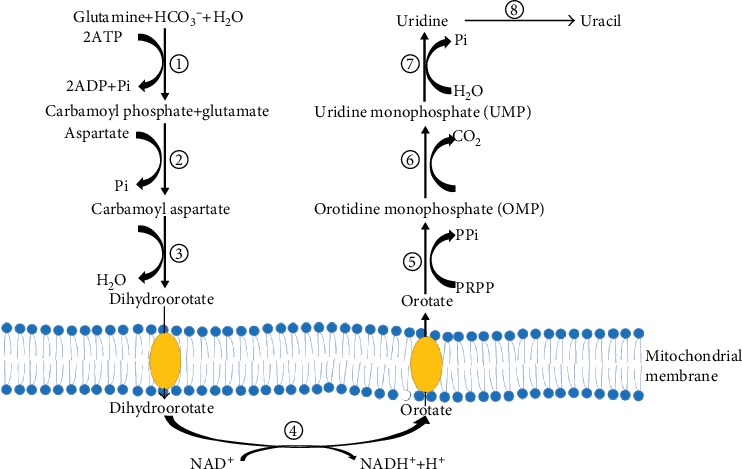
Figure 1
Figure 1
De novo synthesis of uridine: ① carbamoyl phosphate synthetase (CPS II); ② aspartate transcarbamoylase (ATCase); ③ dihydroorotase (DHO); ④ dihydroorotate dehydrogenase (DHODH); ⑤ orotate phosphoribosyltransferase; ⑥ orotidine 5′-phosphate decarboxylase; ⑦ nucleotidase; ⑧ uridine phosphorylase.

References

    1. Yamamoto T., Koyama H., Kurajoh M., Shoji T., Tsutsumi Z., Moriwaki Y. Biochemistry of uridine in plasma. Clinica Chimica Acta. 2011;412(19-20):1712–1724. doi: 10.1016/j.cca.2011.06.006. - DOI - PubMed
    1. Urasaki Y., Pizzorno G., Le T. T. Chronic uridine administration induces fatty liver and pre-diabetic conditions in mice. PLoS One. 2016;11(1) doi: 10.1371/journal.pone.0146994. - DOI - PMC - PubMed
    1. Connolly G. P., Duley J. A. Uridine and its nucleotides:biological actions, therapeutic potentials. Trends in Pharmacological Sciences. 1999;20(5):218–225. doi: 10.1016/s0165-6147(99)01298-5. - DOI - PubMed
    1. McEvilly M., Popelas C., Tremmel B. Use of uridine triacetate for the management of fluorouracil overdose. American Journal of Health-System Pharmacy. 2011;68(19):1806–1809. doi: 10.2146/ajhp100434. - DOI - PubMed
    1. Gallai V., Mazzotta G., Montesi S., Sarchielli P., Gatto F. Effects of uridine in the treatment of diabetic neuropathy: an electrophysiological study. Acta Neurologica Scandinavica. 1992;86(1):3–7. doi: 10.1111/j.1600-0404.1992.tb08045.x. - DOI - PubMed
