


Racial-Ethnic Inequity in Young Adults With Type 1 Diabetes
- PMID: 32382736
- PMCID: PMC7457963
- DOI: 10.1210/clinem/dgaa236
Racial-Ethnic Inequity in Young Adults With Type 1 Diabetes
Abstract
Context: Minority young adults (YA) currently represent the largest growing population with type 1 diabetes (T1D) and experience very poor outcomes. Modifiable drivers of disparities need to be identified, but are not well-studied.
Objective: To describe racial-ethnic disparities among YA with T1D and identify drivers of glycemic disparity other than socioeconomic status (SES).
Design: Cross-sectional multicenter collection of patient and chart-reported variables, including SES, social determinants of health, and diabetes-specific factors, with comparison between non-Hispanic White, non-Hispanic Black, and Hispanic YA and multilevel modeling to identify variables that account for glycemic disparity apart from SES.
Setting: Six diabetes centers across the United States.
Participants: A total of 300 YA with T1D (18-28 years: 33% non-Hispanic White, 32% non-Hispanic Black, and 34% Hispanic).
Main outcome: Racial-ethnic disparity in HbA1c levels.
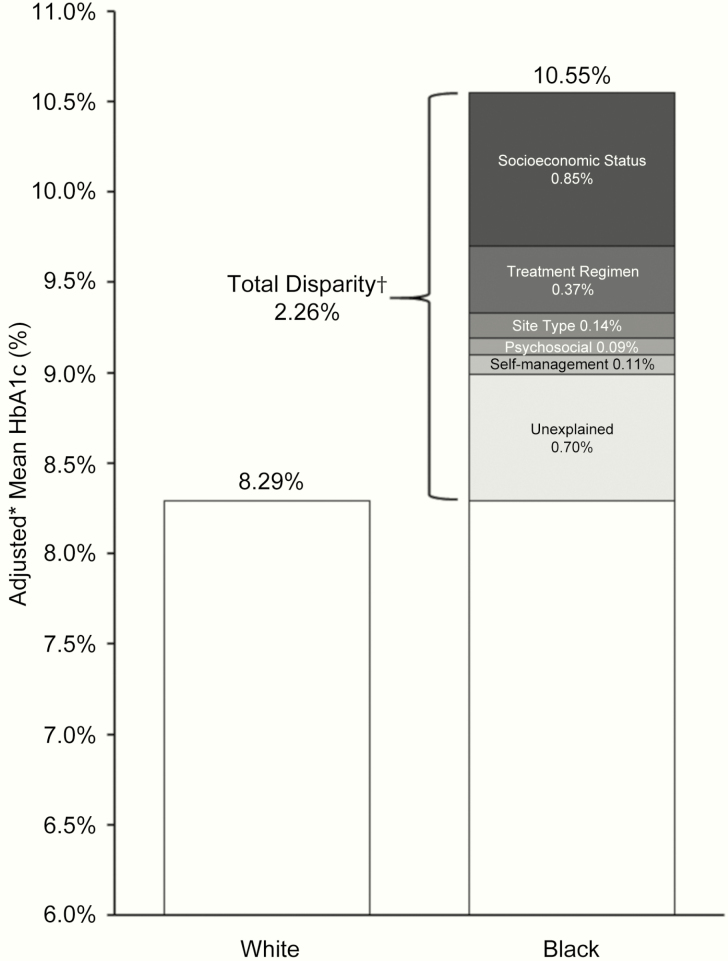
Results: Non-Hispanic Black and Hispanic YA had lower SES, higher HbA1c levels, and much lower diabetes technology use than non-Hispanic White YA (P < 0.001). Non-Hispanic Black YA differed from Hispanic, reporting higher diabetes distress and lower self-management (P < 0.001). After accounting for SES, differences in HbA1c levels disappeared between non-Hispanic White and Hispanic YA, whereas they remained for non-Hispanic Black YA (+ 2.26% [24 mmol/mol], P < 0.001). Diabetes technology use, diabetes distress, and disease self-management accounted for a significant portion of the remaining non-Hispanic Black-White glycemic disparity.
Conclusion: This study demonstrated large racial-ethnic inequity in YA with T1D, especially among non-Hispanic Black participants. Our findings reveal key opportunities for clinicians to potentially mitigate glycemic disparity in minority YA by promoting diabetes technology use, connecting with social programs, and tailoring support for disease self-management and diabetes distress to account for social contextual factors.
Keywords: healthcare disparities; inequity; social determinants of health; type 1 diabetes; young adults.
© Endocrine Society 2020.
Figures
References
-
- Centers for Disease Control and Prevention. National Diabetes Statistics Report, 2020. Accessed May 19, 2020.
-
- Clements MA, Foster NC, Maahs DM, et al. ; T1D Exchange Clinic Network Hemoglobin A1c (HbA1c) changes over time among adolescent and young adult participants in the T1D exchange clinic registry. Pediatr Diabetes. 2016;17(5):327-336. - PubMed
-
- Schwandt A, Hermann JM, Rosenbauer J, et al. ; DPV Initiative Longitudinal trajectories of metabolic control from childhood to young adulthood in type 1 diabetes from a large German/Austrian registry: a group-based modeling approach. Diabetes Care. 2017;40(3):309-316. - PubMed
