


Infertility influencers: an analysis of information and influence in the fertility webspace
- PMID: 32382959
- PMCID: PMC7205373
- DOI: 10.1007/s10815-020-01799-2
Infertility influencers: an analysis of information and influence in the fertility webspace
Abstract
Purpose: To examine fertility-related social media accounts and influencers on two social media platforms.
Methods: The search function of Twitter (TW) and Instagram (IG) was used to generate a list of accounts with the terms: fertility, infertility, ttc, egg freezing, ivf, endometriosis, and reproductive. Accounts not in English, in private, with no posts in > 1 year, or with content unrelated to search terms were excluded. Accounts were assessed for author type; REI board certification (REI-BC); influencer (INF) status (> 10 K followers on IG; verified check mark on TW); account demographics; and content in last 5 posts. Statistical analysis included unpaired t tests, a classification and regression tree (CART) analysis, and stepwise multiple logistic regression.
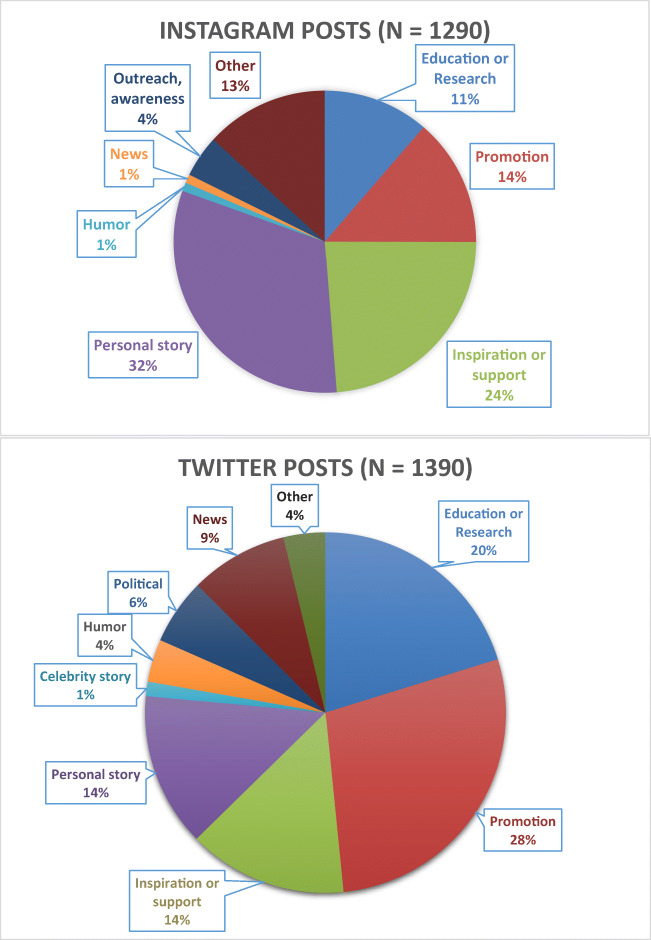
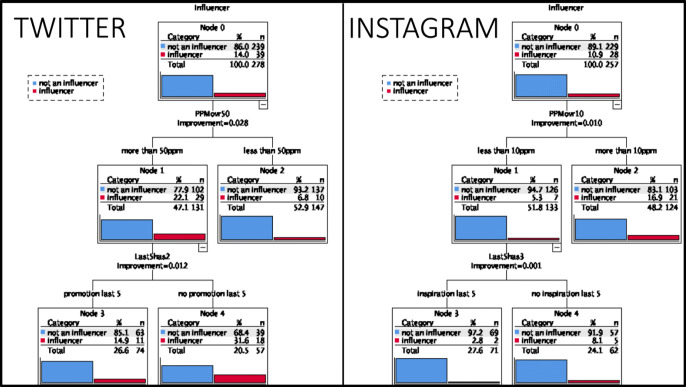
Results: Seven hundred ten accounts were identified and 537 (278 TW, 259 IG) were included. Account types included societies, clinics, physicians, patients, groups, and "other." Instagram content (1290 posts reviewed) was primarily personal stories (31.7%) or inspiration/support (23.7%). Twitter content (1390 posts reviewed) was mostly promotion (28.2%) and research/education (20.2%). Thirty-nine accounts (12.5%) were influencers. Fertility influencers were most often awareness/support accounts (59.8% TW, 25.0% IG), patients (12.8% TW, 25% IG), or other (17.9% TW, 21.0% IG). Only 7.7% TW and 7.1% IG INFs were board-certified REI physicians. The best predictor for classification as an influencer was high activity (> 50 posts/month TW, > 10 posts/month IG).
Conclusion: As patients increasingly utilize social media to obtain and engage with health information, it is critical to understand the fertility-related SM landscape. This understanding may help to successfully enhance relationships with patients and ensure dissemination of accurate information.
Keywords: Infertility; Influencer; Patient education; Social media.
Conflict of interest statement
The authors declare that they have no conflict of interest.
Figures
References
-
- Hackworth BA, Kunz MB. Healthcare and social media: building relationships via social networks. Acad Health Care Manag J. 2011;7(2):1–14.
-
- Kane G, Fichman RG, Gallaugher J, Glaser J. Community relations 2.0. Harv Bus Rev. 2009;87(11):45–50. - PubMed
-
- Pew Research Center. Gender divide on social media use tilts toward men in developing economies, women in advanced economies. https://www.pewresearch.org/global/2018/06/19/3-social-network-adoption-... Accessed August 20th, 2019.
MeSH terms
LinkOut - more resources
Full Text Sources
Research Materials
