


Vitamin D supplementation for nonalcoholic fatty liver disease in type 2 diabetes mellitus: A protocol for a systematic review and meta-analysis
- PMID: 32384501
- PMCID: PMC7220265
- DOI: 10.1097/MD.0000000000020148
Vitamin D supplementation for nonalcoholic fatty liver disease in type 2 diabetes mellitus: A protocol for a systematic review and meta-analysis
Abstract
Background: Nonalcoholic fatty liver disease (NAFLD) is strongly associated with type 2 diabetes mellitus (T2DM), and low vitamin D levels are positively associated with NAFLD and T2DM. But there is absence of convincing evidence-based medicine to confirm the efficacy of vitamin D supplementation for T2DM with NAFLD. Thus, we aimed to conduct this meta-analysis to summarize the efficacy of vitamin D supplementation for T2DM combined with NAFLD, and help to further clarify its beneficial action on diabetic patients with NAFLD.
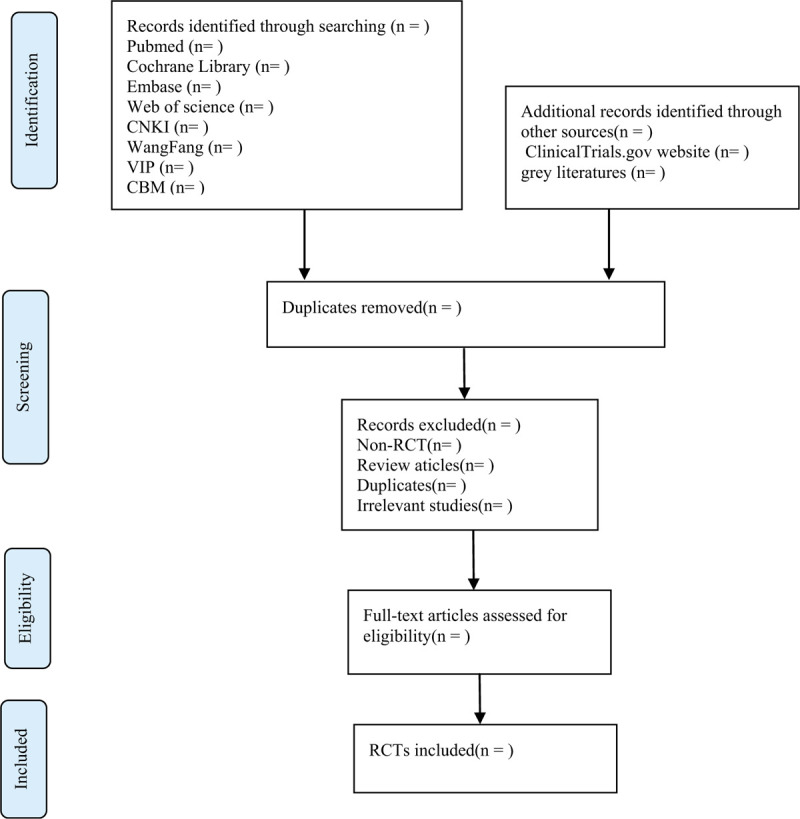
Methods: The study only selects clinical randomized controlled trials of vitamin D supplementation for T2DM combined with NAFLD. We will search each database from the built-in until July 2020. The English literature mainly searches Cochrane Library, Pubmed, EMBASE, and Web of Science. While the Chinese literature comes from CNKI, CBM, VIP, and Wangfang database. Meanwhile, we will retrieve clinical trial registries and grey literature. Two researchers worked independently on literature selection, data extraction, and quality assessment. The dichotomous data is represented by relative risk (RR), and the continuous is expressed by mean difference (MD) or standard mean difference (SMD), eventually the data is synthesized using a fixed effect model (FEM) or a random effect model (REM) depending on the heterogeneity. The imaging markers of liver, biomarkers of hepatic steatosis, serological indexes of hepatic fibrosis, serum NAFLD liver fat score were evaluated as the main outcomes. While several secondary outcomes were also evaluated in this study. The statistical analysis of this meta-analysis was conducted by RevMan software version 5.3.
Results: This meta-analysis will further determine the beneficial efficacy of vitamin D supplementation for T2DM combined with NAFLD.
Conclusion: This study determines the positive efficacy of vitamin D supplementation for diabetic patients with NAFLD.
Conflict of interest statement
The authors have no conflicts of interest to disclose.
References
-
- Gasbarrini G, Vero V, Miele L, et al. Nonalcoholic fatty liver disease: defining a common problem. Eur Rev Med Pharmacol Sci 2005;9:253–9. - PubMed
-
- Videla LA, Rodrigo R, Araya J, et al. Insulin resistance and oxidative stress interdependency in non-alcoholic fatty liver disease. Trends Mol Med 2006;12:555–8. - PubMed
-
- Tilg H, Moschen AR. Insulin resistance, inflammation, and non-alcoholic fatty liver disease. Trends Endocrinol Metab 2008;19:371–9. - PubMed
-
- Anstee QM, Targher G, Day CP. Progression of NAFLD to diabetes mellitus, cardiovascular disease or cirrhosis. Nat Rev Gastroenterol Hepatol 2013;10:330–44. - PubMed
-
- Dyson J, Jaques B, Chattopadyhay D, et al. Hepatocellular cancer: the impact of obesity, type 2 diabetes and a multidisciplinary team. J Hepatol 2014;60:110–7. - PubMed
MeSH terms
Substances
LinkOut - more resources
Full Text Sources
Medical
