


APC Mutation Marks an Aggressive Subtype of BRAF Mutant Colorectal Cancers
- PMID: 32384699
- PMCID: PMC7281581
- DOI: 10.3390/cancers12051171
APC Mutation Marks an Aggressive Subtype of BRAF Mutant Colorectal Cancers
Abstract
Background: WNT activation is a hallmark of colorectal cancer. BRAF mutation is present in 15% of colorectal cancers, and the role of mutations in WNT signaling regulators in this context is unclear. Here, we evaluate the mutational landscape of WNT signaling regulators in BRAF mutant cancers.
Methods: we performed exome-sequencing on 24 BRAF mutant colorectal cancers and analyzed these data in combination with 175 publicly available BRAF mutant colorectal cancer exomes. We assessed the somatic mutational landscape of WNT signaling regulators, and performed hotspot and driver mutation analyses to identify potential drivers of WNT signaling. The effects of Apc and Braf mutation were modelled, in vivo, using the Apcmin/+ and BrafV637/Villin-CreERT2/+ mouse, respectively.
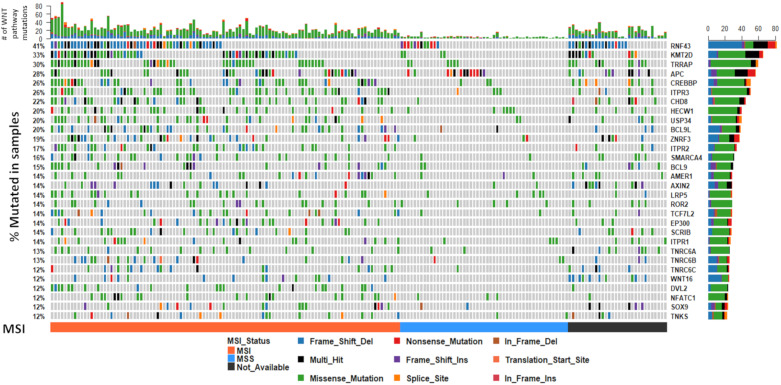
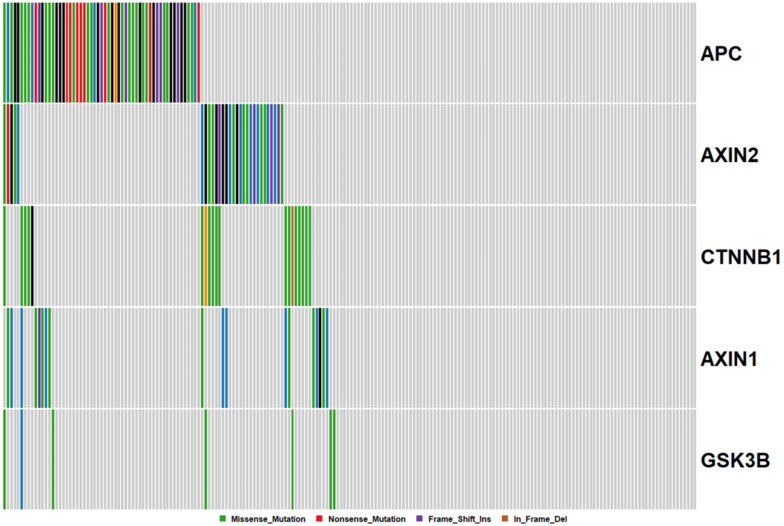
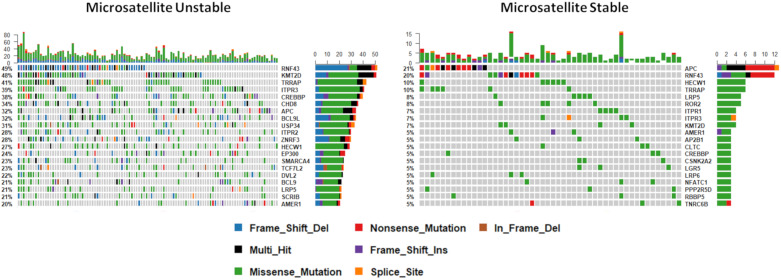
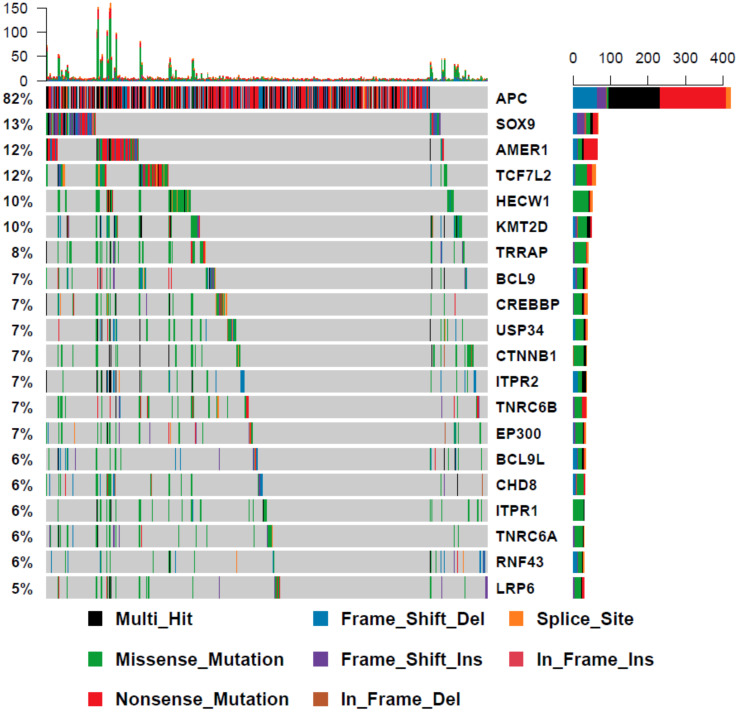
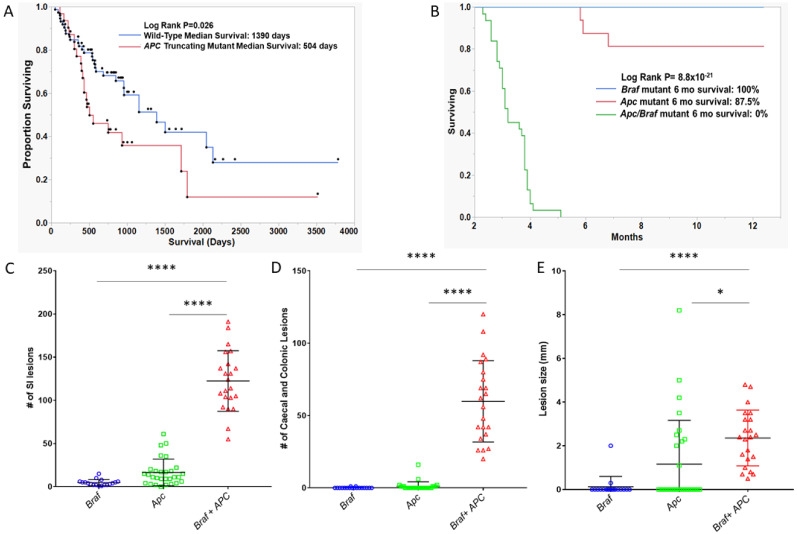
Results: RNF43 was the most frequently mutated WNT signaling regulator (41%). Mutations in the beta-catenin destruction complex occurred in 48% of cancers. Hotspot analyses identified potential cancer driver genes in the WNT signaling cascade, including MEN1, GNG12 and WNT16. Truncating APC mutation was identified in 20.8% of cancers. Truncating APC mutation was associated with early age at diagnosis (p < 2 × 10⁻⁵), advanced stage (p < 0.01), and poor survival (p = 0.026). Apcmin/+/BrafV637 animals had more numerous and larger SI and colonic lesions (p < 0.0001 and p < 0.05, respectively), and a markedly reduced survival (median survival: 3.2 months, p = 8.8 × 10⁻²¹), compared to animals with Apc or Braf mutation alone.
Conclusions: the WNT signaling axis is frequently mutated in BRAF mutant colorectal cancers. WNT16 and MEN1 may be novel drivers of aberrant WNT signaling in colorectal cancer. Co-mutation of BRAF and APC generates an extremely aggressive neoplastic phenotype that is associated with poor patient outcome.
Keywords: APC; BRAF; WNT signaling; colorectal cancer; driver mutations; genomics; serrated neoplasia.
Conflict of interest statement
The authors declare no conflict of interest.
Figures

References
-
- Bond C.E., McKeone D.M., Kalimutho M., Bettington M.L., Pearson S.-A., Dumenil T.D., Wockner L.F., Burge M., Leggett B.A., Whitehall V.L.J. RNF43 and ZNRF3 are commonly altered in serrated pathway colorectal tumorigenesis. Oncotarget. 2016;7:70589–70600. doi: 10.18632/oncotarget.12130. - DOI - PMC - PubMed
-
- Rowan A.J., Lamlum H., Ilyas M., Wheeler J., Straub J., Papadopoulou A., Bicknell D., Bodmer W.F., Tomlinson I.P.M. APC mutations in sporadic colorectal tumors: A mutational “hotspot” and interdependence of the “two hits”. Proc. Natl. Acad. Sci. USA. 2000;97:3352–3357. doi: 10.1073/pnas.97.7.3352. - DOI - PMC - PubMed
LinkOut - more resources
Full Text Sources
Other Literature Sources
Research Materials
