Review
. 2020 May 6;9(5):1145.
doi: 10.3390/cells9051145.

Identifying the Therapeutic Significance of Mesenchymal Stem Cells

Affiliations
Review

Identifying the Therapeutic Significance of Mesenchymal Stem Cells

Vineet Kumar Mishra et al. Cells. .

Abstract

The pleiotropic behavior of mesenchymal stem cells (MSCs) has gained global attention due to their immense potential for immunosuppression and their therapeutic role in immune disorders. MSCs migrate towards inflamed microenvironments, produce anti-inflammatory cytokines and conceal themselves from the innate immune system. These signatures are the reason for the uprising in the sciences of cellular therapy in the last decades. Irrespective of their therapeutic role in immune disorders, some factors limit beneficial effects such as inconsistency of cell characteristics, erratic protocols, deviating dosages, and diverse transfusion patterns. Conclusive protocols for cell culture, differentiation, expansion, and cryopreservation of MSCs are of the utmost importance for a better understanding of MSCs in therapeutic applications. In this review, we address the immunomodulatory properties and immunosuppressive actions of MSCs. Also, we sum up the results of the enhancement, utilization, and therapeutic responses of MSCs in treating inflammatory diseases, metabolic disorders and diabetes.

Keywords: adipogenesis; immunomodulation; immunosuppression; mesenchymal stem cell (MSC), microenvironment; type 2 diabetes.


Conflict of interest statement

The authors declare no conflict of interest.

Figures
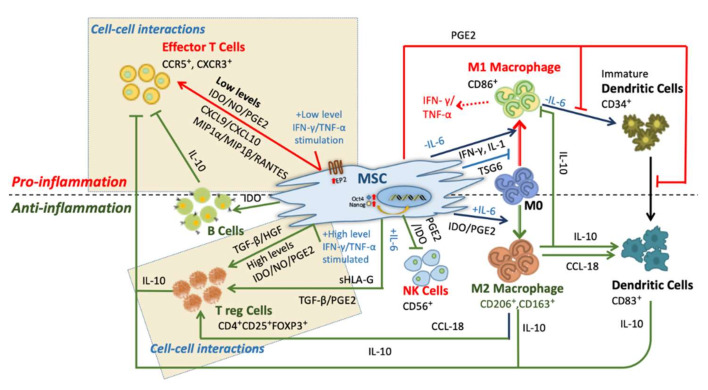
Figure 1
Figure 1
The central role of Mesenchymal Stem Cells (MSC) in immune responses. The above figure distinguishes the response and interaction of MSCs in pro-inflammatory and anti-inflammatory conditions on immune cells. These effects demonstrate cell-to-cell contact-mediated immunosuppression of B and T cell proliferation, induction and transforming growth factor-β (TGF-β)/hepatocyte growth factor (HGF) mediated regulation of regulatory T cells. Also, it shows the capacity of immunomodulation of MSCs by inhibiting the natural killer (NK) cells, dendritic cells (DCs) at various maturation stages as well as macrophage polarization dependency on the microenvironment.
Figure 2
Figure 2
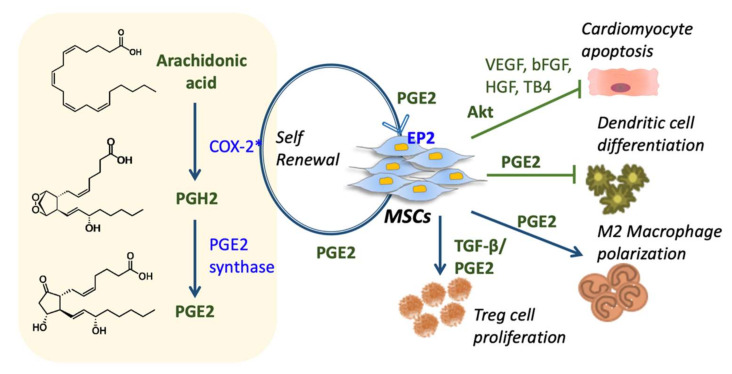
The autocrine and paracrine functions of MSC. The left side depicts the cyclooxygenase-2 (COX-2)/prostaglandin E2 (PGE2) axis for the maintenance of an autocrine/paracrine loop and COX-2 mediated PGE2 production in MSCs as a response to the surrounding microenvironment. The right side of the figure demonstrates the dominance of MSCs on immune cells (inhibiting cardiomyocyte apoptosis and DC differentiation, also promoting M2 macrophage polarization and T-reg cell proliferation) by producing several immunomodulatory factors and chemokines. Note: Figure represents both conditioned/modified and natural MSCs.
Figure 3
Figure 3
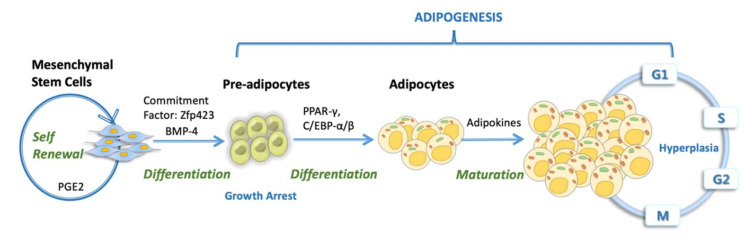
Progression of adipogenic MSCs differentiation and maturation into mature fat cells due to an excess of calories.
Figure 4
Figure 4
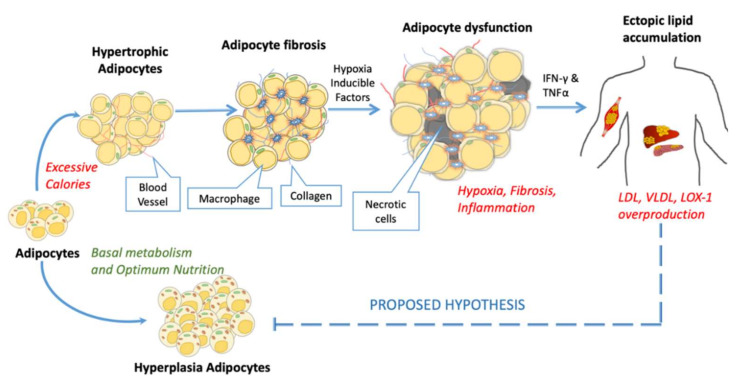
The above figure demonstrates the failure of overnutrition accommodation resulting in adipose tissue dysfunction. Insufficient pre-adipocytes pressure the matured adipose cells to undergo hypertrophy resulting in adipocyte fibrosis (macrophage accumulation and collagen deposition). Furthermore, these cells progress towards adipose dysfunction (ectopic lipid deposition leads to hypoxia and necrosis).

References

    1. Wang Y., Han Z.B., Ma J., Zuo C., Geng J., Gong W., Sun Y., Li H., Wang B., Zhang L., et al. A toxicity study of multiple-administration human umbilical cord mesenchymal stem cells in cynomolgus monkeys. Stem Cells Dev. 2012;21:1401–1408. doi: 10.1089/scd.2011.0441. - DOI - PubMed
    1. Ullah I., Subbarao R.B., Rho G.J. Human mesenchymal stem cells—Current trends and future prospective. Biosci. Rep. 2015;35 doi: 10.1042/BSR20150025. - DOI - PMC - PubMed
    1. Friedenstein A.J., Piatetzky S.I.I., Petrakova K.V. Osteogenesis in transplants of bone marrow cells. J. Embryol. Exp. Morphol. 1966;16:381–390. - PubMed
    1. Caplan A.I. Mesenchymal stem cells. J. Orthop. Res. Off. Publ. Orthop. Res. Soc. 1991;9:641–650. doi: 10.1002/jor.1100090504. - DOI - PubMed
    1. Qiao C., Xu W., Zhu W., Hu J., Qian H., Yin Q., Jiang R., Yan Y., Mao F., Yang H., et al. Human mesenchymal stem cells isolated from the umbilical cord. Cell Biol. Int. 2008;32:8–15. doi: 10.1016/j.cellbi.2007.08.002. - DOI - PubMed

Publication types

LinkOut - more resources