


Androgen-deprivation therapies for prostate cancer and risk of infection by SARS-CoV-2: a population-based study (N = 4532)
- PMID: 32387456
- PMCID: PMC7202813
- DOI: 10.1016/j.annonc.2020.04.479
Androgen-deprivation therapies for prostate cancer and risk of infection by SARS-CoV-2: a population-based study (N = 4532)
Abstract
Background: Cell entry of severe acute respiratory syndrome coronavirus 2 (SARS-CoV-2) depends on binding of the viral spike (S) proteins to angiotensin-converting enzyme 2 and on S protein priming by TMPRSS2. Inhibition of TMPRSS2 may work to block or decrease the severity of SARS-CoV-2 infections. Intriguingly, TMPRSS2 is an androgen-regulated gene that is up-regulated in prostate cancer where it supports tumor progression and is involved in a frequent genetic translocation with the ERG gene. First- or second-generation androgen-deprivation therapies (ADTs) decrease the levels of TMPRSS2. Here we put forward the hypothesis that ADTs may protect patients affected by prostate cancer from SARS-CoV-2 infections.
Materials and methods: We extracted data regarding 9280 patients (4532 males) with laboratory-confirmed SARS-CoV-2 infection from 68 hospitals in Veneto, one of the Italian regions that was most affected by the coronavirus disease 2019 (COVID-19) pandemic. The parameters used for each COVID-19-positive patient were sex, hospitalization, admission to intensive care unit, death, tumor diagnosis, prostate cancer diagnosis, and ADT.
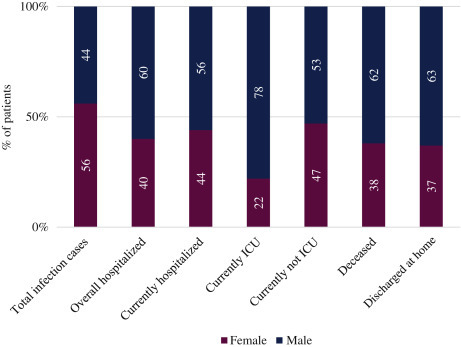
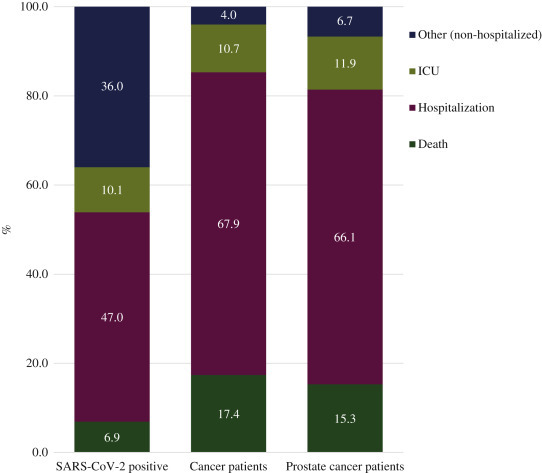
Results: There were evaluable 9280 SARS-CoV-2-positive patients in Veneto on 1 April 2020. Overall, males developed more severe complications, were more frequently hospitalized, and had a worse clinical outcome than females. Considering only the Veneto male population (2.4 million men), 0.2% and 0.3% of non-cancer and cancer patients, respectively, tested positive for SARS-CoV-2. Comparing the total number of SARS-CoV-2-positive cases, prostate cancer patients receiving ADT had a significantly lower risk of SARS-CoV-2 infection compared with patients who did not receive ADT (OR 4.05; 95% CI 1.55-10.59). A greater difference was found comparing prostate cancer patients receiving ADT with patients with any other type of cancer (OR 4.86; 95% CI 1.88-12.56).
Conclusion: Our data suggest that cancer patients have an increased risk of SARS-CoV-2 infections compared with non-cancer patients. However, prostate cancer patients receiving ADT appear to be partially protected from SARS-CoV-2 infections.
Keywords: COVID-19; androgen-deprivation therapy; prostate cancer.
Copyright © 2020 European Society for Medical Oncology. Published by Elsevier Ltd. All rights reserved.
Conflict of interest statement
Disclosure The authors have declared no conflicts of interest.
Figures
Comment in
-
On the relationship between androgen-deprivation therapy for prostate cancer and risk of infection by SARS-CoV-2.Ann Oncol. 2020 Oct;31(10):1415-1416. doi: 10.1016/j.annonc.2020.06.005. Epub 2020 Jun 18. Ann Oncol. 2020. PMID: 32562741 Free PMC article. No abstract available.
-
Re: Androgen-deprivation Therapies for Prostate Cancer and Risk of Infection by SARS-CoV-2: A Population-based Study (n = 4532).Eur Urol. 2020 Dec;78(6):930-931. doi: 10.1016/j.eururo.2020.06.014. Epub 2020 Jun 16. Eur Urol. 2020. PMID: 32591101 Free PMC article. No abstract available.
-
Androgen deprivation and SARS-CoV-2 in men with prostate cancer.Ann Oncol. 2020 Oct;31(10):1417-1418. doi: 10.1016/j.annonc.2020.06.015. Epub 2020 Jun 29. Ann Oncol. 2020. PMID: 32615154 Free PMC article. No abstract available.
-
Does androgen deprivation therapy protect against severe complications from COVID-19?Ann Oncol. 2020 Oct;31(10):1419-1420. doi: 10.1016/j.annonc.2020.06.023. Epub 2020 Jul 9. Ann Oncol. 2020. PMID: 32653425 Free PMC article. No abstract available.
-
Extraperitoneal Radical Prostatectomy with the Senhance Robotic Platform: First 40 Cases.Eur Urol. 2020 Dec;78(6):932-934. doi: 10.1016/j.eururo.2020.07.012. Epub 2020 Jul 24. Eur Urol. 2020. PMID: 32718799 No abstract available.
-
Androgen deprivation therapy may constitute a more effective COVID-19 prophylactic than therapeutic strategy.Ann Oncol. 2020 Nov;31(11):1585-1586. doi: 10.1016/j.annonc.2020.08.2095. Epub 2020 Aug 18. Ann Oncol. 2020. PMID: 32822832 Free PMC article. No abstract available.
-
The potential influence of human Y-chromosome haplogroup on COVID-19 prevalence and mortality.Ann Oncol. 2020 Nov;31(11):1582-1584. doi: 10.1016/j.annonc.2020.08.2096. Epub 2020 Aug 22. Ann Oncol. 2020. PMID: 32835812 Free PMC article. No abstract available.
-
Androgen deprivation therapy in unlikely to be effective for treatment of COVID-19.Ann Oncol. 2020 Dec;31(12):1780-1782. doi: 10.1016/j.annonc.2020.09.014. Epub 2020 Sep 30. Ann Oncol. 2020. PMID: 33007381 Free PMC article. No abstract available.
-
Does androgen deprivation therapy in patients with prostate cancer protect from COVID-19?Rev Assoc Med Bras (1992). 2020 Oct;66(10):1314-1315. doi: 10.1590/1806-9282.66.10.1314. Rev Assoc Med Bras (1992). 2020. PMID: 33174915 No abstract available.
References
-
- Johns Hopkins Coronavirus Resource Center COVID-19 Map. https://coronavirus.jhu.edu/map.html Available at:
Publication types
MeSH terms
Substances
LinkOut - more resources
Full Text Sources
Other Literature Sources
Medical
Miscellaneous
