Review
. 2020:157:83-95.
doi: 10.1016/j.addr.2020.04.012. Epub 2020 May 7.

Complement activation by drug carriers and particulate pharmaceuticals: Principles, challenges and opportunities

Affiliations
Review

Complement activation by drug carriers and particulate pharmaceuticals: Principles, challenges and opportunities

S Moein Moghimi et al. Adv Drug Deliv Rev. 2020.

Abstract

Considering the multifaceted protective and homeostatic roles of the complement system, many consequences arise when drug carriers, and particulate pharmaceutical formulations clash with complement proteins, and trigger complement cascade. Complement activation may induce formulation destabilization, promote opsonization, and affect biological and therapeutic performance of pharmaceutical nano- and micro-particles. In some cases, complement activation is beneficial, where complement may play a role in prophylactic protection, whereas uncontrolled complement activation is deleterious, and contributes to disease progression. Accordingly, design initiatives with particulate medicines should consider complement activation properties of the end formulation within the context of administration route, dosing, systems biology, and therapeutic perspective. Here we examine current progress in mechanistic processes underlying complement activation by pre-clinical and clinical particles, identify opportunities and challenges ahead, and suggest future directions in nanomedicine-complement interface research.

Keywords: Adjuvanticity; Adverse reactions; Complement inhibitors; Complement system; Complosome; Opsonization; Polymers; Protein adsorption.


Figures

Figure 1.
Figure 1.
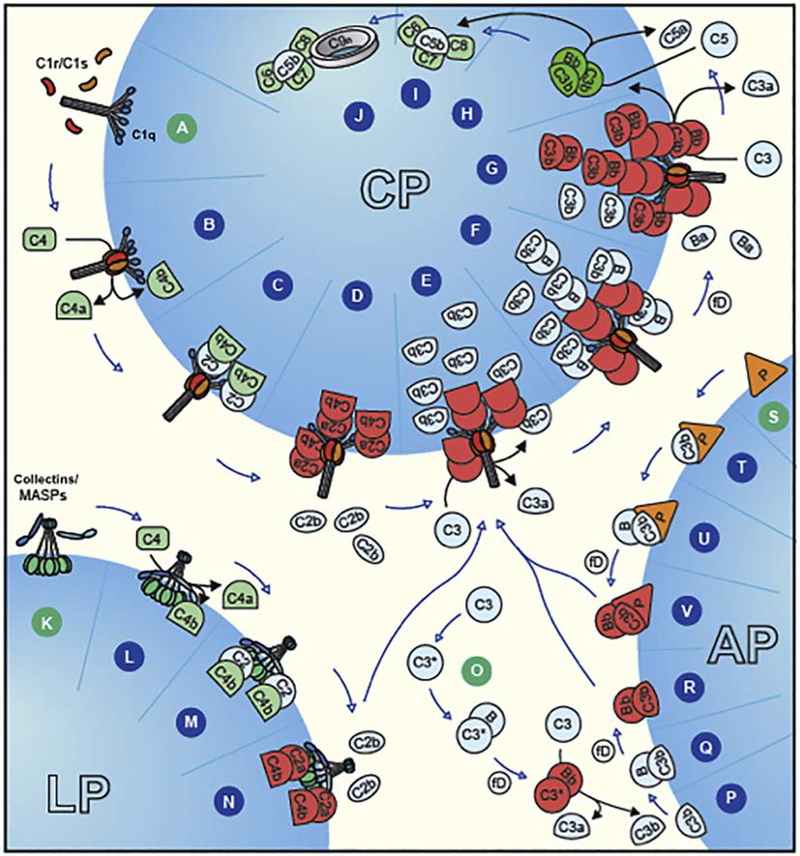
Complement activation pathways. Steps A–E shows C1q-mediated classical pathway (CP) activation and formation of the C3 convertase (C4b2a) formation. Steps F & G depict merging with amplification route of the alternative pathway (AP) for more C3b deposition (opsonization) through C3bBb assembly (AP C3 convertase), and eventual formation of AP C5 convertase formation (C3bBb3b). Classical pathway activation can directly form a C5 convertase (C4b2a3b) as well. Steps H–J represent the terminal pathway of the complement system, regardless of initiation pathway, showing formation of the lytic complex C5b-9. Lectin pathway (LP) is triggered through binding of collectins/MASPs (K) to the particle surface, leading to the formation of C3 convertase (steps L–N). The scheme also shows AP tick-over, initiated by meta-stable C3(H2O) in the fluid phase (step O) eventually leading to the formation of AP C3 convertase (C3bBb) (steps P–R), and its stabilization on binding to properdin (triangle P) (step V). Steps S–U represent a proposed artificial situation, where properdin may act as a pattern-recognition molecule, and on binding may recruit C3b, and form AP C3 convertase (step V). Image credit: Peter Popp Wibroe.
Figure 2.
Figure 2.
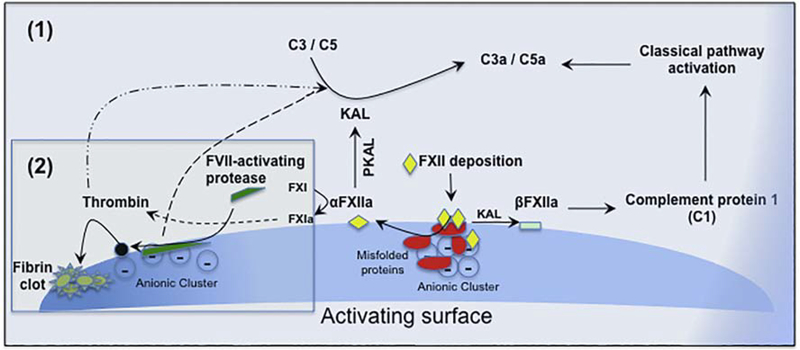
Complement activation through contact (coagulation) system. The cascade is initiated on deposition of Hageman FXII of the contact pathway of coagulation on a negatively charged surface [Scheme (1)]. On binding, FXII is auto-activated to αFX11a. On adsorption, some misfolded proteins and protein aggregates may also auto-activate FXII. Then, αFX11a activates prekallikrein (PKAL) to form kallikrein (KAL), which cleaves C3 and C5 to generate their respective anaphylactic peptides C3a and C5a without involvement of canonical complement pathways. KAL could further generate βFX11a, which subsequently cleaves C1, resulting in activation of the classical pathway of the complement. In addition to these, αFX11a could also induce coagulation cascade with downstream generation of thrombin, and thrombin in turn is capable of cleaving C3 and C5, liberating C3a and C5a, respectively. Complement activation can also proceed on deposition and activation of FVII-activating protease on polyanionic domains [Scheme (2)] through thrombin activity. Modified and redrawn from [146].
Figure 3.
Figure 3.
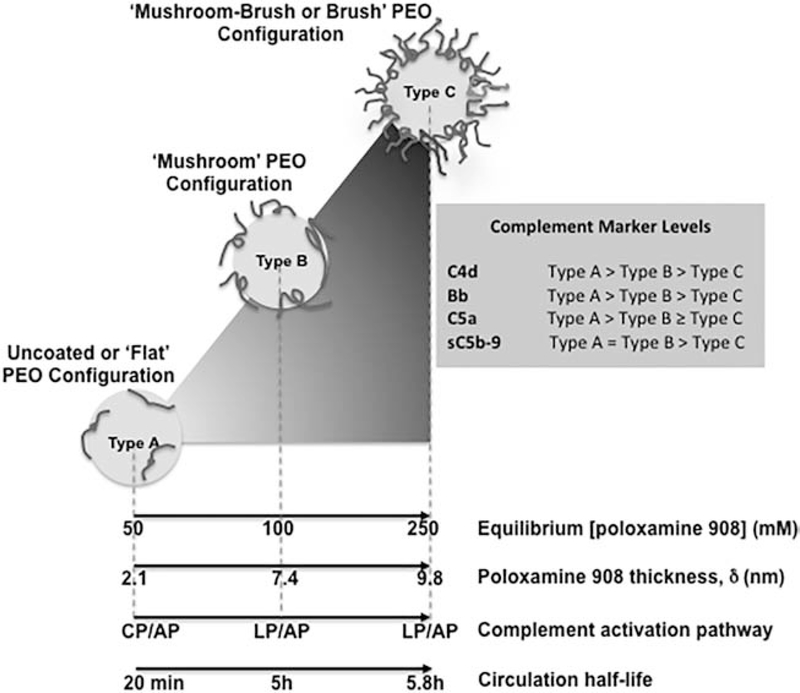
Complement activation pattern of poloxamine 908-coated polystyrene nanospheres. The projected conformation of polyethylene oxide (PEO) chains of poloxamine 908 can shift complement activation from one pathway to another. With Type A nanospheres complement activation is exclusively due to C1q-mediated classical pathway (CP) and alternative pathway (AP). With Type B, complement activation still proceeds through AP, but instead of CP, lectin pathway (LP) is triggered. With Type C nanospheres, complement activation arises from LP, but contribution of AP only arises from the amplification loop. However, with Type C nanospheres, the extent of complement activation is considerably lower than Types B and A.
Figure 4.
Figure 4.
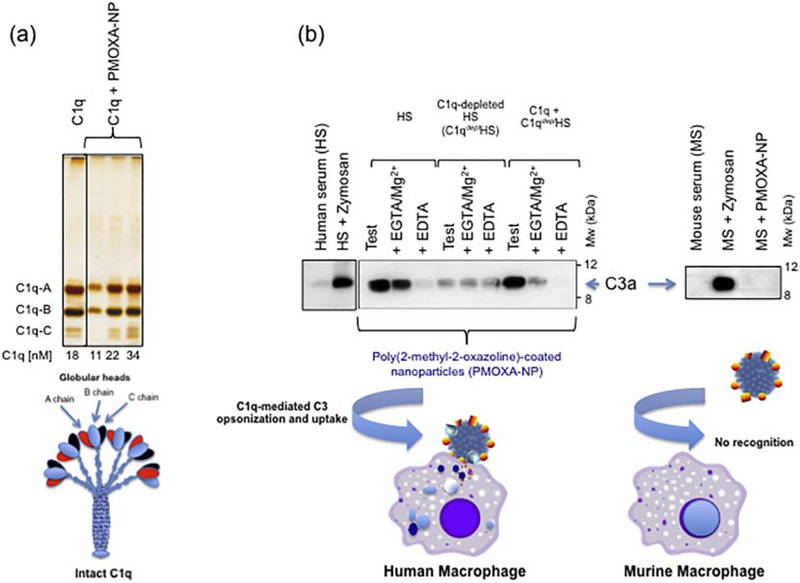
Complement activation by poly(2-methyl-2-oxazoline)-coated nanoparticles (PMOXA-NP). Panel (a) SDS-PAGE of human C1q and its binding to PMOXA-NP in saline. C1q did not bind to uncoated NP. (b) In human serum PMOXA trigger complement activation through C1q-mediated classical pathway and promotes NP uptake through C3 opsonization by human macrophages. PMOXA-NP do not trigger mouse complement and remain stealth on challenge with murine macrophages. Modified with permission [39].
Figure 5.
Figure 5.
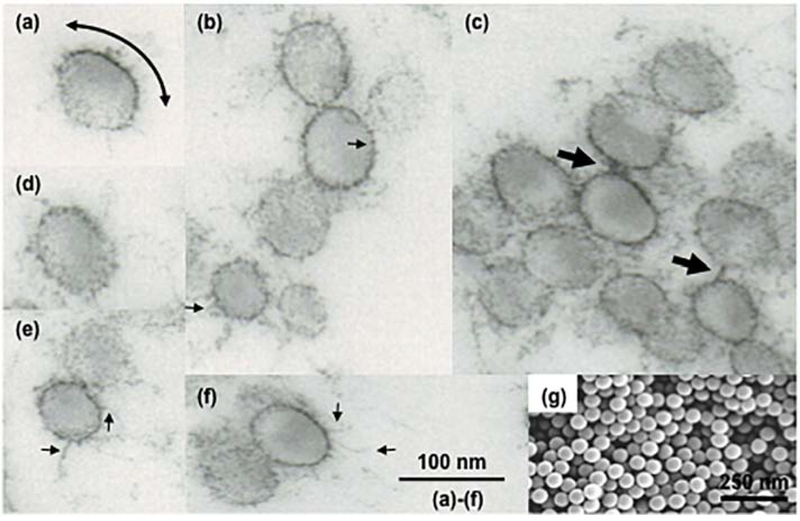
Electron micrographs of model sulfated polystyrene nanospheres after dipping in fresh human plasma. (a–f) Transmission electron microscopy of polystyrene nanospheres (60 nm) dipped in neat human plasma for 2 min. The micrograph in (a) shows contrasting electron density on a nanosphere surface. This is a reflection of variable density of surface-bound proteins. The curved arrow depicts an electron dense region arising from excessive protein-protein interactions. Micrographs also show inhomogeneous and patchy protein deposition on many nanospheres as well as the presence of many electron dense spikes (small arrows). The spikes may represent nucleation sites arising from protein collapse into compact loops, strands, and turns leading to fibre formation. The arrows in (c) are example of protein deposits/fibers that have bridged adjacent nanospheres. (g) Scanning electron micrograph of untreated polystyrene nanospheres. Unpublished observations (S.M. Moghimi, Newcastle University).
Figure 6.
Figure 6.
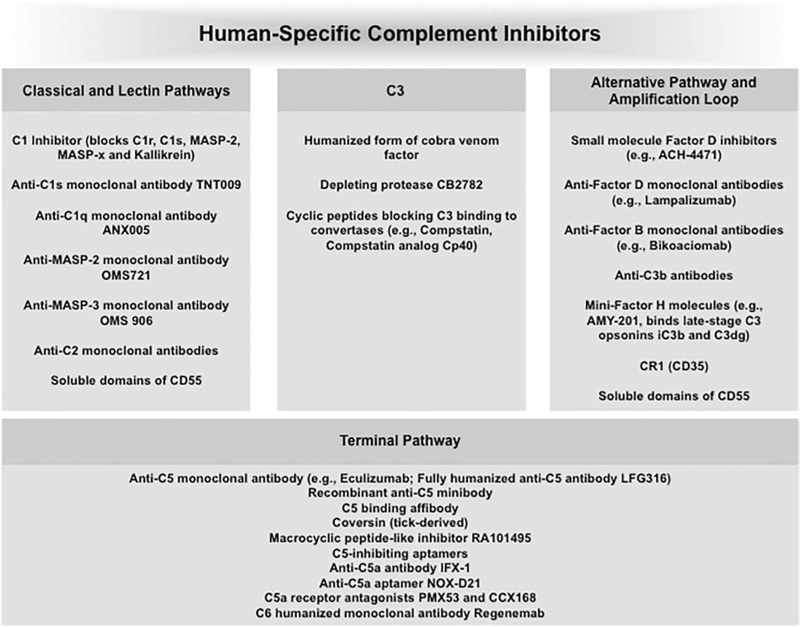
A selection of human-specific complement inhibitors under investigation.

References

    1. Holers VM, Complement and its receptors: new insights into human disease, Annu. Rev. Immunol. 32 (2014) 433–459. - PubMed
    1. Zipfel PF, Skerka C, Complement regulators and inhibitory proteins, Nat. Rev. Immunol. 9 (2009) 729–740. - PubMed
    1. Davies A, Lachmann PJ, Membrane defence against complement lysis: the structure and biological properties of CD59, Immunol. Res. 12 (1993) 258–275. - PubMed
    1. Amara U, Flieri MA, Rittirsch D, Klos A, Chen H, Acker B, Bruckner UB, Nilsson B, Gebhard F, Lambris JD, Huber-Lang M, Molecular intercommunication between the complement and coagulation systems, J. Immunol. 185 (2010) 5628–5636. - PMC - PubMed
    1. Hovland A, Jonasson L, Garred P, Yindestad A, Aukrust P, Lappegard KT, Espevik T, Mollnes TE, The complement system and toll-like receptors as integrated players in the pathophysiology of atherosclerosis, Atherosclerosis 241 (2015) 480–494. - PubMed

Publication types

MeSH terms