


Vaccines to Prevent Infectious Diseases in the Older Population: Immunological Challenges and Future Perspectives
- PMID: 32391017
- PMCID: PMC7190794
- DOI: 10.3389/fimmu.2020.00717
Vaccines to Prevent Infectious Diseases in the Older Population: Immunological Challenges and Future Perspectives
Abstract
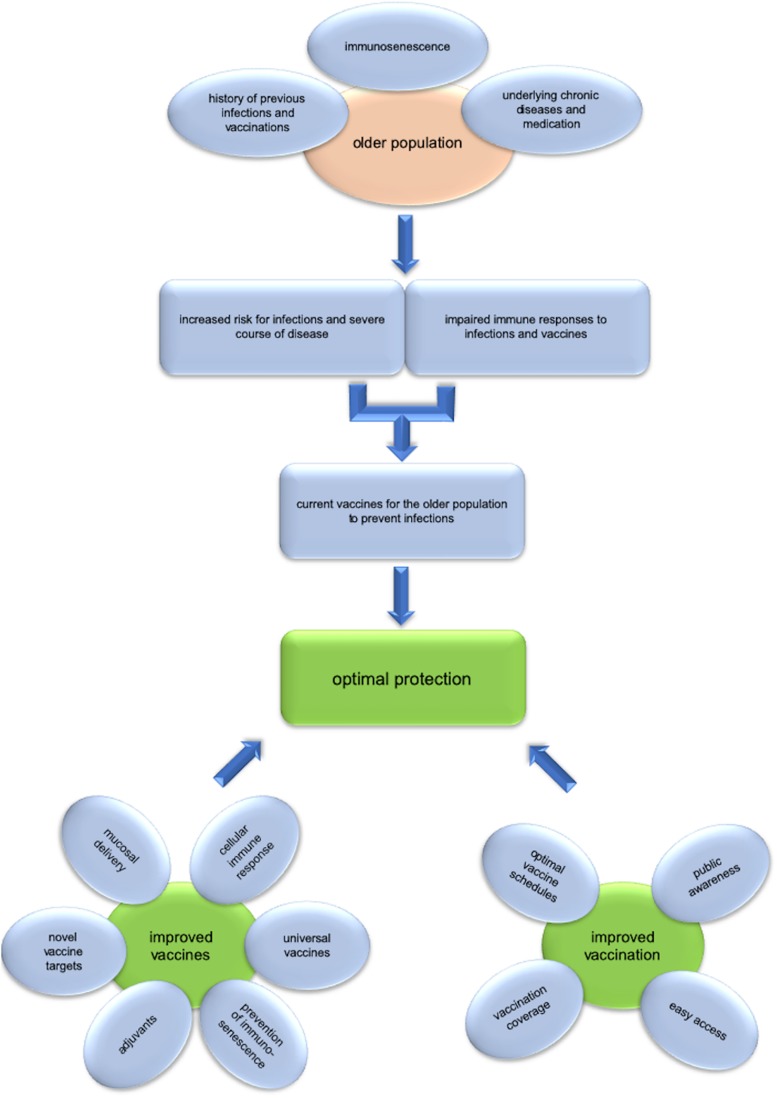
Infectious diseases are a major cause for morbidity and mortality in the older population. Demographic changes will lead to increasing numbers of older persons over the next decades. Prevention of infections becomes increasingly important to ensure healthy aging for the individual, and to alleviate the socio-economic burden for societies. Undoubtedly, vaccines are the most efficient health care measure to prevent infections. Age-associated changes of the immune system are responsible for decreased immunogenicity and clinical efficacy of most currently used vaccines in older age. Efficacy of standard influenza vaccines is only 30-50% in the older population. Several approaches, such as higher antigen dose, use of MF59 as adjuvant and intradermal administration have been implemented in order to specifically target the aged immune system. The use of a 23-valent polysaccharide vaccine against Streptococcus pneumoniae has been amended by a 13-valent conjugated pneumococcal vaccine originally developed for young children several years ago to overcome at least some of the limitations of the T cell-independent polysaccharide antigens, but still is only approximately 50% protective against pneumonia. A live-attenuated vaccine against herpes zoster, which has been available for several years, demonstrated efficacy of 51% against herpes zoster and 67% against post-herpetic neuralgia. Protection was lower in the very old and decreased several years after vaccination. Recently, a recombinant vaccine containing the viral glycoprotein gE and the novel adjuvant AS01B has been licensed. Phase III studies demonstrated efficacy against herpes zoster of approx. 90% even in the oldest age groups after administration of two doses and many countries now recommend the preferential use of this vaccine. There are still many infectious diseases causing substantial morbidity in the older population, for which no vaccines are available so far. Extensive research is ongoing to develop vaccines against novel targets with several vaccine candidates already being clinically tested, which have the potential to substantially reduce health care costs and to save many lives. In addition to the development of novel and improved vaccines, which specifically target the aged immune system, it is also important to improve uptake of the existing vaccines in order to protect the vulnerable, older population.
Keywords: Streptococcus pneumoniae; adjuvant; elderly; herpes zoster; high-dose; immunosenescence; influenza; vaccine.
Copyright © 2020 Wagner and Weinberger.
Figures
References
-
- United Nations, Department of Economic and Social Affairs, Population Division. World Population Prospects 2019: Highlights. (ST/ESA/SER.A/423). New York, NY: United Nations; (2019).
-
- Janssens JP. Pneumonia in the elderly (geriatric) population. Curr Opin Pulm Med. (2005) 11:226–30. - PubMed
Publication types
MeSH terms
Substances
LinkOut - more resources
Full Text Sources
Other Literature Sources
Medical
