Review
. 2020 Apr 23:11:724.
doi: 10.3389/fimmu.2020.00724. eCollection 2020.

TLR4 Cross-Talk With NLRP3 Inflammasome and Complement Signaling Pathways in Alzheimer's Disease

Affiliations
Review

TLR4 Cross-Talk With NLRP3 Inflammasome and Complement Signaling Pathways in Alzheimer's Disease

Junling Yang et al. Front Immunol. .

Abstract

Amyloid plaques, mainly composed of abnormally aggregated amyloid β-protein (Aβ) in the brain parenchyma, and neurofibrillary tangles (NFTs), consisting of hyperphosphorylated tau protein aggregates in neurons, are two pathological hallmarks of Alzheimer's disease (AD). Aβ fibrils and tau aggregates in the brain are closely associated with neuroinflammation and synapse loss, characterized by activated microglia and dystrophic neurites. Genome-wide genetic association studies revealed important roles of innate immune cells in the pathogenesis of late-onset AD by recognizing a dozen genetic risk loci that modulate innate immune activities. Furthermore, microglia, brain resident innate immune cells, have been increasingly recognized to play key, opposing roles in AD pathogenesis by either eliminating toxic Aβ aggregates and enhancing neuronal plasticity or producing proinflammatory cytokines, reactive oxygen species, and synaptotoxicity. Aggregated Aβ binds to toll-like receptor 4 (TLR4) and activates microglia, resulting in increased phagocytosis and cytokine production. Complement components are associated with amyloid plaques and NFTs. Aggregated Aβ can activate complement, leading to synapse pruning and loss by microglial phagocytosis. Systemic inflammation can activate microglial TLR4, NLRP3 inflammasome, and complement in the brain, leading to neuroinflammation, Aβ accumulation, synapse loss and neurodegeneration. The host immune response has been shown to function through complex crosstalk between the TLR, complement and inflammasome signaling pathways. Accordingly, targeting the molecular mechanisms underlying the TLR-complement-NLRP3 inflammasome signaling pathways can be a preventive and therapeutic approach for AD.

Keywords: Alzheimer's disease; TLR4; amyloid; complement; inflammasome; synapse.


Figures

Figure 1
Figure 1
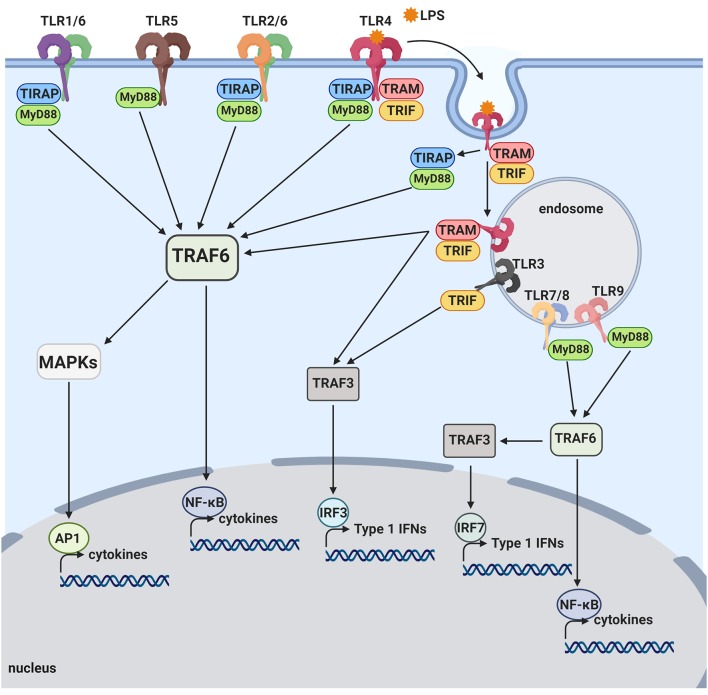
Toll-like receptor pathways. TLR1, TLR2, TLR4, TLR5, and TLR6 are mostly expressed on the cell surface and bind to bacterial products. When activated by LPS, TLR4 is internalized onto an endosome surface. The internalization triggers the release of TIRAP/MyD88, activating the TRAF6 pathway and resulting in activation of transcription factors, NF-kB and AP-1. The release of TIRAP/MyD88 from TLR4 allows for the signaling by TRAM/TRIF to commence from the endosome, also activating NF-kB as well as the transcription factor, IRF3. TLR3, TLR7, TLR8, and TLR9 are located on internal vesicles and bind to bacterial and viral nucleic acids. TLR7, TLR8, and TLR9 each activate NF-kB, as well as the transcription factor, IRF7, through the MyD88 pathway. TLR3 is the only toll-like receptor that does not activate via the MyD88 pathway and instead activates NF-kB and IRF3 through the TRIF pathway.
Figure 2
Figure 2
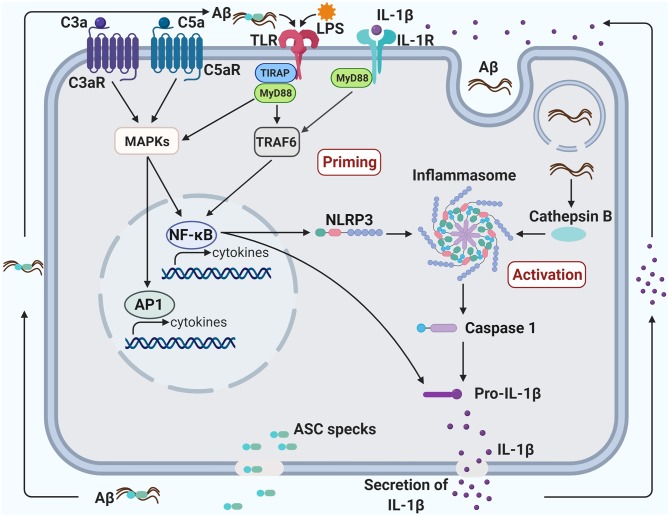
Crosstalk between TLR4, NLRP3 inflammasome, and complement promotes neuroinflammation in Alzheimer's disease. Priming of the inflammasome occurs when the transcription factor, NF-kB, is activated, triggering the production of both NLRP3 and Pro-IL-1β. NF-kB can be activated via the TLR/IL-1R MyD88-dependent pathway and the C3/C5 MAPK pathway. The TLR pathway can be induced by a bacterial component, such as LPS, and the MAPK pathway can be induced by C3a/C5a binding to their respective receptors. The activation of NF-kB through complement, TLR and IL-1R pathways may create a synergistic increase in pro-inflammatory factors. The inflammasome can be activated in several ways, including an increase of endogenous damage-associated and pathogen-associated molecular patterns or an efflux of potassium or chloride ions. Additionally, aggregated fibrillary Aβ engulfed by the microglia can damage the lysosome and leak into the cytoplasm, also contributing to the activation of the inflammasome. Activation of the inflammasome can induce pyroptosis, leading to the secretion of IL-1β and ASC specks. ASC specks bind to Aβ and seed the surrounding parenchyma leading to further Aβ aggregation. Aggregated Aβ can also bind to TLR and induce activation of the MyD88 pathway. Likewise, IL-1β secreted from the pyroptotic microglia can bind to IL-1R and induce activation of the MyD88 pathway. The induction of the MyD88 pathway through the by-products of microglial pyroptosis may lead to a vicious cycle of inflammasome priming, inflammasome activation and pyropotosis that will exacerbate Aβ pathology.

References

    1. Akiyama H, Barger S, Barnum S, Bradt B, Bauer J, et al. . Inflammation and alzheimer's disease. Neurobiol Aging. (2000) 21:383–421. 10.1016/S0197-4580(00)00124-X - DOI - PMC - PubMed
    1. Holmes C. Review: systemic inflammation and alzheimer's disease. Neuropathol Appl Neurobiol. (2013) 39:51–68. 10.1111/j.1365-2990.2012.01307.x - DOI - PubMed
    1. Perry VH, Holmes C. Microglial priming in neurodegenerative disease. Nat Rev Neurol. (2014) 10:217–24. 10.1038/nrneurol.2014.38 - DOI - PubMed
    1. Misiak B, Leszek J, Kiejna A. Metabolic syndrome, mild cognitive impairment and alzheimer's disease–the emerging role of systemic low-grade inflammation and adiposity. Brain Res Bull. (2012) 89:144–9. 10.1016/j.brainresbull.2012.08.003 - DOI - PubMed
    1. Takeda S, Sato N, Morishita R. Systemic inflammation, blood-brain barrier vulnerability and cognitive/non-cognitive symptoms in alzheimer disease: relevance to pathogenesis and therapy. Front Aging Neurosci. (2014) 6:171. 10.3389/fnagi.2014.00171 - DOI - PMC - PubMed

Publication types

MeSH terms