


A Literature Review of Gene Function Prediction by Modeling Gene Ontology
- PMID: 32391061
- PMCID: PMC7193026
- DOI: 10.3389/fgene.2020.00400
A Literature Review of Gene Function Prediction by Modeling Gene Ontology
Abstract
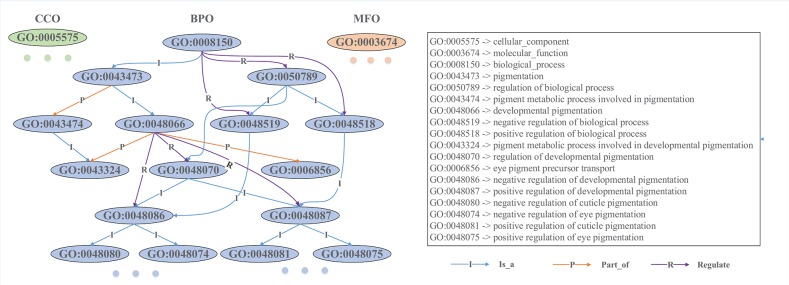
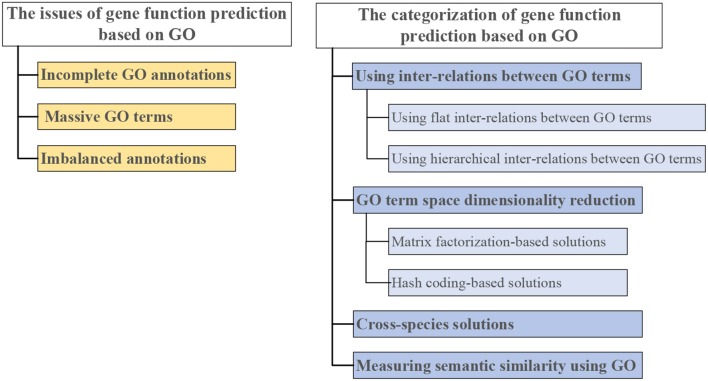
Annotating the functional properties of gene products, i.e., RNAs and proteins, is a fundamental task in biology. The Gene Ontology database (GO) was developed to systematically describe the functional properties of gene products across species, and to facilitate the computational prediction of gene function. As GO is routinely updated, it serves as the gold standard and main knowledge source in functional genomics. Many gene function prediction methods making use of GO have been proposed. But no literature review has summarized these methods and the possibilities for future efforts from the perspective of GO. To bridge this gap, we review the existing methods with an emphasis on recent solutions. First, we introduce the conventions of GO and the widely adopted evaluation metrics for gene function prediction. Next, we summarize current methods of gene function prediction that apply GO in different ways, such as using hierarchical or flat inter-relationships between GO terms, compressing massive GO terms and quantifying semantic similarities. Although many efforts have improved performance by harnessing GO, we conclude that there remain many largely overlooked but important topics for future research.
Keywords: directed acyclic graph; functional genomics; gene function prediction; gene ontology; inter-relationships; semantic similarity.
Copyright © 2020 Zhao, Wang, Chen, Zhang, Guo and Yu.
Figures
References
-
- Blei D. M., Ng A. Y., Jordan M. I. (2003). Latent dirichlet allocation. J. Mach. Learn. Res. 3, 993–1022. 10.1162/jmlr.2003.3.4-5.993 - DOI
Publication types
LinkOut - more resources
Full Text Sources
Other Literature Sources
Research Materials
Miscellaneous
