Review
. 2020 Apr 23:7:71.
doi: 10.3389/fmolb.2020.00071. eCollection 2020.

New Insights Into the Role of Phenotypic Plasticity and EMT in Driving Cancer Progression

Affiliations
Review

New Insights Into the Role of Phenotypic Plasticity and EMT in Driving Cancer Progression

Sugandha Bhatia et al. Front Mol Biosci. .

Abstract

Tumor cells demonstrate substantial plasticity in their genotypic and phenotypic characteristics. Epithelial-mesenchymal plasticity (EMP) can be characterized into dynamic intermediate states and can be orchestrated by many factors, either intercellularly via epigenetic reprograming, or extracellularly via growth factors, inflammation and/or hypoxia generated by the tumor stromal microenvironment. EMP has the capability to alter phenotype and produce heterogeneity, and thus by changing the whole cancer landscape can attenuate oncogenic signaling networks, invoke anti-apoptotic features, defend against chemotherapeutics and reprogram angiogenic and immune recognition functions. We discuss here the role of phenotypic plasticity in tumor initiation, progression and metastasis and provide an update of the modalities utilized for the molecular characterization of the EMT states and attributes of cellular behavior, including cellular metabolism, in the context of EMP. We also summarize recent findings in dynamic EMP studies that provide new insights into the phenotypic plasticity of EMP flux in cancer and propose therapeutic strategies to impede the metastatic outgrowth of phenotypically heterogeneous tumors.

Keywords: CTCs; EMP; EMT; hybrid EMT states; metabolism; metastasis; stem cell; tumor cell heterogeneity.


Figures

FIGURE 1
FIGURE 1
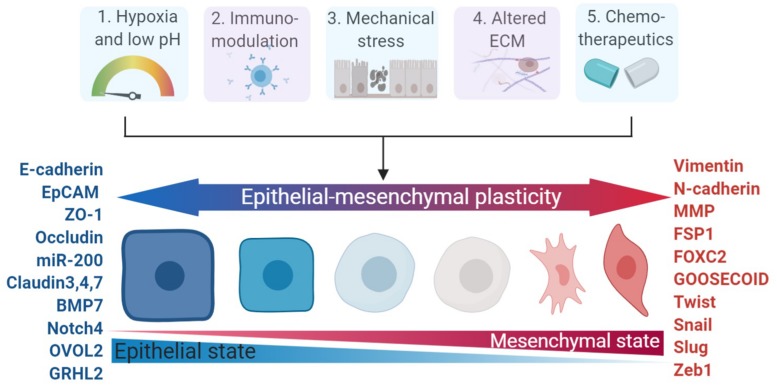
Major categories of EMP stimuli and markers involved in EMP. The dynamics of the epithelial – mesenchymal spectrum can be induced by five major stimulii (hypoxia, immuno-modulators, mechanical stress, altered ECM, and chemotherapeutics), which involve changes in various functional and morphological states and enlisted markers across the spectrum of epithelial–mesenchymal plasticity. ECM, extracellular matrix.
FIGURE 2
FIGURE 2
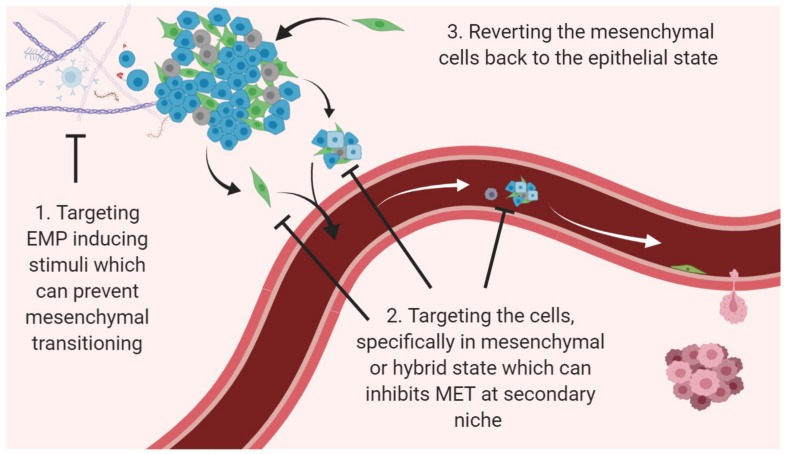
Potential avenues to target EMP. Three main strategies for targeting cancer progression and recurrence with relevance to EMP dynamics are to use agents/compounds (i) that can target the inducers to prevent EMT; (ii) that can selectively kill mesenchymal phenotype and cells present within multiple transition states; (iii) that can revert the cells via MET.

References

    1. Aceto N., Bardia A., Miyamoto D. T., Donaldson M. C., Wittner B. S., Spencer J. A., et al. (2014). Circulating tumor cell clusters are oligoclonal precursors of breast cancer metastasis. Cell 158 1110–1122. 10.1016/j.cell.2014.07.013 - DOI - PMC - PubMed
    1. Agnoletto C., Corrà F., Minotti L., Baldassari F., Crudele F., Cook W. J. J., et al. (2019). Heterogeneity in circulating tumor cells: the relevance of the stem-cell subset. Cancer 11:483. 10.3390/cancers11040483 - DOI - PMC - PubMed
    1. Aiello N. M., Brabletz T., Kang Y., Nieto M. A., Weinberg R. A., Stanger B. Z. (2017). Upholding a role for EMT in pancreatic cancer metastasis. Nature 547 E7–E8. 10.1038/nature22963 - DOI - PMC - PubMed
    1. Aiello N. M., Kang Y. (2019). Context-dependent EMT programs in cancer metastasis. J. Exp. Med. 216 1016–1026. 10.1084/jem.20181827 - DOI - PMC - PubMed
    1. Aiello N. M., Maddipati R., Norgard R. J., Balli D., Li J., Yuan S., et al. (2018). EMT subtype influences epithelial plasticity and mode of cell migration. Dev. Cell 45 681–695. 10.1016/j.devcel.2018.05.027 - DOI - PMC - PubMed

LinkOut - more resources