


Indoor Dust as a Source of Virulent Strains of the Agents of Cryptococcosis in the Rio Negro Micro-Region of the Brazilian Amazon
- PMID: 32392852
- PMCID: PMC7284895
- DOI: 10.3390/microorganisms8050682
Indoor Dust as a Source of Virulent Strains of the Agents of Cryptococcosis in the Rio Negro Micro-Region of the Brazilian Amazon
Abstract
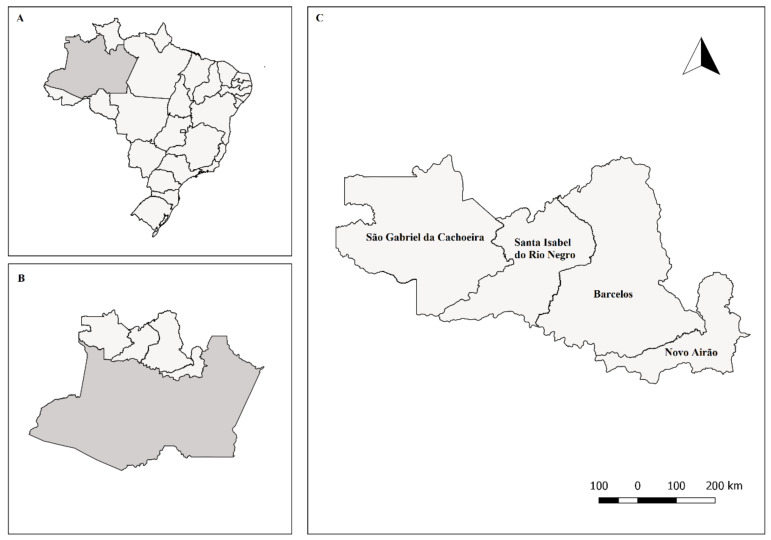
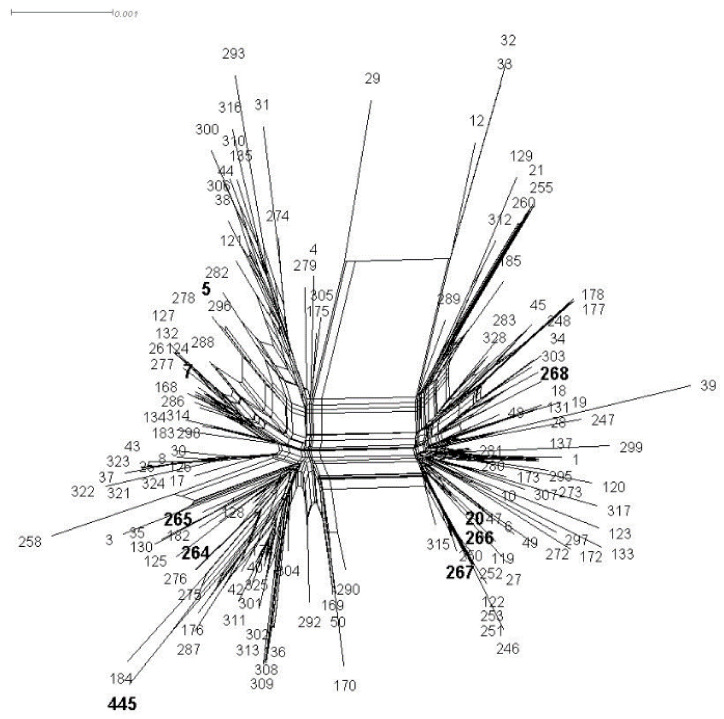
Cryptococcosis, a potentially fatal mycosis in humans, is acquired via exposure to exogenous environmental sources. This study aimed to investigate the frequency, genetic diversity, and virulence of cryptococcal strains isolated from indoor dust in the Rio Negro micro-region of the Brazilian Amazon. A total of 8.9% of the studied houses were positive, recovering nine Cryptococcus neoformans VNI and 16 C. gattii VGII isolates, revealing an endemic pattern in domestic microenvironments. The International Society for Human and Animal Mycology (ISHAM) consensus multilocus sequence typing (MLST) scheme for the C. neoformans/C. gattii species complexes identified two sequence types (STs), ST93 and ST5, amongst C. neoformans isolates and six STs amongst C. gattii isolates, including the Vancouver Island Outbreak ST7 (VGIIa) and ST20 (VGIIb), the Australian ST5, and ST264, ST268 and ST445, being unique to the studied region. Virulence studies in the Galleria mellonella model showed that five C. gattii strains and one C. neoformans strain showed a similar pathogenic potential to the highly virulent Vancouver Island outbreak strain CDR265 (VGIIa). The findings of this study indicate that humans can be exposed to the agents of cryptococcosis via house dust, forming the basis for future studies to analyze the impact of early and continuous exposure to indoor dust on the development of subclinical or clinical infections.
Keywords: Brazilian Amazon; Cryptococcus gattii; Cryptococcus neoformans; MLST; indoor dust; virulence.
Conflict of interest statement
The authors declare no conflict of interest. The funders had no role in the design of the study; in the collection, analyses, or interpretation of data; in the writing of the manuscript or in the decision to publish the results.
Figures
References
-
- Kwon-Chung K.J., Bennett J.E., Wickes B.L., Meyer W., Cuomo C.A., Wollenburg K.R., Bicanic T.A., Castañeda E., Chang Y.C., Chen J., et al. The Case for Adopting the “Species Complex” Nomenclature for the Etiologic Agents of Cryptococcosis. mSphere. 2017;2:e00357-16. doi: 10.1128/mSphere.00357-16. - DOI - PMC - PubMed
-
- Rajasingham R., Smith R.M., Park B.J., Jarvis J.N., Govender N.P., Chiller T.M., Denning D.W., Loyse A., Boulware D.R. Global burden of disease of HIV-associated cryptococcal meningitis: an updated analysis. Lancet Infect. Dis. 2017;17:873–881. doi: 10.1016/S1473-3099(17)30243-8. - DOI - PMC - PubMed
-
- Fyfe M., MacDougall L., Romney M., Starr M., Pearce M., Mak S., Mithani S., Kibsey P. Cryptococcus gattii infections on Vancouver Island, British Columbia, Canada: emergence of a tropical fungus in a temperate environment. Can. Commun. Dis. Rep. 2008;34:1–12. - PubMed
-
- Trilles L., dos Lazéra M.S., Wanke B., Oliveira R.V., Barbosa G.G., Nishikawa M.M., Morales B.P., Meyer W. Regional pattern of the molecular types of Cryptococcus neoformans and Cryptococcus gattii in Brazil. Memórias do Instituto Oswaldo Cruz. 2008;103:455–462. doi: 10.1590/S0074-02762008000500008. - DOI - PubMed
-
- Phillips P., Galanis E., MacDougall L., Chong M.Y., Balshaw R., Cook V.J., Bowie W., Steiner T., Hoang L., Morshed M., et al. Longitudinal Clinical Findings and Outcome among Cryptococcus gattii Patients in British Columbia. Clin. Infect. Dis. 2015;60:1368–1376. doi: 10.1093/cid/civ041. - DOI - PubMed
Grants and funding
LinkOut - more resources
Full Text Sources
