. 2020 Dec;9(1):1011-1022.
doi: 10.1080/22221751.2020.1763209.

The type I-E CRISPR-Cas system influences the acquisition of blaKPC-IncF plasmid in Klebsiella pneumonia

Affiliations

The type I-E CRISPR-Cas system influences the acquisition of blaKPC-IncF plasmid in Klebsiella pneumonia

Ying Zhou et al. Emerg Microbes Infect. 2020 Dec.

Abstract

Klebsiella pneumoniae carbapenemase (KPC)-producing K. pneumoniae (KPC-KP) have disseminated worldwide and emerged as major threats to public health. Of epidemiological significance, the international pandemic of KPC-KP is primarily associated with CG258 isolates and blaKPC-IncF plasmids. CRISPR-Cas system is an adaptive immune system that can hinder gene expansion driven by horizontal gene transfer. Because of blaKPC-IncF plasmids are favored by CG258 K. pneumoniae, it was of interest to examine the co-distribution of CRISPR and blaKPC-IncF plasmids in such isolates. We collected 459 clinical K. pneumoniae isolates in China and collected 203 global whole-genome sequences in GenBank to determine the prevalence of CRISPR-Cas systems. We observed that CRISPR-Cas system was significantly scarce in the CG258 lineage and blaKPC-positive isolates. Furthermore, the results of conjugation and plasmid stability assay fully demonstrated the CRIPSR-Cas system in K. pneumoniae could effectively hindered blaKPC-IncF plasmids invasion and existence. Notably, most blaKPC-IncF plasmids were also proved to be good targets of CRISPR owing to carry matched and functional protospacers and PAMs. Overall, our work suggests that type I-E CRISPR-Cas systems could impact the spread of blaKPC in K. pneumoniae populations, and the scarcity of CRISPR-Cas system was one of potential factors leading to the propagation of blaKPC-IncF plasmids in CG258 K. pneumoniae.

Keywords: CRISPR-Cas; Klebsiella pneumoniae clonal complex 258; carbapenem resistance; horizontal gene transfer; plasmids.


Conflict of interest statement

No potential conflict of interest was reported by the author(s).

Figures
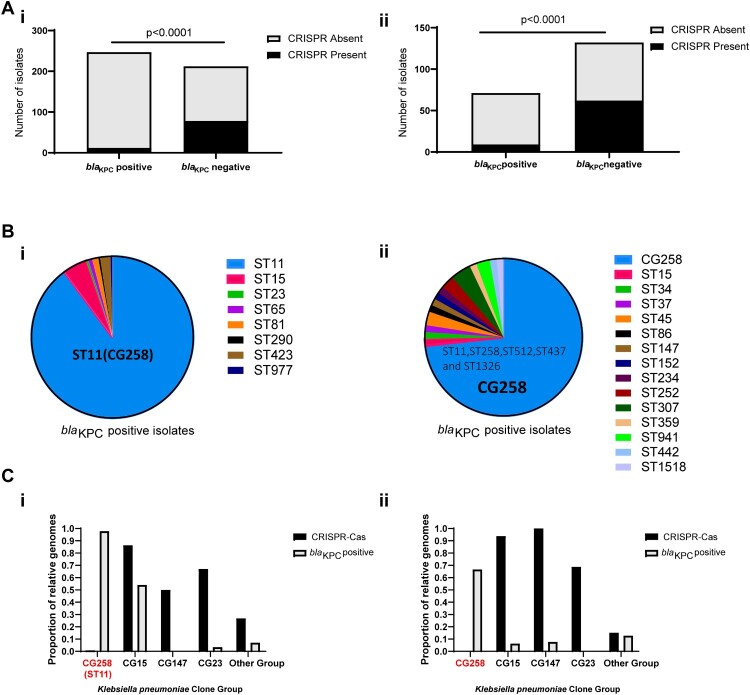
Figure 1.
Figure 1.
Presence of CRISPR-Cas system in blaKPC-positive /blaKPC-negative groups and CG258/non-CG258 isolates. (A) i. Presence of type I-E CRISPR systems in 459 Chinese clinical isolates collected in this study; ii. Presence of type I-E CRISPR systems in 203 completely sequenced strains available in GenBank. (B) i. MLSTs of blaKPC-positive group in459 Chinese clinical isolates; ii. MLSTs of blaKPC-positive group in 203 completely sequenced strains available in GenBank. (C) i. Presence of type I-E CRISPR systems among different clone groups in 459 Chinese clinical isolates collected in this study; ii. Presence of type I-E systems among different clone groups in 203 completely sequenced strains available in GenBank. p < 0.0001 indicate significant differences between two groups as determined using Chi-square (and Fisher’s exact) test with Bonferroni correction of the GraphPad Prism8 software.
Figure 2.
Figure 2.
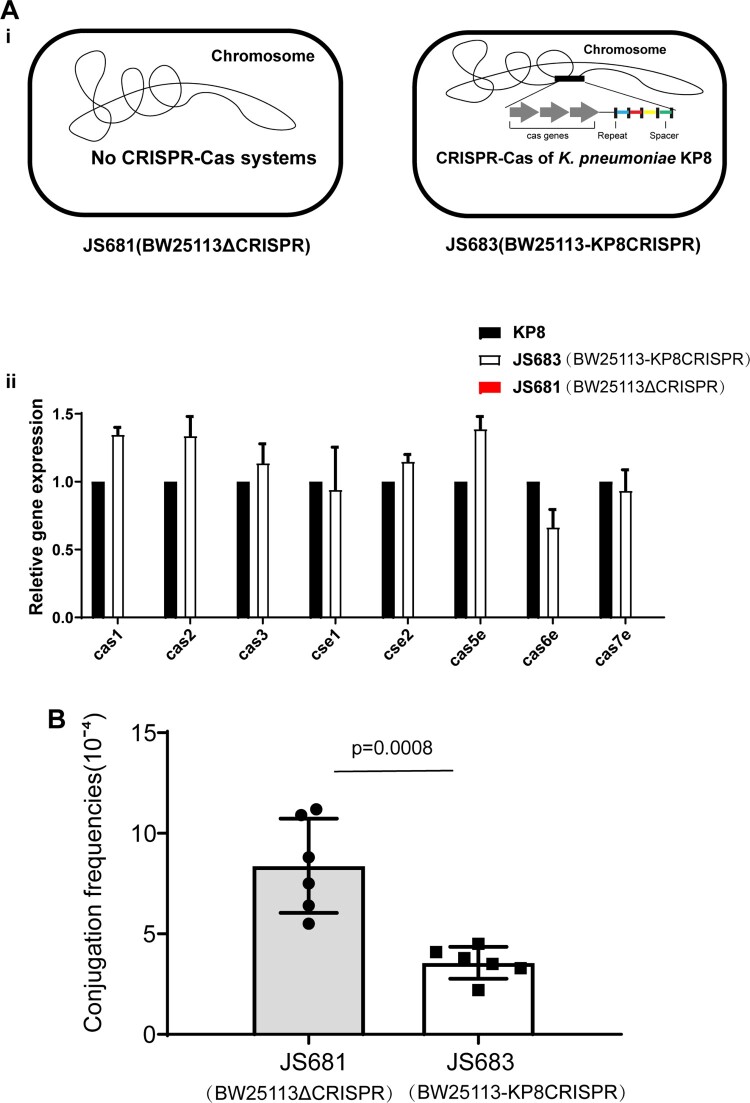
Conjugation frequencies of p187-2 in BW25113 strains with or without KP8 CRISPR. (A) (i) Schematic of JS681 and JS683. (ii)Expression of the Cas operon in the KP8, JS683 and JS681 cells. (B) Effect of the KP8 CRISPR on the conjugation frequencies of p187-2(IncF conjugative plasmid with blaKPC and matched proto-spacers). The data represent the mean ± SD for six independent biological replicates. p = 0.0008 indicate significant differences between two groups as determined using two-tailed Student’s t-test.
Figure 3.
Figure 3.
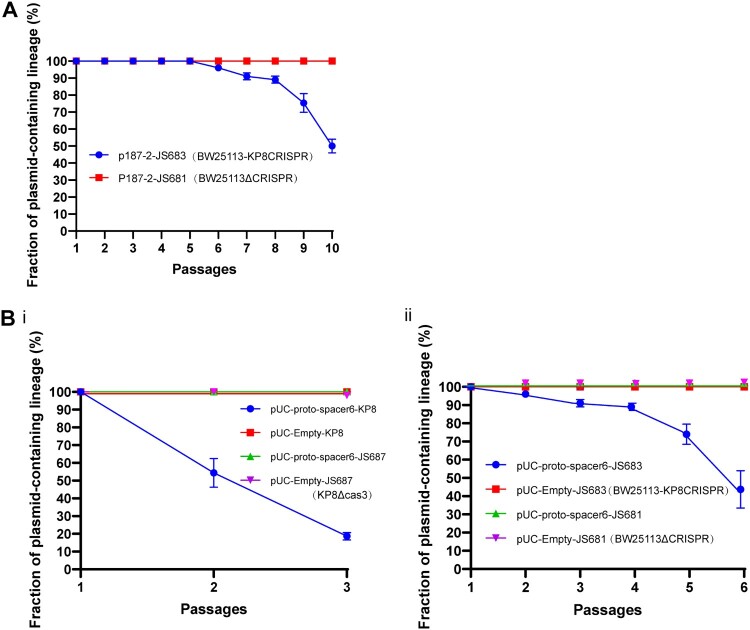
Plasmid stability in KP8 and JS683 (BW25113-KP8CRISPR) cells. (A) The E. coli strains JS683 and JS681 were transformed with a clinical plasmid p187-2 (an IncF conjugative plasmid with blaKPC and matched spacers). Plasmid stability experiment results during10 passages. The number of imipenem-resistant clones was lesser in the CRISPR-positive strain (blue line) at the 10th passage than in the CRISPR-negative strain (red line), in which the number of resistant clones were no altered. (B) Two chloramphenicol-resistant plasmids with or without matched spacer were transformed into KP8, JS683, and their CRISPR-mutant versions(JS687, KP8ΔCas3 and JS681,BW25113ΔCRISPR). Plasmid stability experiment results during 3 passages(i) or 6 passages(ii). The elimination rates of pUC-proto-spacer 6 in the CRISPR-positive strain (blue lines) decreased to variable extents, whereas that of pUC-empty in all strains were identical. The stability of all plasmids was identical in the CRISPR deletion strain(JS687, KP8ΔCas3 and JS681,BW25113ΔCRISPR). All experiments were conducted in triplicate.
Figure 4.
Figure 4.
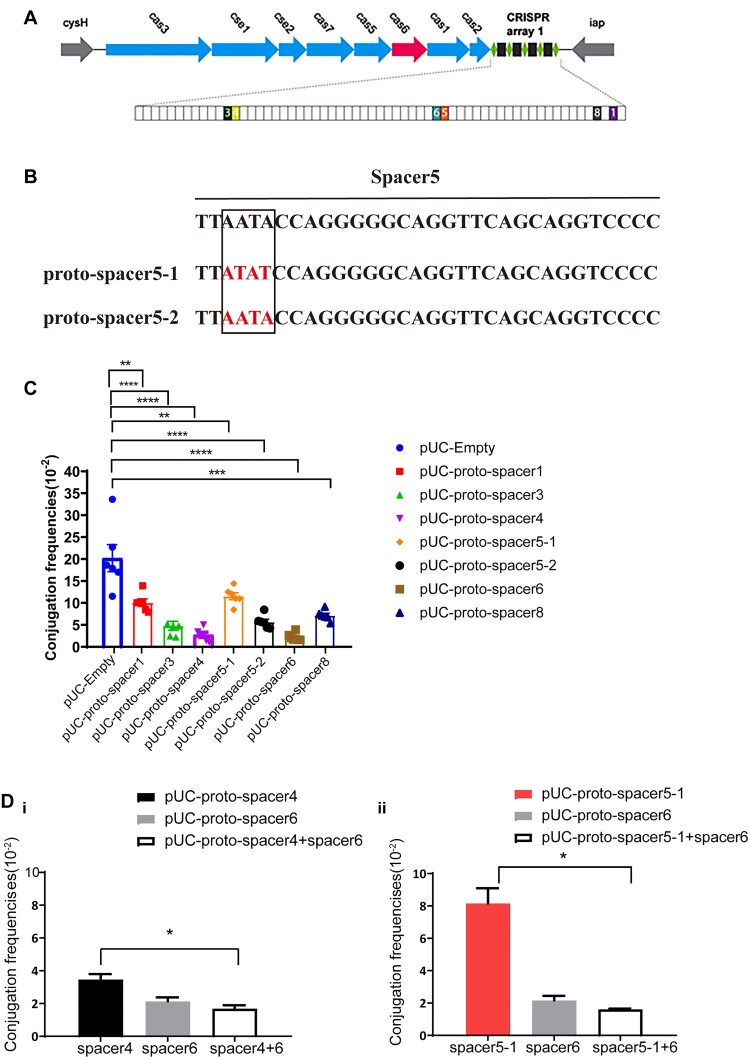
Characteristics of proto-spacers located on the blaKPC -IncF plasmids. (A) Schematic showing the CRISPR-Cas system in KP8. Genes are depicted as arrows in different colours and the IncF plasmid-matched spacers are shown as colourful boxes. (B) Two subtypes of proto-spacer 5, in which the nucleotide sequence in red represents the base mutation. (C) Conjugation frequencies of different proto-spacers. (D) Conjugation frequencies of single and combined proto-spacers. The results of the conjugation assay are presented as means ± SD from six independent experiments. * p < 0.05, ** p < 0.01, *** p < 0.001, ****p < 0.0001 indicate significant differences between the strains and the control group (pUC-Empty) as determined using one-way ANOVA with Dunnett correction(C). Statistical significance between the two strains was assessed using a two-tailed Student’s t-test with Bonferroni correction of the GraphPad Prism8 software. * p < 0.05 was considered statistically significant (D).
Figure 5.
Figure 5.
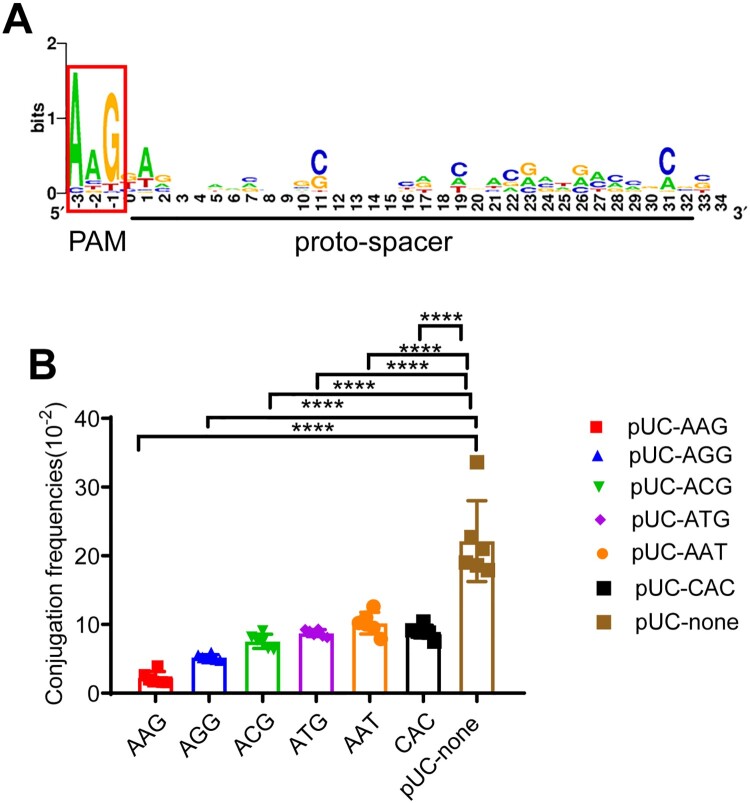
Characteristics of PAMs adjunct to the proto-spacers harboured by blaKPC-IncF plasmids. (A) WebLogo was used to analyze PAMs from blaKPC-IncF plasmids. The first nucleotide of the proto-spacer is at position 0. WebLog of the proto-spacer, as well as those 3 nucleotides upstream and downstream of the proto-spacer are shown. The relative letter size indicates the base frequency at that position. (B) Conjugation frequencies of proto-spacers with different PAMs. The data represent the mean ± SD for six independent biological replicates. * p < 0.05, ** p < 0.01, *** p < 0.001, ****p < 0.0001 indicate significant differences between the strains and the control group (pUC-none) as determined using one-way ANOVA with Dunnett correction.

References

    1. McKenna M. Antibiotic resistance: the last resort. Nature. 2013 Jul 25;499(7459):394–396. doi: 10.1038/499394a - DOI - PubMed
    1. Chen L, Mathema B, Chavda KD, et al. Carbapenemase-producing Klebsiella pneumoniae: molecular and genetic decoding. Trends Microbiol. 2014 Dec 1;22(12):686–696. doi: 10.1016/j.tim.2014.09.003 - DOI - PMC - PubMed
    1. Kuehn BM. “Nightmare” bacteria on the rise in US hospitals, long-term care facilities. JAMA. 2013 Apr 7;309(15):1573–1574. doi: 10.1001/jama.2013.2922 - DOI - PubMed
    1. Logan LK, Weinstein RA.. The epidemiology of carbapenem-resistant enterobacteriaceae: the impact and evolution of a global menace. J Infect Dis. 2017 Feb 15;215(suppl_1):S28–S36. doi: 10.1093/infdis/jiw282 - DOI - PMC - PubMed
    1. Munoz-Price LS, Poirel L, Bonomo RA, et al. Clinical epidemiology of the global expansion of Klebsiella pneumoniae carbapenemases. Lancet Infect Dis. 2013 Sept 1;13(9):785–796. doi: 10.1016/S1473-3099(13)70190-7 - DOI - PMC - PubMed

MeSH terms

Substances

LinkOut - more resources