


Longitudinal trajectories of Alzheimer's ATN biomarkers in elderly persons without dementia
- PMID: 32393375
- PMCID: PMC7216714
- DOI: 10.1186/s13195-020-00621-6
Longitudinal trajectories of Alzheimer's ATN biomarkers in elderly persons without dementia
Abstract
Background: Models of Alzheimer's disease (AD) pathophysiology posit that amyloidosis [A] precedes and accelerates tau pathology [T] that leads to neurodegeneration [N]. Besides this A-T-N sequence, other biomarker sequences are possible. This current work investigates and compares the longitudinal trajectories of Alzheimer's ATN biomarker profiles in non-demented elderly adults from the Alzheimer's Disease Neuroimaging Initiative (ADNI) cohort.
Methods: Based on the ATN classification system, 262 individuals were identified before dementia diagnosis and accompanied by baseline and follow-up data of ATN biomarkers (CSF Aβ42, p-tau, and FDG-PET). We recorded the conversion processes in ATN biomarkers during follow-up, then analyzed the possible longitudinal trajectories and estimated the conversion rate and temporal evolution of biomarker changes. To evaluate how biomarkers changed over time, we used linear mixed-effects models.
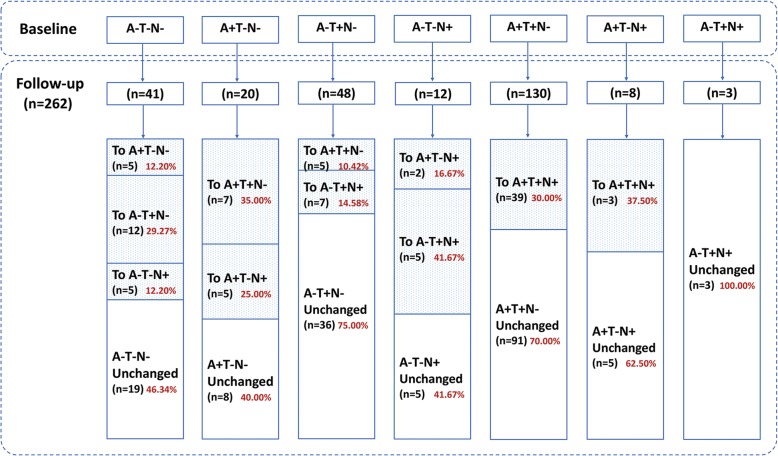
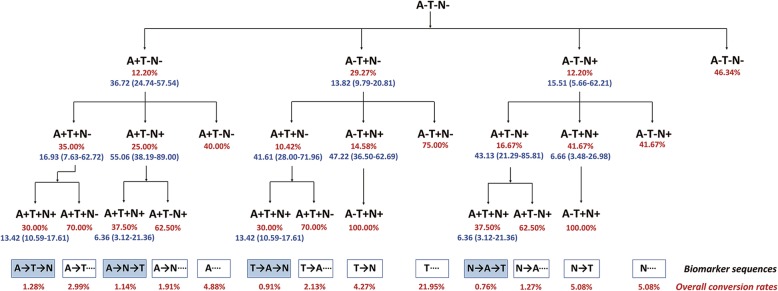
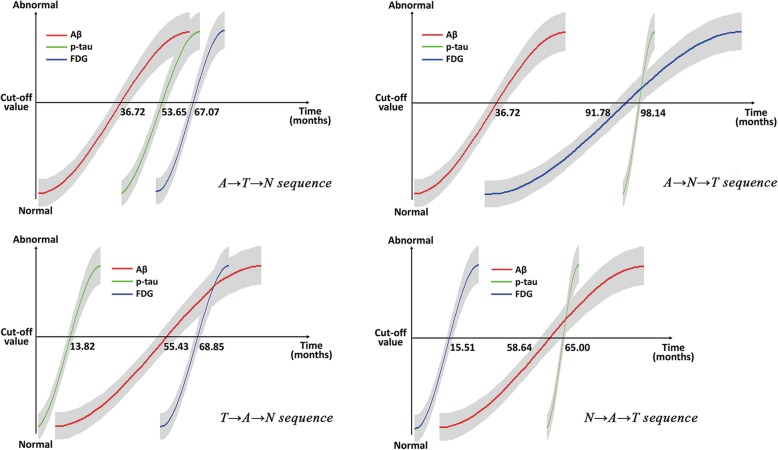
Results: During a 6-120-month follow-up period, there were four patterns of longitudinal changes in Alzheimer's ATN biomarker profiles, from all negative to positive through the course of the disease. The most common pattern is that A pathology biomarker first emerges. As well as the classical A-T-N sequence, other "A-first," "T-first," and "N-first" biomarker pathways were found. The N-A-T sequence had the fastest rate of pathological progression (mean 65.00 months), followed by A-T-N (mean 67.07 months), T-A-N (mean 68.85 months), and A-N-T sequences (mean 98.14 months).
Conclusions: Our current work presents a comprehensive analysis of longitudinal trajectories of Alzheimer's ATN biomarkers in non-demented elderly adults. Stratifying disease into subtypes depending on the temporal evolution of biomarkers will benefit the early recognition and treatment.
Keywords: ADNI; Alzheimer’s disease; Amyloid; Biomarker; Neurodegeneration; Tau.
Conflict of interest statement
The authors declared no potential conflicts of interest with respect to the research, authorship, and/or publication of this article.
Figures
References
-
- Sperling RA, Aisen PS, Beckett LA, Bennett DA, Craft S, Fagan AM, et al. Toward defining the preclinical stages of Alzheimer’s disease: recommendations from the National Institute on Aging-Alzheimer’s Association workgroups on diagnostic guidelines for Alzheimer’s disease. Alzheimers Dement. 2011;7:280–292. doi: 10.1016/j.jalz.2011.03.003. - DOI - PMC - PubMed
-
- McKhann GM, Knopman DS, Chertkow H, Hyman BT, Jack CR, Jr, Kawas CH, et al. The diagnosis of dementia due to Alzheimer’s disease: recommendations from the National Institute on Aging-Alzheimer’s Association workgroups on diagnostic guidelines for Alzheimer’s disease. Alzheimers Dement. 2011;7:263–269. doi: 10.1016/j.jalz.2011.03.005. - DOI - PMC - PubMed
-
- Albert MS, DeKosky ST, Dickson D, Dubois B, Feldman HH, Fox NC, et al. The diagnosis of mild cognitive impairment due to Alzheimer’s disease: recommendations from the National Institute on Aging-Alzheimer’s Association workgroups on diagnostic guidelines for Alzheimer’s disease. Alzheimers Dement. 2011;7:270–279. doi: 10.1016/j.jalz.2011.03.008. - DOI - PMC - PubMed
Publication types
MeSH terms
Substances
LinkOut - more resources
Full Text Sources
Medical
Research Materials
