DMARD-free remission as novel treatment target in rheumatoid arthritis: A systematic literature review of achievability and sustainability
- PMID: 32393523
- PMCID: PMC7299506
- DOI: 10.1136/rmdopen-2020-001220
DMARD-free remission as novel treatment target in rheumatoid arthritis: A systematic literature review of achievability and sustainability
Abstract
Objectives: Although current treatment guidelines for rheumatoid arthritis (RA) suggest tapering disease-modifying anti-rheumatic drugs (DMARDs), it is unclear whether DMARD-free remission (DFR) is an achievable and sustainable outcome. Therefore, we systematically reviewed the literature to determine the prevalence and sustainability of DFR and evaluated potential predictors for DFR.
Methods: A systematic literature search was performed in March 2019 in multiple databases. All clinical trials and observational studies reporting on discontinuation of DMARDs in RA patients in remission were included. Our quality assessment included a general assessment and assessment of the description of DFR. Prevalence of DFR and its sustainability and flares during tapering and after DMARD stop were summarised. Also, potential predictors for achieving DFR were reviewed.
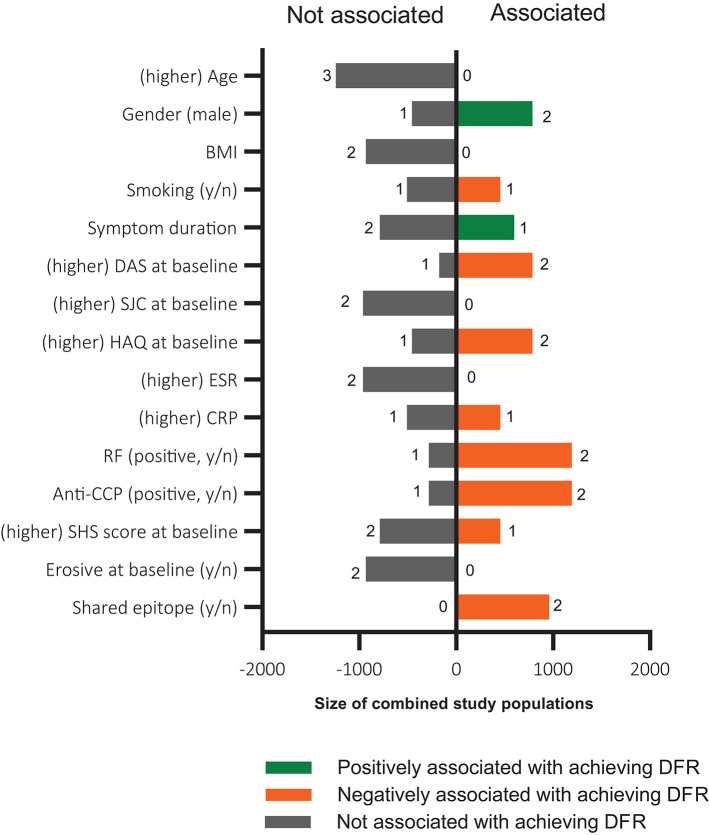
Results: From 631 articles, 51 were included, comprising 14 clinical trials and 5 observational studies. DFR definition differed, especially for the duration of DMARD-free state. Considering only high- and moderate-quality studies, DFR was achieved in 5.0%-24.3% and sustained DFR (duration>12 months) in 11.6%-19.4% (both relative to the number of patients eligible for tapering). Flares occurred frequently during DMARD tapering (41.8%-75.0%) and in the first year after achieving DFR (10.4%-11.8%), while late flares, >1 year after DMARD-stop, were infrequent (0.3%-3.5%). Many patient characteristics lacked association with DFR. Absence of autoantibodies and shared epitope alleles increased the chance of achieving DFR.
Conclusions: DFR is achievable in RA and is sustainable in ~10%-20% of patients. DFR can become an important outcome measure for clinical trials and requires consistency in the definition. Considering the high rate of flares in the first year after DMARD stop, a DMARD-free follow-up of >12 months is advisable to evaluate sustainability.
Keywords: DMARD-free remission; disease flare; rheumatoid arthritis; tapering.
© Author(s) (or their employer(s)) 2020. Re-use permitted under CC BY-NC. No commercial re-use. See rights and permissions. Published by BMJ.
Conflict of interest statement
Competing interests: None declared.
Figures


References
-
- Kerschbaumer A, Sepriano A, Smolen JS, et al. Efficacy of pharmacological treatment in rheumatoid arthritis: a systematic literature research informing the 2019 update of the EULAR recommendations for management of rheumatoid arthritis. J Ann Rheum Dis 2020. 10.1136/annrheumdis-2019-216656 - DOI - PMC - PubMed
Publication types
MeSH terms
Substances
LinkOut - more resources
Full Text Sources
Medical