Case Management in Primary Care for Frequent Users of Health Care Services: A Realist Synthesis
- PMID: 32393557
- PMCID: PMC7213991
- DOI: 10.1370/afm.2499
Case Management in Primary Care for Frequent Users of Health Care Services: A Realist Synthesis
Abstract
Purpose: Case management (CM) is a promising intervention for frequent users of health care services. Our research question was how and under what circumstances does CM in primary care work to improve outcomes among frequent users with chronic conditions?
Methods: We conducted a realist synthesis, searching MEDLINE, CINAHL, Embase, and PsycINFO (1996 to September 2017) for articles meeting the following criteria: (1) population: adult frequent users with chronic disease, (2) intervention: CM in a primary care setting with a postintervention evaluation, and (3) primary outcomes: integration of services, health care system use, cost, and patient outcome measures. Academic and gray literature were evaluated for relevance and robustness. Independent reviewers extracted data to identify context, mechanism, and outcome (CMO) configurations. Analysis of CMO configurations allowed for the modification of an initial program theory toward a refined program theory.
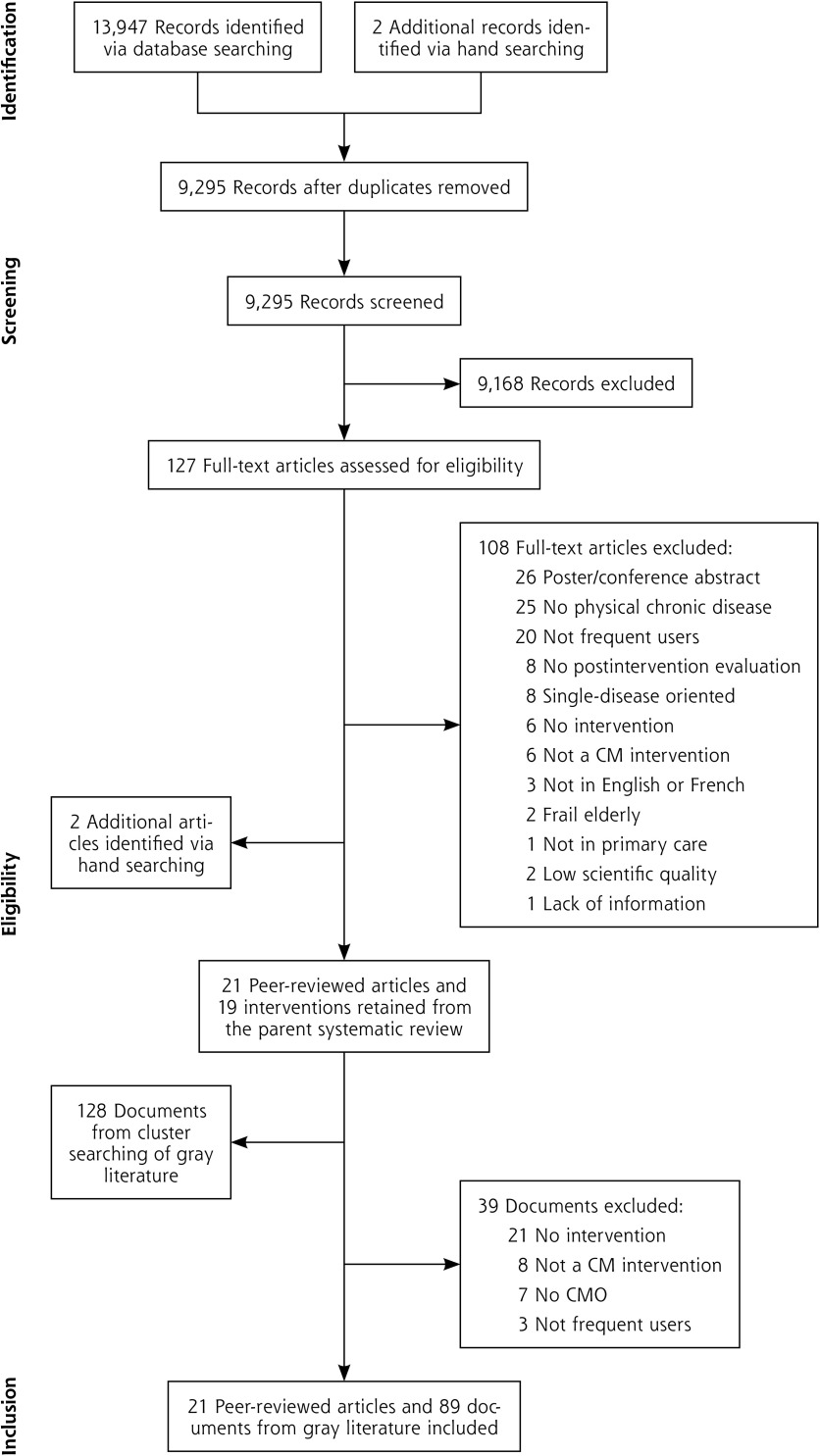
Results: Of the 9,295 records retrieved, 21 peer-reviewed articles and an additional 89 documents were retained. We evaluated 19 CM interventions and identified 11 CMO configurations. The development of a trusting relationship fostering patient and clinician engagement in the CM intervention was recurrent in many CMO configurations.
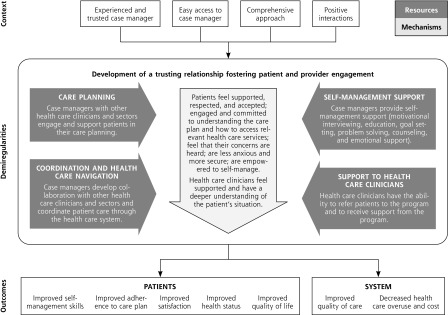
Conclusion: Our refined program theory proposes that in the context of easy access to an experienced and trusted case manager who provides comprehensive care while maintaining positive interactions with patients, the development of this relationship fosters the engagement of both individuals and yields positive outcomes when the following mechanisms are triggered: patients and clinicians feel supported, respected, accepted, engaged, and committed; and patients feel less anxious, more secure, and empowered to self-manage.
Keywords: CMO configurations; case management; causal mechanisms; chronic conditions; frequent users; primary care issues; program theory; realist synthesis.
© 2020 Annals of Family Medicine, Inc.
Figures
References
-
- Bodenheimer T, Berry-Millett R. Follow the money–controlling expenditures by improving care for patients needing costly services. N Engl J Med. 2009; 361(16): 1521-1523. - PubMed
-
- LaCalle E, Rabin E. Frequent users of emergency departments: the myths, the data, and the policy implications. Ann Emerg Med. 2010; 56(1): 42-48. - PubMed
-
- Wodchis WP. High cost users: driving value with a patient-centred health system. https://www.ryerson.ca/content/dam/crncc/knowledge/eventsandpresentation.... Published Jun 30, 2013 Accessed Apr 20, 2020.
-
- Schoen C, Osborn R, Squires D, Doty M, Pierson R, Applebaum S. New 2011 survey of patients with complex care needs in eleven countries finds that care is often poorly coordinated. Health Aff (Millwood). 2011; 30(12): 2437-2448. - PubMed
-
- Sun BC, Burstin HR, Brennan TA. Predictors and outcomes of frequent emergency department users. Acad Emerg Med. 2003; 10(4): 320-328. - PubMed
Publication types
MeSH terms
LinkOut - more resources
Full Text Sources
Medical