Review
. 2020 Jul 14;40(15):e00104-20.
doi: 10.1128/MCB.00104-20. Print 2020 Jul 14.

Looking Down on NF-κB

Affiliations
Review

Looking Down on NF-κB

Leah M Williams et al. Mol Cell Biol. .

Abstract

The diversified NF-κB transcription factor family has been extensively characterized in organisms ranging from flies to humans. However, homologs of NF-κB and many upstream signaling components have recently been characterized in basal phyla, including Cnidaria (sea anemones, corals, hydras, and jellyfish), Porifera (sponges), and single-celled protists, including Capsaspora owczarzaki and some choanoflagellates. Herein, we review what is known about basal NF-κBs and how that knowledge informs on the evolution and conservation of key sequences and domains in NF-κB, as well as the regulation of NF-κB activity. The structures and DNA-binding activities of basal NF-κB proteins resemble those of mammalian NF-κB p100 proteins, and their posttranslational activation appears to have aspects of both canonical and noncanonical pathways in mammals. Several studies suggest that the single NF-κB proteins found in some basal organisms have dual roles in development and immunity. Further research on NF-κB in invertebrates will reveal information about the evolutionary roots of this major signaling pathway, will shed light on the origins of regulated innate immunity, and may have relevance to our understanding of the responses of ecologically important organisms to changing environmental conditions and emerging pathogen-based diseases.

Keywords: NF-kappaB; development; evolution; innate immunity; signal transduction.


Figures

FIG 1
FIG 1
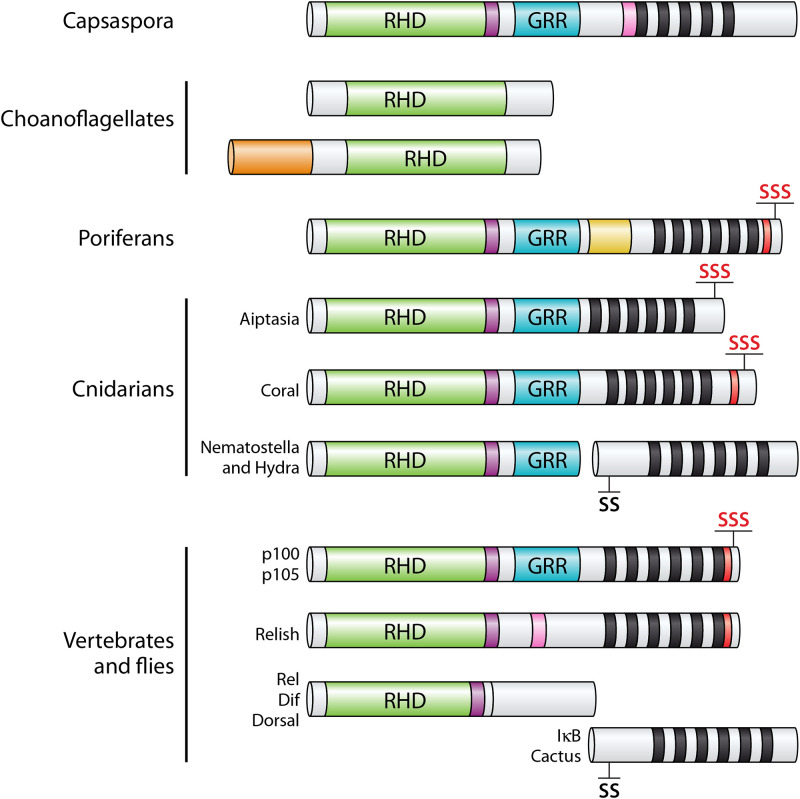
Structures of NF-κBs in organisms basal to Bilateria are most similar to human NF-κB proteins rather than Rel proteins. The basic domain structures of homologs of NF-κB in Capsaspora, choanoflagellates, poriferans (sponges), and cnidarians are compared to those of the fly and vertebrate NF-κBs (Relish and p100/p105), Rels (Dif, Dorsal, RelA, RelB, and c-Rel), and IκB (Cactus). Green, Rel homology domain (RHD); purple, nuclear localization signal (NLS); blue, glycine-rich region (GRR); pink, caspase cleavage site; black bars, ankyrin repeats; red, death domain; SSS/SS, conserved serines important for phosphorylation and degradation of the protein (the red SSSs indicate homology to p100); orange, N-terminal domains of choanoflagellates not seen in other NF-κB proteins.
FIG 2
FIG 2
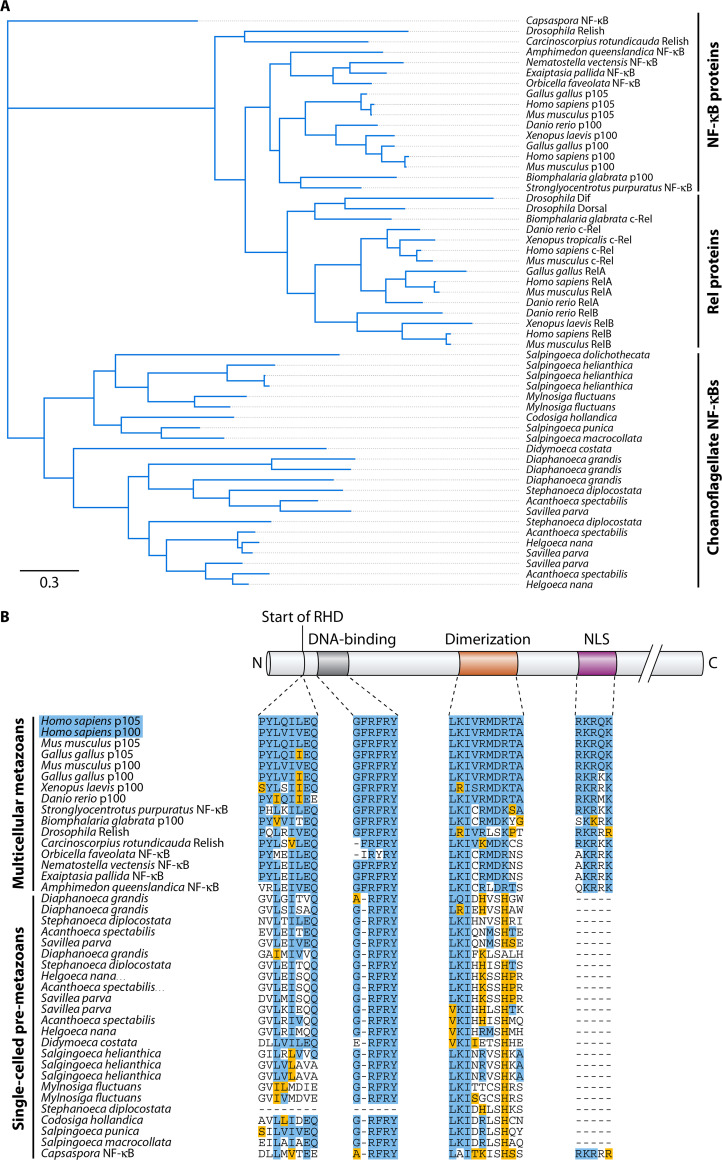
Phylogenetic analysis places choanoflagellate NF-κBs as an outgroup of vertebrate and fly NF-κBs. (A) Bayesian analysis of holozoan RHDs, including the recently identified choanoflagellate NF-κBs. MEME analysis was performed on each sequence to identify shared motifs. NF-κB proteins and Rel proteins cluster separately from each other, and choanoflagellate NF-κBs cluster as a single outgroup. (B) A multiple-sequence alignment of important NF-κB subdomains across multicellular metazoans and single-celled premetazoans. Exact amino acid matches to either p100 or p105 are highlighted in blue across phyla, and residues with conserved functional groups are highlighted in yellow. All multicellular metazoans contain a defined start to the Rel homology domain (RHD), dimerization sequence, and nuclear localization sequence (NLS). Single-celled premetazoans have a less defined RHD start, low homology in the dimerization sequence, and no canonical NLS (with the exception of Capsaspora). All metazoan and premetazoan NF-κB sequences contain a highly conserved DNA-binding sequence.
FIG 3
FIG 3
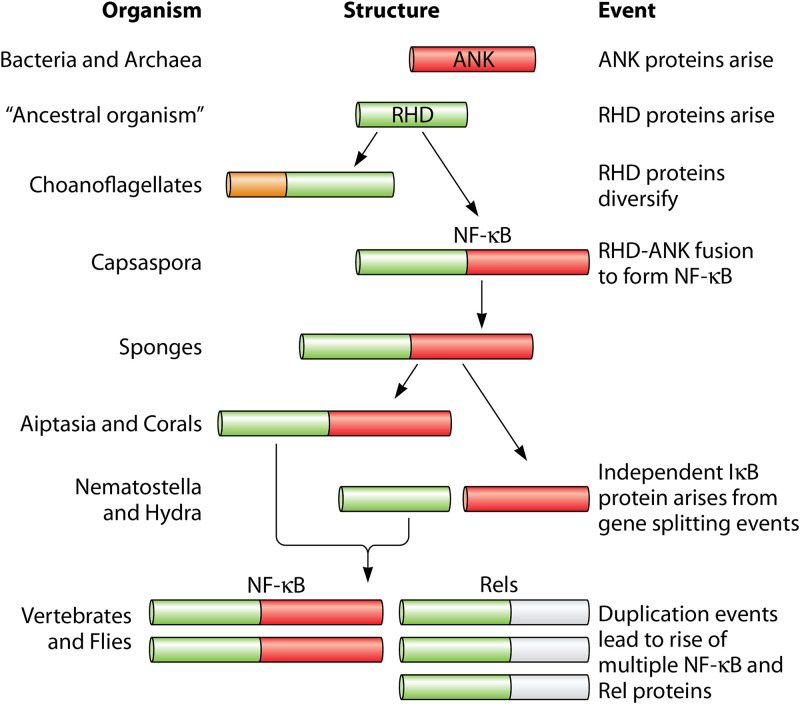
Evolution of NF-κB. Prior to the rise of holozoan life, ankyrin (ANK) repeats (red) were present in bacteria and archaea. The appearance of an RHD-containing protein (green) likely led to RHD-only proteins that diversified in choanoflagellates and to an RHD-ANK fusion in an ancestor of Capsaspora. Metazoans generally retained the full-length NF-κB fusion protein, although in some cnidarians (e.g., Hydra and Nematostella) there were gene-splitting events that created separate RHD and ANK repeat proteins. Eventually, a series of duplication events gave rise to the multiple NF-κB and Rel proteins that are present in vertebrates and flies.

References

    1. Gilmore TD, Temin HM. 1986. Different localization of the product of the v-rel oncogene in chicken fibroblasts and spleen cells correlates with transformation by REV-T. Cell 44:791–800. doi:10.1016/0092-8674(86)90845-7. - DOI - PubMed
    1. Gilmore TD. 1990. NF-κB, KBF1, dorsal, and related matters. Cell 62:841–843. doi:10.1016/0092-8674(90)90257-f. - DOI - PubMed
    1. Steward R. 1987. Dorsal, an embryonic polarity gene in Drosophila, is homologous to the vertebrate proto-oncogene, c-rel. Science 238:692–694. doi:10.1126/science.3118464. - DOI - PubMed
    1. Ghosh S, Gifford AM, Riviere LR, Tempst P, Nolan GP, Baltimore D. 1990. Cloning of the p50 DNA binding subunit of NF-κB: homology to rel and dorsal. Cell 62:1019–1029. doi:10.1016/0092-8674(90)90276-k. - DOI - PubMed
    1. Kieran M, Blank V, Logeat F, Vandekerckhove J, Lottspeich F, Le Bail O, Urban MB, Kourilsky P, Baeuerle PA, Israël A. 1990. The DNA binding subunit of NF-κB is identical to factor KBF1 and homologous to the rel oncogene product. Cell 62:1007–1018. doi:10.1016/0092-8674(90)90275-j. - DOI - PubMed

Publication types

MeSH terms

LinkOut - more resources