. 2020 May 11;11(1):2220.
doi: 10.1038/s41467-020-15905-6.

Protein-altering germline mutations implicate novel genes related to lung cancer development

Xuemei Ji  1 Semanti Mukherjee  2 Maria Teresa Landi  3 Yohan Bosse  4 Philippe Joubert  4 Dakai Zhu  5   6 Ivan Gorlov  5 Xiangjun Xiao  6 Younghun Han  6 Olga Gorlova  5 Rayjean J Hung  7 Yonathan Brhane  7 Robert Carreras-Torres  8 David C Christiani  9   10 Neil Caporaso  3 Mattias Johansson  8 Geoffrey Liu  7 Stig E Bojesen  11   12   13 Loic Le Marchand  14 Demetrios Albanes  3 Heike Bickeböller  15 Melinda C Aldrich  16 William S Bush  17 Adonina Tardon  18 Gad Rennert  19 Chu Chen  20 Jinyoung Byun  6 Konstantin H Dragnev  21 John K Field  22 Lambertus Fa Kiemeney  23 Philip Lazarus  24 Shan Zienolddiny  25 Stephen Lam  26 Matthew B Schabath  27 Angeline S Andrew  28 Pier A Bertazzi  29   30 Angela C Pesatori  29   30 Nancy Diao  9 Li Su  9 Lei Song  3 Ruyang Zhang  9 Natasha Leighl  31 Jakob S Johansen  32 Anders Mellemgaard  32 Walid Saliba  19 Christopher Haiman  33 Lynne Wilkens  14 Ana Fernandez-Somoano  18 Guillermo Fernandez-Tardon  18 Erik H F M van der Heijden  23 Jin Hee Kim  34 Michael P A Davies  22 Michael W Marcus  22 Hans Brunnström  35 Jonas Manjer  36 Olle Melander  36 David C Muller  37 Kim Overvad  36 Antonia Trichopoulou  38 Rosario Tumino  39 Gary E Goodman  40   41 Angela Cox  42 Fiona Taylor  42 Penella Woll  42 Erich Wichmann  43 Thomas Muley  44   45 Angela Risch  46 Albert Rosenberger  15 Kjell Grankvist  47 Mikael Johansson  48 Frances Shepherd  49 Ming-Sound Tsao  49 Susanne M Arnold  50 Eric B Haura  51 Ciprian Bolca  52 Ivana Holcatova  53 Vladimir Janout  54 Milica Kontic  55 Jolanta Lissowska  56 Anush Mukeria  57 Simona Ognjanovic  58 Tadeusz M Orlowski  59 Ghislaine Scelo  8 Beata Swiatkowska  60 David Zaridze  57 Per Bakke  61 Vidar Skaug  25 Lesley M Butler  62 Kenneth Offit  2 Preethi Srinivasan  63 Chaitanya Bandlamudi  64 Matthew D Hellmann  2 David B Solit  2   64 Mark E Robson  2 Charles M Rudin  2 Zsofia K Stadler  2 Barry S Taylor  64   65 Michael F Berger  63   64 Richard Houlston  66 John McLaughlin  67 Victoria Stevens  68 David C Nickle  69 Ma'en Obeidat  70 Wim Timens  71 María Soler Artigas  72   73 Sanjay Shete  74 Hermann Brenner  75 Stephen Chanock  3 Paul Brennan  8 James D McKay  8 Christopher I Amos  76   77
Affiliations

Protein-altering germline mutations implicate novel genes related to lung cancer development

Xuemei Ji et al. Nat Commun. .

Abstract

Few germline mutations are known to affect lung cancer risk. We performed analyses of rare variants from 39,146 individuals of European ancestry and investigated gene expression levels in 7,773 samples. We find a large-effect association with an ATM L2307F (rs56009889) mutation in adenocarcinoma for discovery (adjusted Odds Ratio = 8.82, P = 1.18 × 10⁻¹⁵) and replication (adjusted OR = 2.93, P = 2.22 × 10⁻³) that is more pronounced in females (adjusted OR = 6.81 and 3.19 and for discovery and replication). We observe an excess loss of heterozygosity in lung tumors among ATM L2307F allele carriers. L2307F is more frequent (4%) among Ashkenazi Jewish populations. We also observe an association in discovery (adjusted OR = 2.61, P = 7.98 × 10⁻²²) and replication datasets (adjusted OR = 1.55, P = 0.06) with a loss-of-function mutation, Q4X (rs150665432) of an uncharacterized gene, KIAA0930. Our findings implicate germline genetic variants in ATM with lung cancer susceptibility and suggest KIAA0930 as a novel candidate gene for lung cancer risk.


Conflict of interest statement

The authors declare no competing interests.

Figures
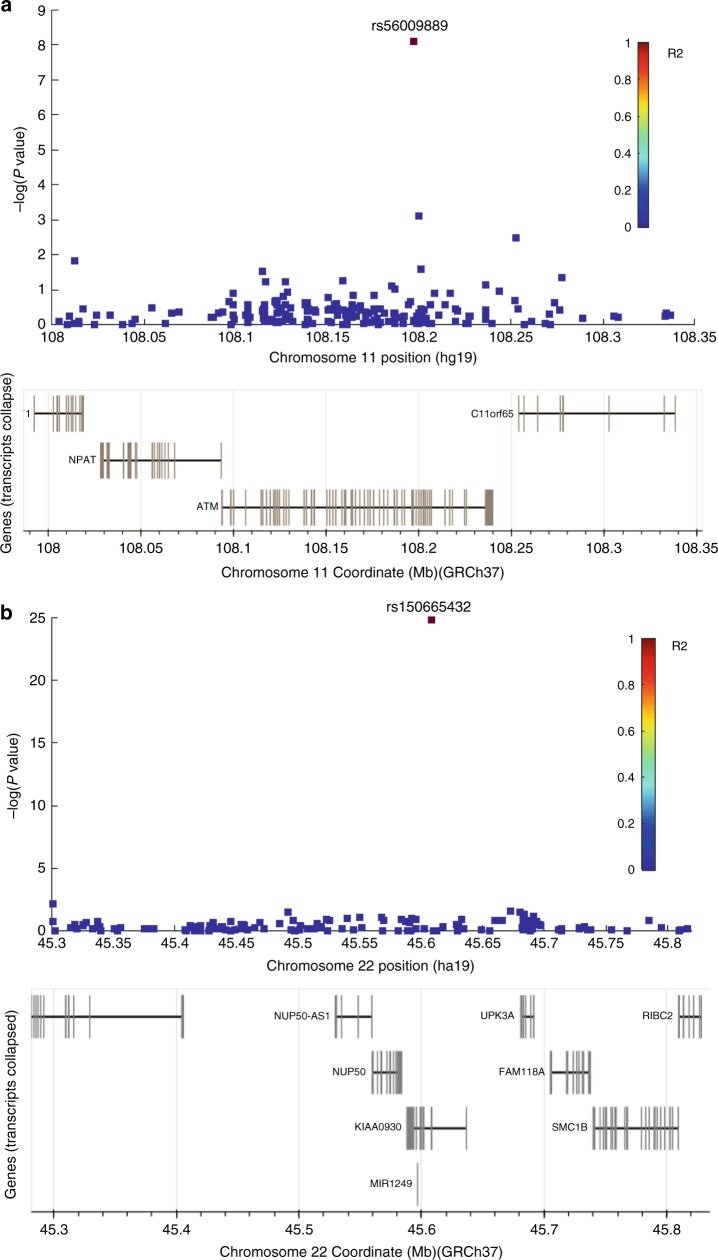
Fig. 1
Fig. 1. Regional lung cancer association plots for the ATM and KIAA0930 risk loci.
a ATM region for lung cancer risk. rs56009889, localizing to chromosome 11 and mapping within ATM, is not in linkage disequilibrium (LD) with any SNPs that have been identified before; b KIAA0930 region for lung cancer risk. rs150665432 localizes to chromosome 22 and maps within uncharacterized KIAA0930, which is not in LD with any SNPs that have been identified before. For each plot, −log10 P values (y-axis) of the SNPs are shown according to their chromosomal positions (x-axis). The top genotyped SNP in each analysis is labeled by its rs number. The color intensity of each symbol reflects the extent of LD with the top lung cancer-associated SNP in the discovery data: blue (r2 = 0) through to red (r2 = 1.0). Physical positions are based on NCBI build 37 of the human genome. The relative positions of genes are also shown. Source data are provided as a Source Data file (Source Data 1).
Fig. 2
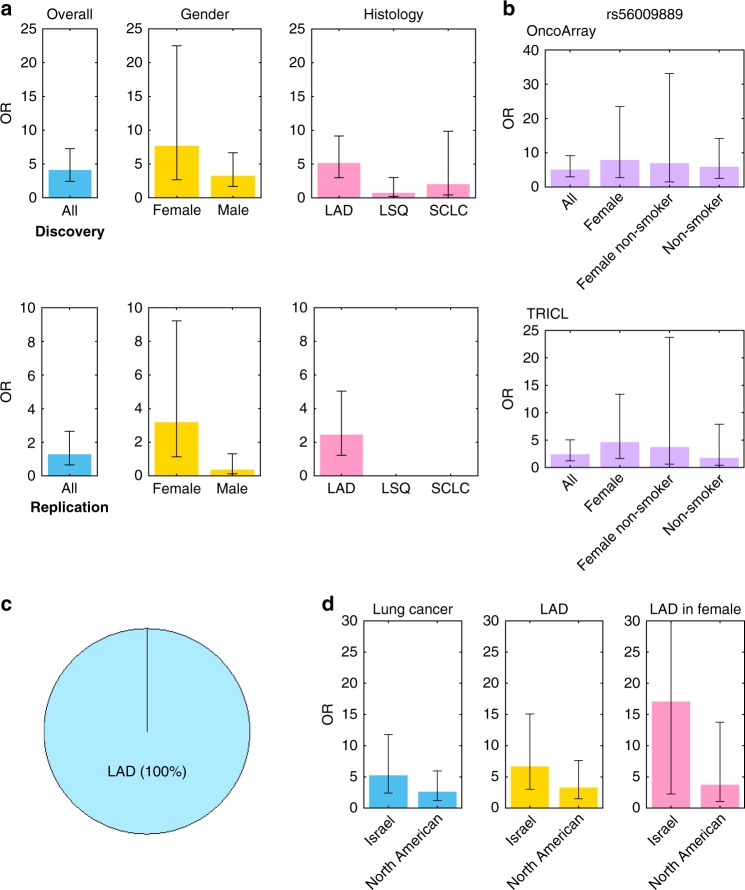
Fig. 2. ATM rs56009889 association with lung cancer risk.
P values were determined by logistic regression analysis adjusted by age, gender, smoking status and the principal components. a Stratified analyses of the association between rs56009889 and Lung cancer. Compared to non-carriers, L2307F carriers had an increased risk of lung cancer with ORs being 4.19 in the discovery data (P = 3.56 × 10−7, n = 28872) and 1.31 in the replication data (P = 0.45, n = 10256). In females, L2307F carriers had a lung cancer risk with ORs being 7.76 in the discovery data (P = 0.0002, n = 10919) and 3.22 in the replication data (P = 0.03, n = 4698). L2307F carriers had a significant 5.2-fold increased risk for lung adenocarcinoma (LAD) in the discovery data (P = 6.47 × 10−9, n = 19356) and a 2.5-fold increased risk in the replication data (P = 0.01, n = 7503). No associations of L2307F with the risk of lung squamous cell carcinoma (LSQ) (n = 16853) or small cell lung cancer (SCLC) (n = 14746) were observed in the discovery data. No L2307F variants were observed in LSQ or SCLC in the replication data. Colors indicate demographic and histological stratifications of the data. b Stratified analyses of the association between rs56009889 and LAD. Females who carried L2307F had a >8-fold greater risk of LAD in the discovery dataset (P = 0.0001, n = 8056) and a 4.7-fold risk of LAD in the replication data (P = 0.004, n = 3680). Never smoking females who harbored L2307F had a 7-fold greater risk of LAD in the discovery data (P = 0.01, n = 2817) and a 3.8-fold risk of LAD in the replication data (P = 0.15, n = 1212). c Distribution of L2307F homozygotes. All the homozygotes of L2307F in the discovery data, no matter what age, gender, and smoking status, developed LAD in the discovery data. No homozygotes were found in the replication data. d Higher ORs of association between rs56009889 and the risk of lung cancer, of LAD in overall and in females were found in Israeli (n = 1173) than in North Americas (n = 10858). All of the associations have reached significant. The upper 95% CI of the LAD risk in female in Israel (adjusted OR = 17.15; 95% CI 2.24–131.32, n = 373) was not shown because it was too high. Colors indicate stratifications of the data by histology and sex. The error bars are OR ± the 95% CI values. Source data are provided as a Source Data file.
Fig. 3
Fig. 3. KIAA0930 rs150665432 association with lung cancer risk.
a Stratified analyses of the association between KIAA0930 Q4X and lung cancer risk, shown by different colors. Compared to non-carriers, Q4X carriers had a significantly increased lung cancer risk with ORs being 2.59 in the discovery (P = 1.15 × 10−18, n = 27966) and 1.69 in the replication datasets (P = 0.03, n = 10248). Stratified analysis showed that Q4X carriers had an increased, consistent risk for lung cancer among females, males, smokers and non-smokers and consistent in histological subtypes. The error bars are OR ± the 95% CI values. P values were determined by logistic regression analysis adjusted by age, gender, smoking status and the principal components. Source data are provided as a Source Data file. b Distribution of KIAA0930 Q4X homozygotes. In the discovery data, all homozygotes of the mutated allele in rs150665432 were developed to lung cancer in the discovery data. Source data are provided as a Source Data file (Source Data 1, 2, and 3). Color shades indicate the histological subtypes.
Fig. 4
Fig. 4. The onset of lung cancer risk and biallelic two-hit events of ATM rs56009889.
a rs56009889 affects the age of onset. The error bars are mean + the standard error of the mean (SEM). In the discovery data, the mean age of onset for lung cancer cases carrying L2307F was significantly higher than cases of non-carriers. Later age of onset was observed for overall lung cancer (n = 15830), females (n = 5810), males (n = 10019), smokers (n = 14006), LAD (n = 6329) and females (n = 2954) with LAD. In the replication data, a borderline significant difference in the age of onset was observed only in females with LAD (n = 906) and non-smoker with LAD (n = 293) though the sample size is small. P values were determined by the two sides t test without adjustment. No carrier of the T allele developed LSQ and SCLC in the replication data. b the rate of loss of heterozygosity targeting either ATM L2306F allele or synonymous variants in ATM gene. Source data are provided as a Source Data file.
Fig. 5
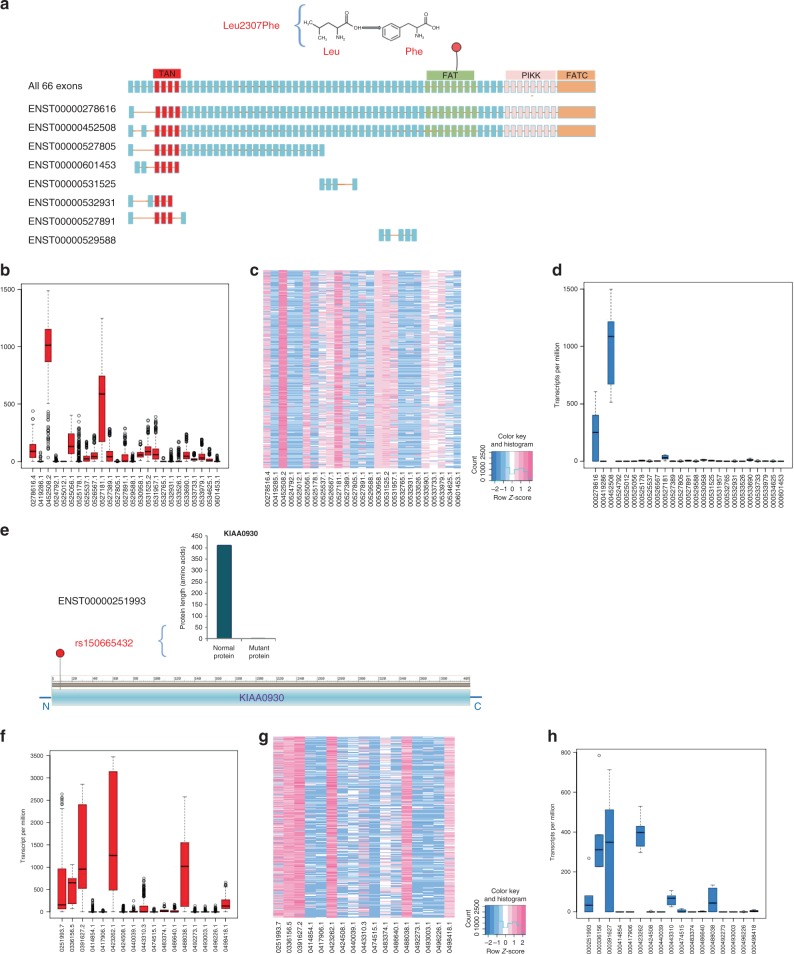
Fig. 5. ATM and KIAA0930 isoforms.
a ATM has eight isoforms that produce proteins with different length. ATM has four functional domains, including TAN domain which is used for telomere-length maintenance and DNA damage repair, FAT and FATC domains, which are important regulatory domains, and Phosphoinositide 3-kinase related kinase (PIKK), which is a catalytic domain that has intrinsic serine/threonine kinase activity. b ATM isoforms expression from GTEx data (n = 427). c A heatmap showing ATM isoforms expression from GTEx data. b ATM isoforms expression from Germany data (n = 6). e ENST00000251993 is the full-length and canonical isoform of KIAA0930. rs150665432 can truncate its protein length from 409 to 3 aa. f KIAA0930 isoforms expression from GTEx data (n = 427). g A heatmap showing KIAA0930 isoforms expression from GTEx data. h KIAA0930 isoforms expression from Germany data (n = 6). Boxplots in this figure were the visualization representing three quartiles (25%, median: 50%, and 75%) of the data set that are calculated using the percentile function, and the minimum and maximum values of the data set that are not outliers. Outliers are detected using the interquartile range method. Data points are labeled as outliers if they lie 1.5 times the interquartile range above or below the end points of that range.

References

    1. Siegel RL, Miller KD, Jemal A. Cancer Statistics, 2017. CA Cancer J. Clin. 2017;67:7–30. doi: 10.3322/caac.21387. - DOI - PubMed
    1. Mucci LA, et al. Familial risk and heritability of cancer among twins in Nordic countries. JAMA. 2016;315:68–76. doi: 10.1001/jama.2015.17703. - DOI - PMC - PubMed
    1. McKay JD, et al. Large-scale association analysis identifies new lung cancer susceptibility loci and heterogeneity in genetic susceptibility across histological subtypes. Nat. Genet. 2017;49:1126–1132. doi: 10.1038/ng.3892. - DOI - PMC - PubMed
    1. Roukos DH, Murray S, Briasoulis E. Molecular genetic tools shape a roadmap towards a more accurate prognostic prediction and personalized management of cancer. Cancer Biol. Ther. 2007;6:308–312. doi: 10.4161/cbt.6.3.3994. - DOI - PubMed
    1. Roukos DH. Genome-wide association studies: how predictable is a person’s cancer risk? Expert Rev. Anticancer Ther. 2009;9:389–392. doi: 10.1586/era.09.12. - DOI - PubMed

Publication types

MeSH terms

Substances

Grants and funding