


Impacts of social and economic factors on the transmission of coronavirus disease 2019 (COVID-19) in China
- PMID: 32395017
- PMCID: PMC7210464
- DOI: 10.1007/s00148-020-00778-2
Impacts of social and economic factors on the transmission of coronavirus disease 2019 (COVID-19) in China
Abstract
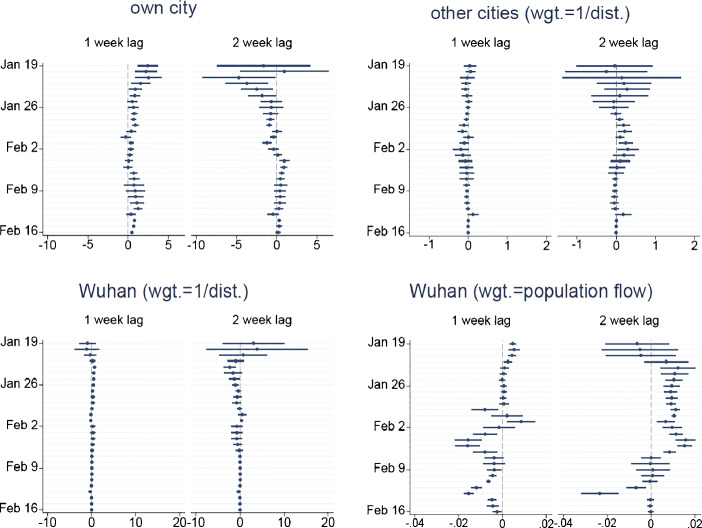
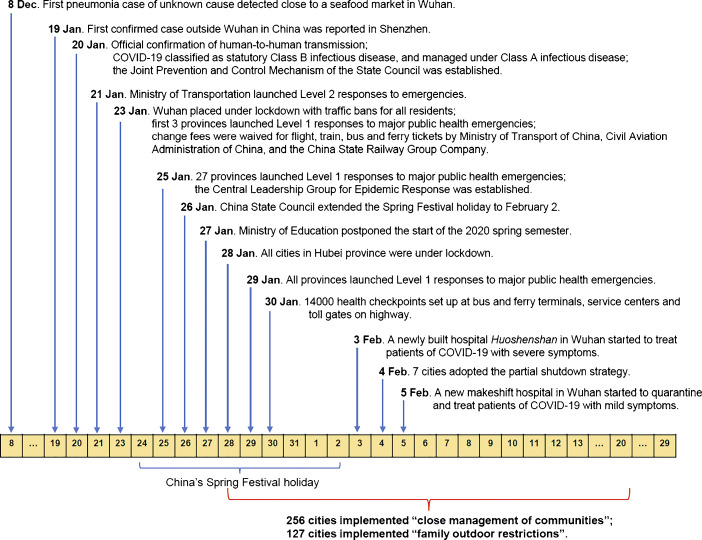
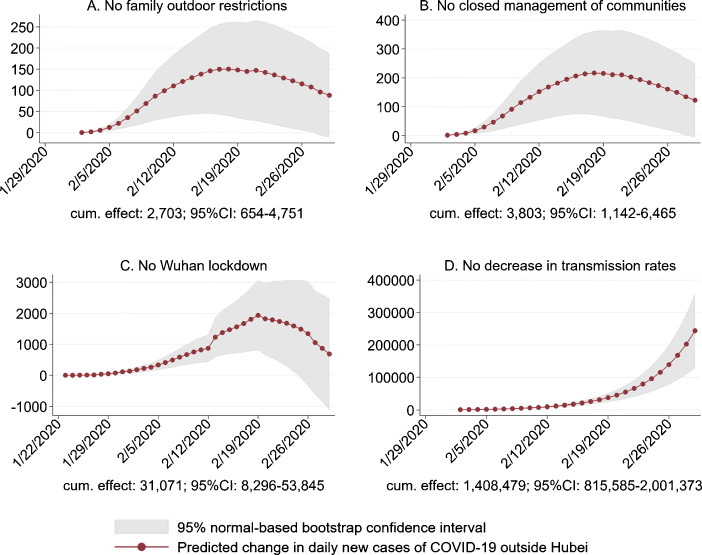
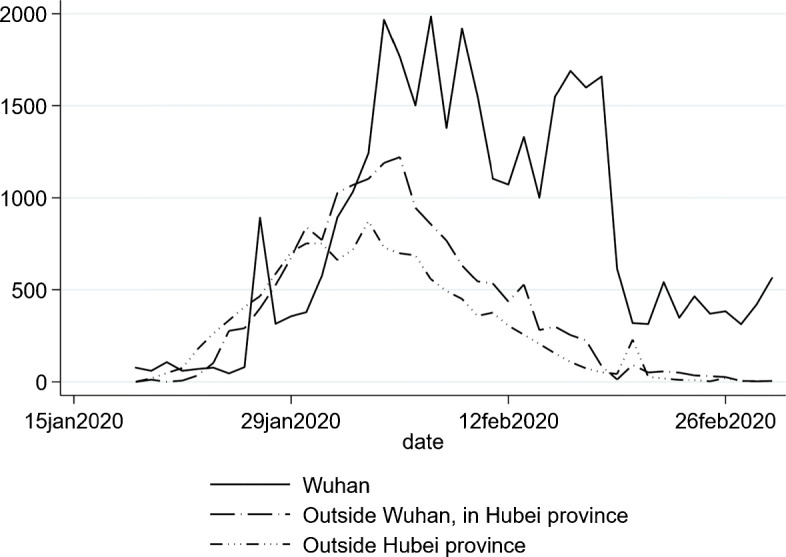
This study models local and cross-city transmissions of the novel coronavirus in China between January 19 and February 29, 2020. We examine the role of various socioeconomic mediating factors, including public health measures that encourage social distancing in local communities. Weather characteristics 2 weeks prior are used as instrumental variables for causal inference. Stringent quarantines, city lockdowns, and local public health measures imposed in late January significantly decreased the virus transmission rate. The virus spread was contained by the middle of February. Population outflow from the outbreak source region posed a higher risk to the destination regions than other factors, including geographic proximity and similarity in economic conditions. We quantify the effects of different public health measures in reducing the number of infections through counterfactual analyses. Over 1.4 million infections and 56,000 deaths may have been avoided as a result of the national and provincial public health measures imposed in late January in China.
Keywords: 2019 novel coronavirus; Quarantine; Transmission.
© The Author(s) 2020.
Conflict of interest statement
Conflict of interestsThe authors declare that they have no conflict of interest.
Figures
Update of
-
Impacts of Social and Economic Factors on the Transmission of Coronavirus Disease 2019 (COVID-19) in China.medRxiv [Preprint]. 2020 Mar 17:2020.03.13.20035238. doi: 10.1101/2020.03.13.20035238. medRxiv. 2020. Update in: J Popul Econ. 2020;33(4):1127-1172. doi: 10.1007/s00148-020-00778-2. PMID: 32511444 Free PMC article. Updated. Preprint.
References
-
- Adda J. Economic activity and the spread of viral diseases: evidence from high frequency data. Q J Econ. 2016;131(2):891–941. doi: 10.1093/qje/qjw005. - DOI
-
- Ahrens A, Hansen C, Schaffer ME (2019) lassopack: model selection and prediction with regularized regression in Stata, arXiv:1901.05397
-
- Belloni A, Chernozhukov V, Hansen C, Kozbur D. Inference in high-dimensional panel models with an application to gun control. J Bus Econ Stat. 2016;34:590–605. doi: 10.1080/07350015.2015.1102733. - DOI
-
- Chin Y-M, Wilson N. Disease risk and fertility: evidence from the HIV/AIDS pandemic. J Popul Econ. 2018;31:429–451. doi: 10.1007/s00148-017-0669-5. - DOI
Grants and funding
LinkOut - more resources
Full Text Sources