


Past, present, and future of palliative care in emergency medicine in the USA
- PMID: 32395248
- PMCID: PMC7204801
- DOI: 10.1002/ams2.497
Past, present, and future of palliative care in emergency medicine in the USA
Abstract
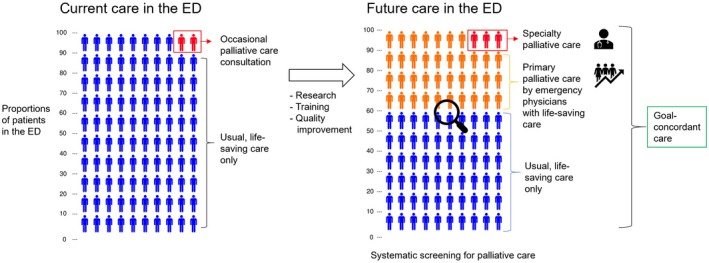
The emergency department (ED) provides immediate access to medical care for patients and families in times of need. Increasingly, older patients with serious illness seek care in the ED, hoping for relief from symptoms and suffering associated with advanced disease. Until recently, emergency medicine (EM) clinicians have been ill-equipped to meet the needs of patients with serious illness, and palliative services have been largely unavailable in the ED. However, in the past decade, there has been growing recognition from within both the EM and palliative medicine communities on the importance of palliative care provision in the ED. The past 10 years have seen a surge in EM-palliative care training and education, quality improvement projects, and research. As a result, the practice paradigm within EM for the seriously ill has begun to shift to incorporate more palliative care practices. Despite this progress, substantial work has yet to be done in terms of identifying ED patients in need of palliative care, training EM clinicians to provide high-quality primary palliative care, creating pathways for ED referral to palliative care and hospice, and researching the outcomes and impact of palliative care provision on patients with serious illness in the ED.
Keywords: Emergency medicine; geriatrics; palliative care.
© 2020 The Authors. Acute Medicine & Surgery published by John Wiley & Sons Australia, Ltd on behalf of Japanese Association for Acute Medicine.
Conflict of interest statement
Approval of the research protocol: N/A. Informed consent: N/A. Registry and registration no. of the study/trial: N/A. Animal studies: N/A. Conflicts of interest: None.
Figures
References
-
- Chronic Disease Overview. 2009; http://www.cdc.gov/nccdphp/overview.htm. Accessed 8/7, 2017.
-
- Murray CJ, Lopez AD. Mortality by cause for eight regions of the world: global burden of disease study. Lancet 1997; 349: 1269–76. - PubMed
-
- Chronic Care: Making the case for ongoing care. 2010; https://www.rwjf.org/content/dam/farm/reports/reports/2010/. Accessed 12/1, 2018.
-
- Pitts SR, Niska RW, Xu J, Burt CW. National hospital ambulatory medical care survey: 2006 emergency department summary. Natl. Health Stat. Report 2008; 7: 1–38. - PubMed
-
- Wilper AP, Woolhandler S, Lasser KE et al Waits to see an emergency department physician: U.S. trends and predictors, 1997–2004. Health Aff. (Millwood) 2008; 27: w84–95. - PubMed
Publication types
LinkOut - more resources
Full Text Sources
Medical
Miscellaneous
