. 2020 Apr;12(4):1437-1448.
doi: 10.21037/jtd.2020.03.10.

Endovascular treatment for aortic arch pathologies: chimney, on-the-table fenestration, and in-situ fenestration techniques

Affiliations

Endovascular treatment for aortic arch pathologies: chimney, on-the-table fenestration, and in-situ fenestration techniques

Chang Shu et al. J Thorac Dis. 2020 Apr.

Abstract

Background: Revascularization of the supra-aortic major branches in thoracic endovascular aortic repair (TEVAR) is challenging owing to the complex anatomic configuration of aortic arch pathologies. This study aims to evaluate the feasibility, effectiveness, and safety of three major techniques-chimney, fenestrated, and in-situ fenestration-for patients with aortic arch pathologies.

Methods: A retrospective analysis was performed involving 234 patients with aortic arch lesions, who underwent TEVAR with adaptations in technique (chimney, fenestrated, or in-situ fenestration) between January 2016 and December 2017.

Results: One hundred and twenty-six patients underwent the chimney technique (98 single chimneys, 24 double chimneys, and four triple chimneys); one hundred and two patients (102/234) were treated with on-the-table fenestration technique (92 single fenestrations, nine double fenestrations, and one double fenestration plus innominate artery chimney); and the remaining six patients underwent in-situ needle fenestration technique. Overall, indications included aortic dissections (99/234), aortic arch aneurysms (60/234), penetrating aortic ulcers (72/234), and re-interventions (3/234). The technical success rates were 99.6%. There were five cases of early all-cause mortality. The patency rates of overall branches were 99.6%. There were 15 cases with type Ia endoleak-14 in the chimney group (11.1%) and one in the on-the-table fenestration group (1%). Five patients underwent re-interventions. The median follow-up time for all patients was 28 (range, 16-41) months.

Conclusions: Our experience suggests that chimney, on-the-table fenestration, and in-situ needle fenestration techniques are feasible, effective, and safe treatment options for aortic arch pathologies with encouraging mid-term results. Long-term durability concerns require further evaluation.

Keywords: Endovascular procedure; aneurysm; aortic diseases; dissecting.


Conflict of interest statement

Conflicts of Interest: The authors have no conflicts of interest to declare.

Figures
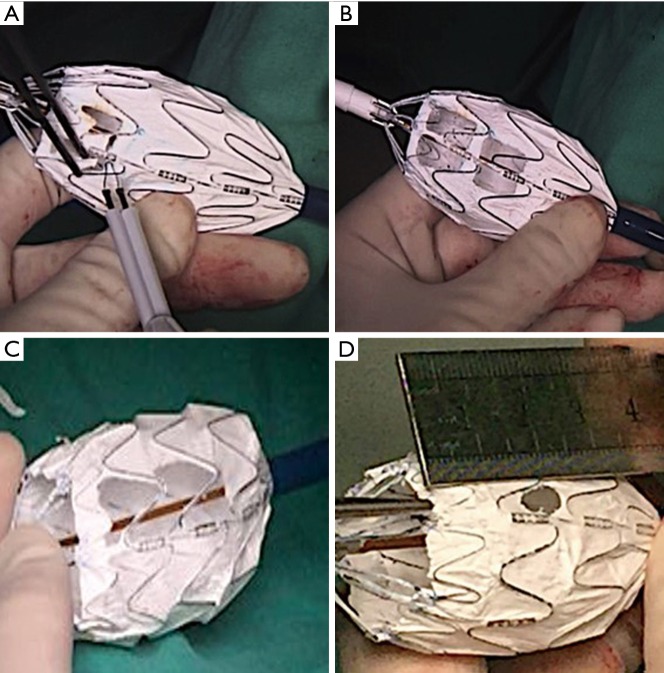
Figure 1
Figure 1
Fenestrations modified by surgeons. (A) The Ankura thoracic stent-graft was partially unsheathed, measured, and fashioned using a laser scalpel alongside the spiral support strut of the aortic stent-graft; (B) a double fenestration was created for both the LSA and LCCA; (C) a large fenestration was made for preserving the left subclavian artery (LSA); (D) a small fenestration was made to align with the LSA to prevent from endoleaks.
Figure 2
Figure 2
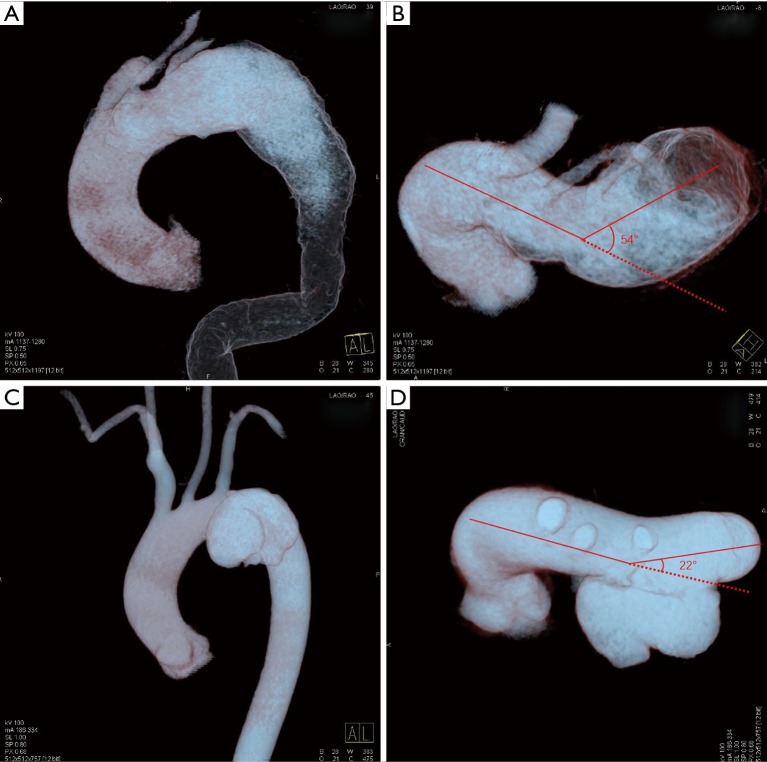
Morphology of the aortic arch. (A,B) The vertical and horizontal 3D fusion image of a patient with aortic arch aneurysm. Red lines showed an angle of 54 degrees between the aortic arch and the descending aorta. For this hostile aortic arch angulation, chimney technique would be selected. (C,D) The vertical and horizontal 3D fusion image of another patient with aortic arch aneurysm. Red lines showed an angle of 22 degrees. This less angulated aortic arch allows planning of on-the-table fenestration technique.
Figure 3
Figure 3
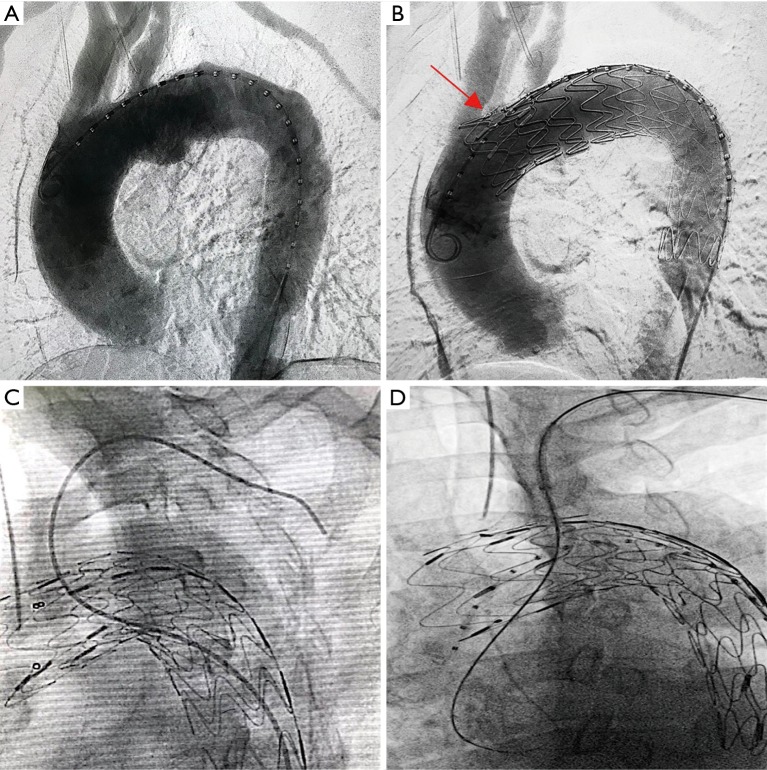
Procedures of on-the-table fenestration technique. (A) DSA showed a penetrating aortic ulcer (PAU) involving both the LSA and LCCA. (B) The fenestrated stent-graft was oriented towards both the LSA and LCCA, ensuring the eight-shaped radiopaque marker (red arrow) and the spiral support strut align with two target vessels. Completion DSA showed isolation of the PAU while patency of all branches. (C) Antegrade route for endografts delivery from the common femoral artery. (D) Retrograde route for endografts delivery from the brachial artery.
Figure 4
Figure 4
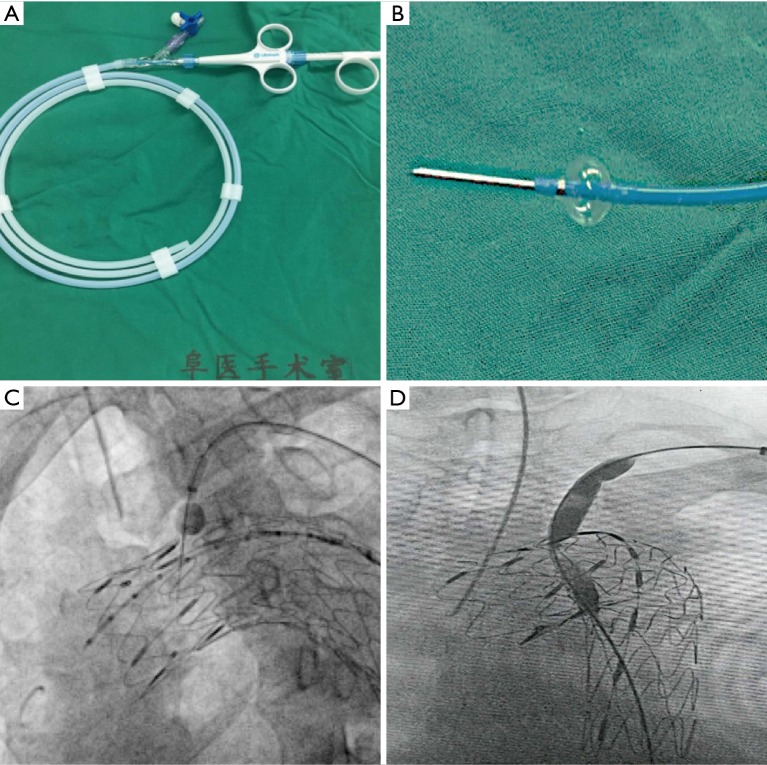
In-situ needle fenestration technique. (A) The balloon expandable puncture needle. (B) The puncture needle activates when inflating the balloon. (C) An in-situ fenestration was created by the puncture needle, and a wire was advanced to the aortic lumen. (D) A balloon catheter of comparable size was used to expand the fenestration.
Figure 5
Figure 5
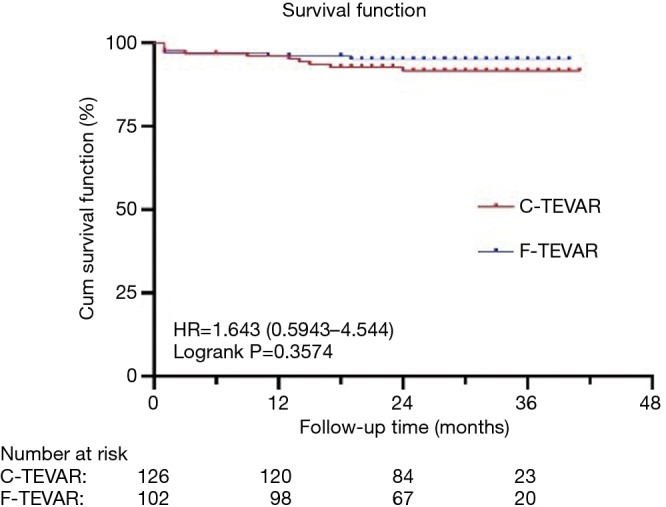
Kaplan-Meier estimates of overall survival.

References

    1. De Rango P, Ferrer C, Coscarella C, et al. Contemporary comparison of aortic arch repair by endovascular and open surgical reconstructions. J Vasc Surg 2015;61:339-46. 10.1016/j.jvs.2014.09.006 - DOI - PubMed
    1. Moulakakis KG, Mylonas SN, Markatis F, et al. A systematic review and meta-analysis of hybrid aortic arch replacement. Ann Cardiothorac Surg 2013;2:247-60. - PMC - PubMed
    1. Mastracci TM, Eagleton MJ, Kuramochi Y, et al. Twelve-year results of fenestrated endografts for juxtarenal and group IV thoracoabdominal aneurysms. J Vasc Surg 2015;61:355-64. 10.1016/j.jvs.2014.09.068 - DOI - PubMed
    1. Lindblad B, Bin Jabr A, Holst J, et al. Chimney Grafts in Aortic Stent Grafting: Hazardous or Useful Technique? Systematic Review of Current Data. Eur J Vasc Endovasc Surg 2015;50:722-31. 10.1016/j.ejvs.2015.07.038 - DOI - PubMed
    1. Canaud L, Baba T, Gandet T, et al. Physician-Modified Thoracic Stent-Grafts for the Treatment of Aortic Arch Lesions. J Endovasc Ther 2017;24:542-48. 10.1177/1526602817714206 - DOI - PubMed