


The potential of wastewater-based epidemiology as surveillance and early warning of infectious disease outbreaks
- PMID: 32395676
- PMCID: PMC7212976
- DOI: 10.1016/j.coesh.2020.04.006
The potential of wastewater-based epidemiology as surveillance and early warning of infectious disease outbreaks
Abstract
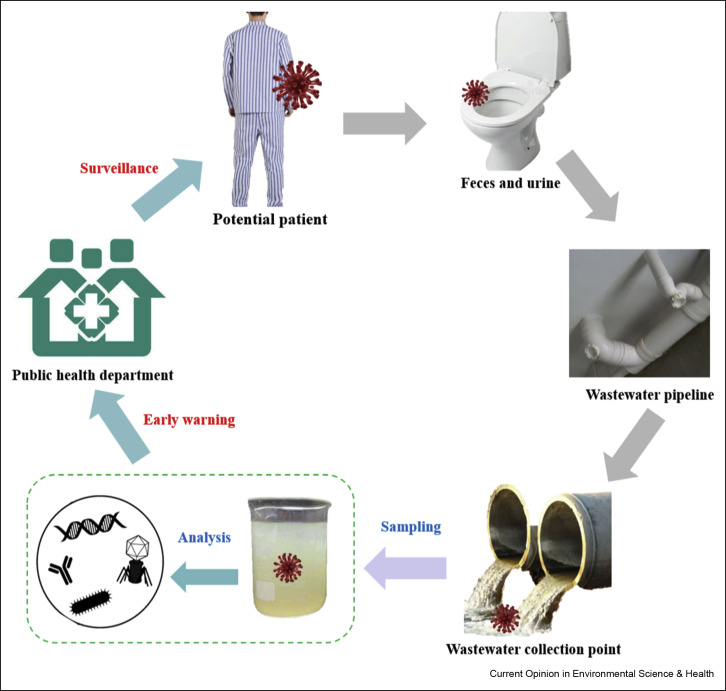
Infectious diseases caused by pathogens have become one of the main threats to public health. Efficient monitoring of infectious disease transmission is critical to prevent and manage infectious disease epidemics. Wastewater-based epidemiology (WBE) is an efficient approach with great potential for early warning of infectious disease transmission and outbreaks. By analyzing infectious disease biomarkers in wastewater taken from wastewater collection points, the transmission of infectious diseases in certain areas can be comprehensively monitored in near real time. This short review presents WBE as a surveillance and early warning system for infectious disease outbreaks regarding pathogens with pandemic potential. We also discuss the challenges and perspective of WBE in infectious disease surveillance and early warning.
Keywords: Early warning; Infectious disease; Pathogen; Wastewater-based epidemiology.
© 2020 Elsevier B.V. All rights reserved.
Conflict of interest statement
Nothing declared.
Figures
References
-
- Wigginton K.R., Boehm A.B. Environmental engineers and scientists have important roles to play in stemming outbreaks and pandemics caused by enveloped viruses. Environ Sci Technol. 2020;54:3736–3739. - PubMed
-
- Qu G., Li X., Hu L., Jiang G. An imperative need for research on the role of environmental factors in transmission of novel coronavirus (COVID-19) Environ Sci Technol. 2020;54:3730–3732. - PubMed
-
∗∗This paper proposes that the role of environmental factors in the spread of COVID-19 cannot be ignored, and strongly calls on scientists in the environmental field to pay attention to the research on the environmental transmissions of COVID-19. This is the first study to put an empahsis on environmental factors in transmission of COVID-19.
-
- Gracia-Lor E., Rousis N.I., Hernández F., Zuccato E., Castiglioni S. Wastewater-based epidemiology as a novel biomonitoring tool to evaluate human exposure to pollutants. Environ Sci Technol. 2018;52:10224–10226. - PubMed
Publication types
LinkOut - more resources
Full Text Sources