. 2020 May;16(5):20200097.
doi: 10.1098/rsbl.2020.0097. Epub 2020 May 13.

Teenage dogs? Evidence for adolescent-phase conflict behaviour and an association between attachment to humans and pubertal timing in the domestic dog

Affiliations

Teenage dogs? Evidence for adolescent-phase conflict behaviour and an association between attachment to humans and pubertal timing in the domestic dog

Lucy Asher et al. Biol Lett. 2020 May.

Abstract

The relationship between parent and child changes around adolescence, with children believed to have: (i) an earlier puberty if they have less secure attachments to their carer; (ii) a phase of increased conflict behaviour toward their carer; and (iii) heightened conflict behaviour when carer attachments are less secure. We find support for analogous associations in adolescent dogs based on behaviour and reproductive timing of potential guide dogs. Bitches with behaviour indicative of insecure attachments pre-adolescence became reproductively capable earlier. Providing the first empirical evidence to our knowledge in support of adolescent-phase behaviour in dogs, we found a passing phase of carer-specific conflict-like behaviour during adolescence (reduced trainability and responsiveness to commands), an effect that was more pronounced in dogs with behaviour indicative of less secure attachments. These results indicate a possibility for cross-species influence on reproductive development and highlight adolescence as a vulnerable time for dog-owner relationships.

Keywords: adolescence; attachment; dog; human–animal interaction; puberty; sensitive period.


Conflict of interest statement

We declare we have no competing interests.

Figures
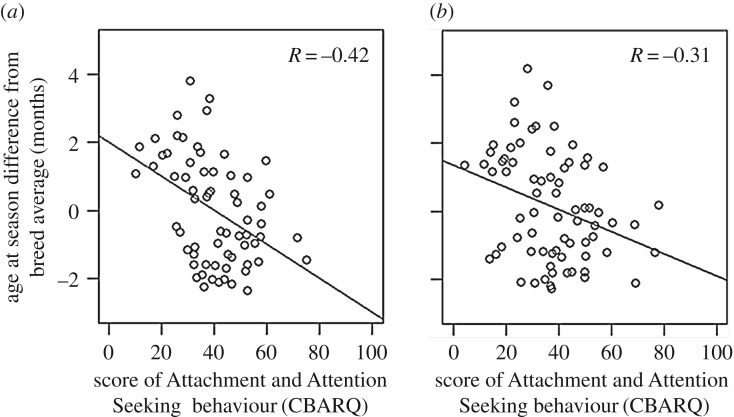
Figure 1.
Figure 1.
The negative association between insecure attachment behaviour measured by carers at 5 months and puberty end (first proestrus) relative to breed norm, based on: (a) partial correlation controlling for confounds of shared parentage and diet type; (b) correlation with no control for confounds. Attachment and Attention Seeking was scored on a 100 mm visual analogue scale, with a higher score indicating an insecure attachment.
Figure 2.
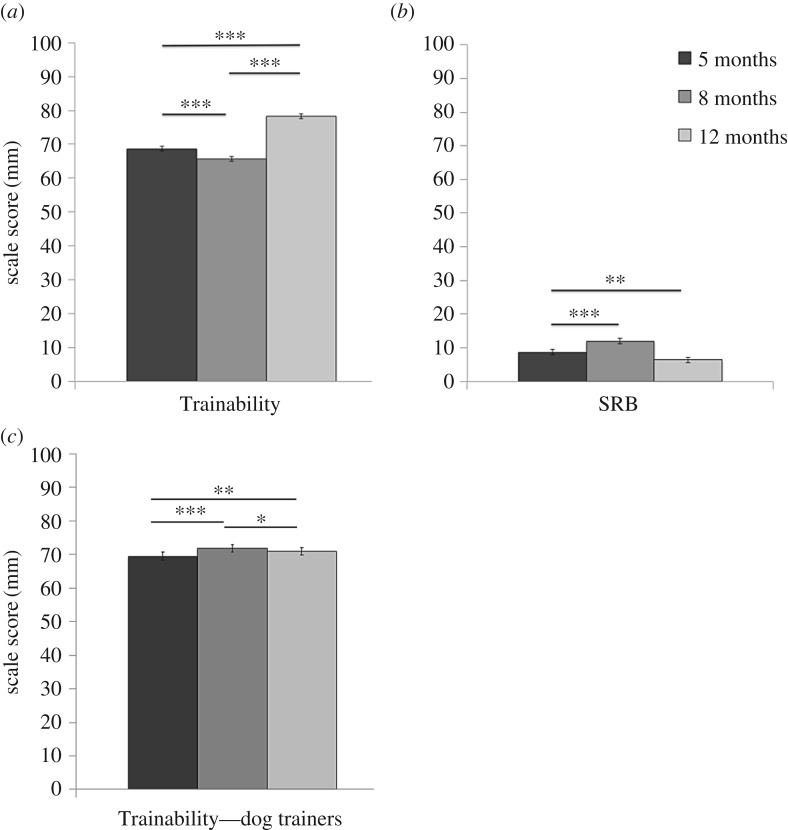
Figure 2.
Scores for (a) Trainability (higher is more ‘trainable’) and (b) Separation-Related Behaviour (SRB, from C-BARQ where higher scores indicate more Separation-Related Behaviour displayed), as scored by dog carers (puppy walkers) when dogs were aged 5, 8 and 12 months. Scores for (c) Trainability when scored by the dogs' training supervisors when dogs were aged 5, 8 and 12 months. *p < 0.05, **p < 0.01, ***p < 0.001. Error bars represent s.e. of ±1.

References

    1. Romero T, Nagasawa M, Mogi K, Hasegawa T, Kikusui T. 2014. Oxytocin promotes social bonding in dogs. Proc. Natl Acad. Sci. USA 111, 9085–9090. ( 10.1073/pnas.1322868111) - DOI - PMC - PubMed
    1. Nagasawa M, Mitsui S, En S, Ohtani N, Ohta M, Sakuma Y, Onaka T, Mogi K, Kikusui T. 2015. Oxytocin-gaze positive loop and the coevolution of human–dog bonds. Science 348, 333–336. ( 10.1126/science.1261022) - DOI - PubMed
    1. Sisk CL, Zehr JL. 2005. Pubertal hormones organize the adolescent brain and behavior. Front. Neuroendocrinol. 26, 163–174. ( 10.1016/j.yfrne.2005.10.003) - DOI - PubMed
    1. Sisk CL, Foster DL. 2004. The neural basis of puberty and adolescence. Nat. Neurosci. 7, 1040–1047. ( 10.1038/nn1326) - DOI - PubMed
    1. Buchanan CM, Eccles JS, Becker JB. 1992. Are adolescents the victims of raging hormones: evidence for activational effects of hormones on moods and behavior at adolescence. Psychol. Bull. 111, 62–107. ( 10.1037/0033-2909.111.1.62) - DOI - PubMed

Publication types