


Saliva-Friend and Foe in the COVID-19 Outbreak
- PMID: 32397487
- PMCID: PMC7277967
- DOI: 10.3390/diagnostics10050290
Saliva-Friend and Foe in the COVID-19 Outbreak
Abstract
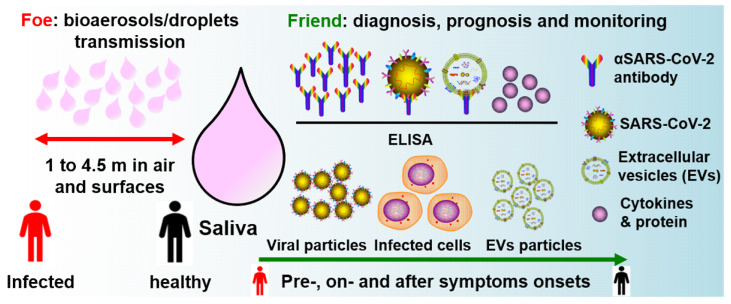
The coronavirus disease 2019 (COVID-19) outbreak, caused by the novel severe acute respiratory syndrome coronavirus 2 (SARS-CoV-2), has become a global ongoing pandemic. Timely, accurate and non-invasive SARS-CoV-2 detection in both symptomatic and asymptomatic patients, as well as determination of their immune status, will facilitate effective large-scale pandemic control measures to prevent the spread of COVID-19. Saliva is a biofluid whose anatomical source and location is of particularly strategic relevance to COVID-19 transmission and monitoring. This review focuses on the role of saliva as both a foe (a common mode of viral transmission via salivary droplets and potentially aerosols) and a friend (as a non-invasive diagnostic tool for viral detection and immune status surveillance) in combating COVID-19.
Keywords: COVID-19; salivary bioaerosols transmission; salivary diagnostics.
Conflict of interest statement
The authors declare no conflict of interest.
Figures
References
-
- WHO [(accessed on 31 January 2020)]; Available online: http://www.euro.who.int/en/health-topics/health-emergencies/internationa....
-
- WHO [(accessed on 21 April 2020)]; Available online: https://www.who.int/emergencies/diseases/novel-coronavirus-2019/situatio...
-
- Coronavirus COVID-19 Global Cases by the Center for Systems Science and Engineering (CSSE) at Johns Hopkins University (JHU). ArcGIS. Johns Hopkins CSSE. [(accessed on 6 April 2020)]; Available online: https://coronavirus.jhu.edu/map.html.
-
- Max Roser H.R.A.E.O.-O. Coronavirus Disease (COVID-19)–Statistics and Research. Published online at OurWorldInData.org. [(accessed on 21 April 2020)]; Available online: https://ourworldindata.org/coronavirus.
-
- Hui D.S., Azhar E.E., Madani T.A., Ntoumi F., Kock R., Dar O., Ippolito G., McHugh T.D., Memish Z.A., Drosten C., et al. The continuing 2019-nCoV epidemic threat of novel coronaviruses to global health—The latest 2019 novel coronavirus outbreak in Wuhan, China. Int. J. Infect. Dis. 2020;91:264–266. doi: 10.1016/j.ijid.2020.01.009. - DOI - PMC - PubMed
Publication types
LinkOut - more resources
Full Text Sources
Miscellaneous
