


Screening, Identification and Efficacy Evaluation of Antagonistic Bacteria for Biocontrol of Soft Rot Disease Caused by Dickeya zeae
- PMID: 32397545
- PMCID: PMC7285164
- DOI: 10.3390/microorganisms8050697
Screening, Identification and Efficacy Evaluation of Antagonistic Bacteria for Biocontrol of Soft Rot Disease Caused by Dickeya zeae
Abstract
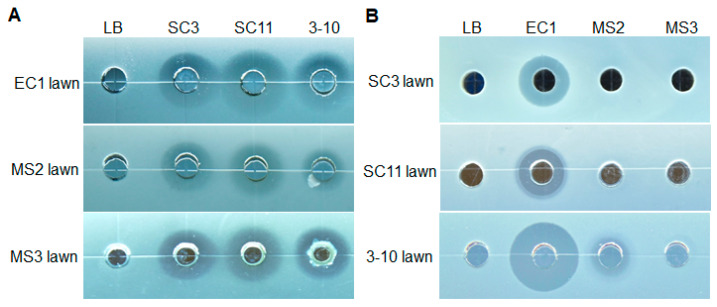
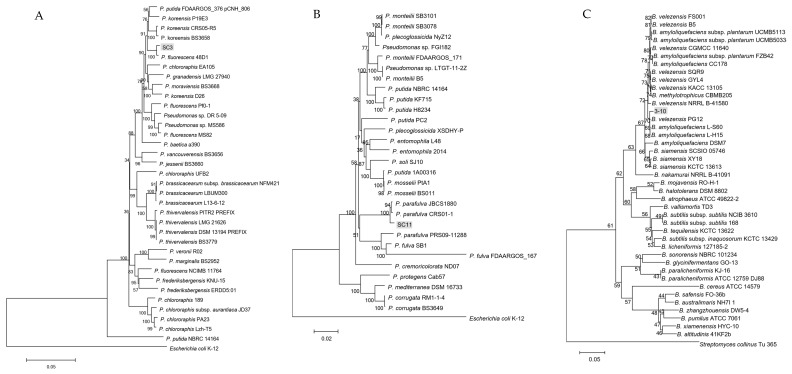
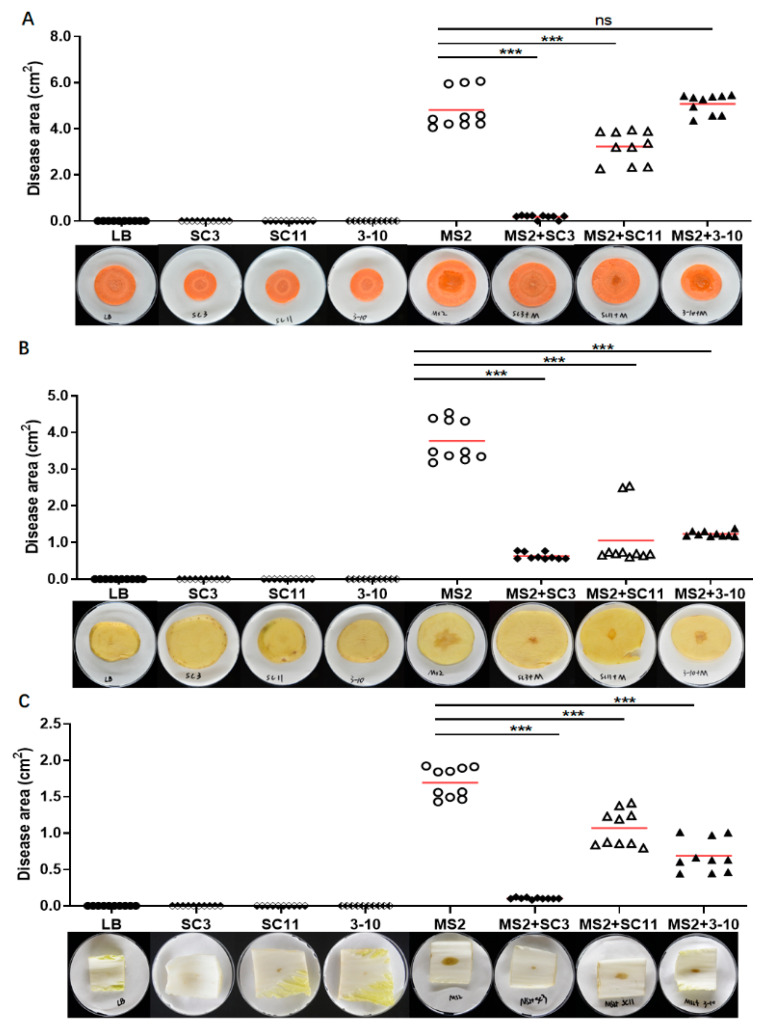
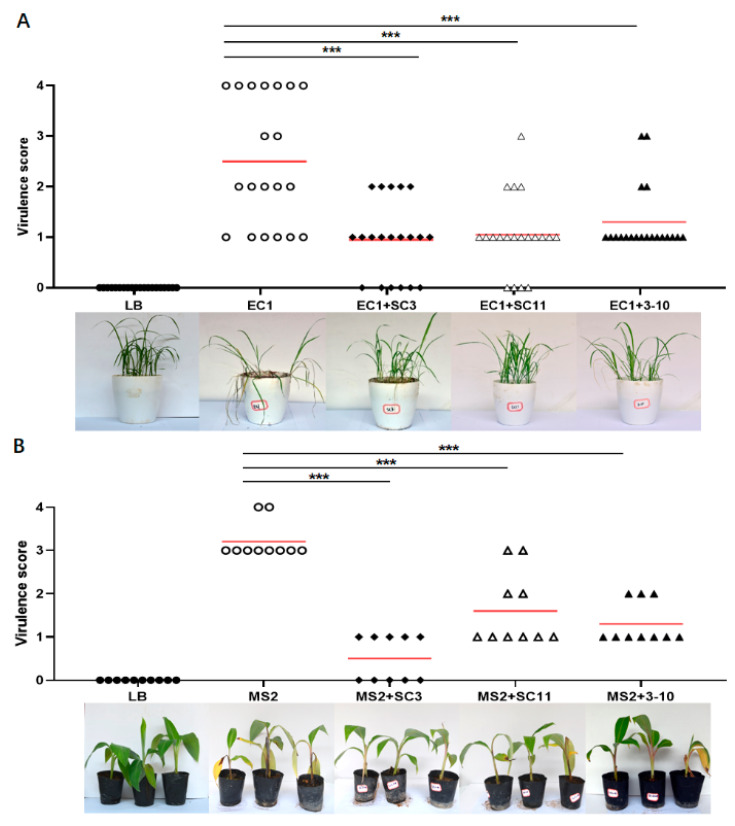
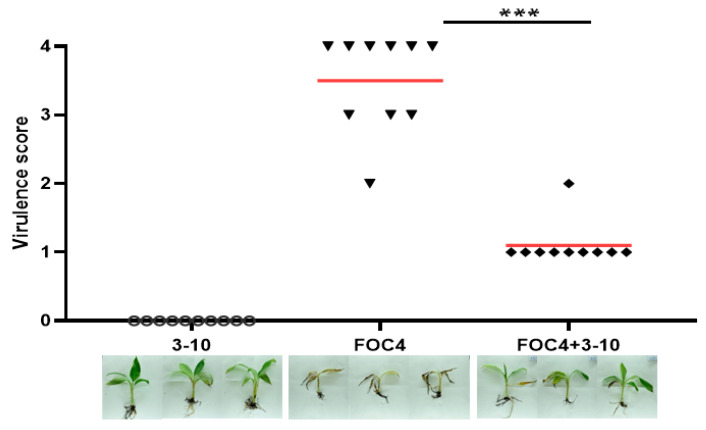
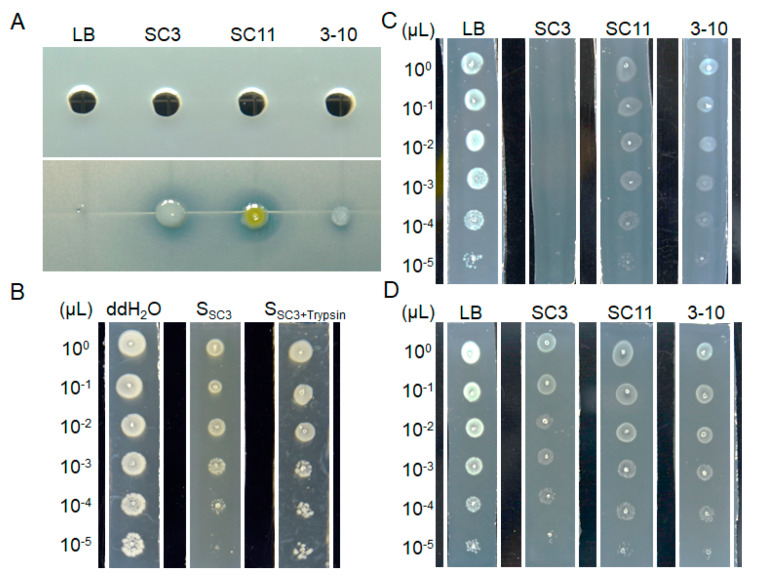
Dickeya zeae is the causal agent of bacterial soft rot disease, with a wide range of hosts all over the world. At present, chemical agents, especially agricultural antibiotics, are commonly used in the prevention and control of bacterial soft rot, causing the emergence of resistant pathogens and therefore increasing the difficulty of disease prevention and control. This study aims to provide a safer and more effective biocontrol method for soft rot disease caused by D. zeae. The spot-on-lawn assay was used to screen antagonistic bacteria, and three strains including SC3, SC11 and 3-10 revealed strong antagonistic effects and were identified as Pseudomonas fluorescens, P. parafulva and Bacillus velezensis, respectively, using multi-locus sequence analysis (MLSA) based on the sequences of 16S rRNA and other housekeeping genes. In vitro antimicrobial activity showed that two Pseudomonas strains SC3 and SC11 were only antagonistic to some pathogenic bacteria, while strain 3-10 had broad-spectrum antimicrobial activity on both pathogenic bacteria and fungi. Evaluation of control efficacy in greenhouse trials showed that they all restrained the occurrence and development of soft rot disease caused by D. zeae MS2 or EC1. Among them, strain SC3 had the most impressive biocontrol efficacy on alleviating the soft rot symptoms on both monocotyledonous and dicotyledonous hosts, and strain 3-10 additionally reduced the occurrence of banana wilt disease caused by Fusarium oxysporum f. sp. cubensis. This is the first report of P. fluorescens, P. parafulva and B. velezensis as potential bio-reagents on controlling soft rot disease caused by D. zeae.
Keywords: antagonistic bacterial screening; determination of biocontrol effect; species identification.
Conflict of interest statement
The authors declare no conflict of interest.
Figures
References
-
- Samson R.G., Legendre J.B., Christen R., Saux M.F., Achouak W., Gardan L. Transfer of Pectobacterium chrysanthemi (Burkholder et al. 1953) Brenner et al. 1973 and Brenneria paradisiaca to the genus Dickeya gen. nov. as Dickeya chrysanthemi comb. nov. and Dickeya paradisiaca comb. nov. and delineation of four novel species, Dickeya dadantii sp. nov., Dickeya dianthicola sp. nov., Dickeya dieffenbachiae sp. nov. and Dickeya zeae sp. nov. Int. J. Syst. Evol. Microbiol. 2005;55:1415–1427. - PubMed
-
- Goto M. Bacterial Foot Rot of Rice Caused by a Strain of Erwinia chrysanthemi. Phytopathology. 1979;69:213–216. doi: 10.1094/Phyto-69-213. - DOI
-
- Liu Q.G., Wang Z.Z. Infection characteristics of Erwinia chrysanthemi pv. zeae on rice. J. South China Agric. Univ. 2004;25:55–57.
-
- Kumar A., Hunjan M.S., Kaur H., Dhillon H.K., Singh P.P. Biochemical responses associated with resistance to bacterial stalk rot caused by Dickeya zeae in maize. J. Phytopathol. 2017;165:822–832. doi: 10.1111/jph.12622. - DOI
Grants and funding
- 31972230/National Natural Science Foundation of China
- 2018B020205003/Key Realm of R&D Program of Guangdong Province
- 2020A1515011534/Natural Science Foundation of Guangdong Province, China
- SKLCUSA-b201908/State Key Laboratory for Conservation and Utilization of Subtropical Agro-bioresources
- 2017A010105009/Science and Technology Planning Project of Guangdong Province
LinkOut - more resources
Full Text Sources
Other Literature Sources
