


Sugar-Sweetened Beverage Intake and Cardiovascular Disease Risk in the California Teachers Study
- PMID: 32397792
- PMCID: PMC7660873
- DOI: 10.1161/JAHA.119.014883
Sugar-Sweetened Beverage Intake and Cardiovascular Disease Risk in the California Teachers Study
Abstract
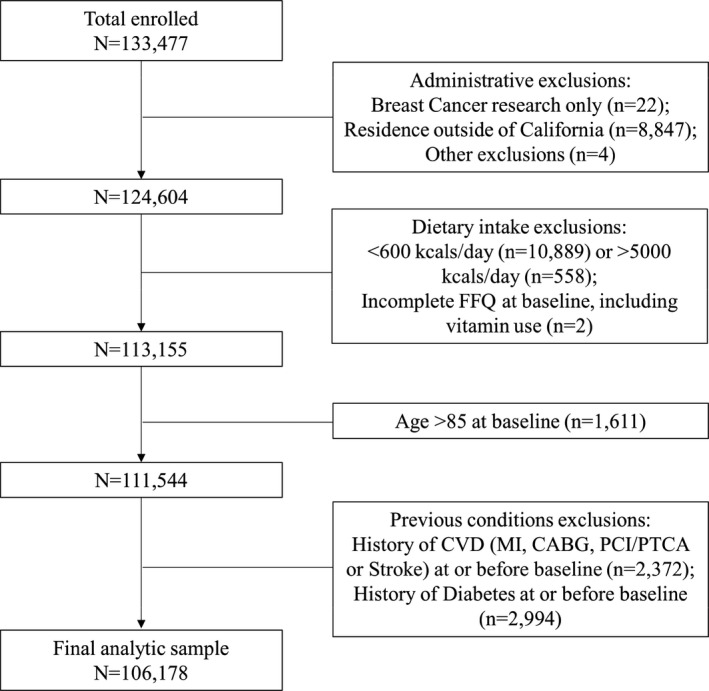
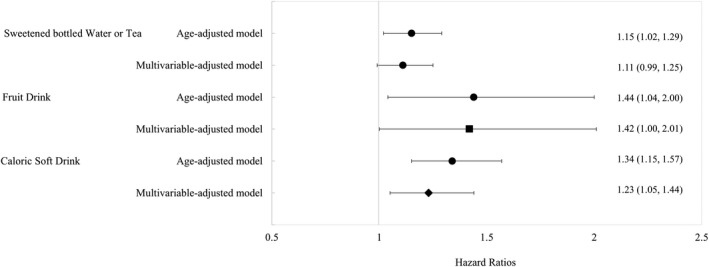
Background Sugar-sweetened beverage (SSB) consumption has been associated with cardiometabolic risk. However, the association between total and type of SSB intake and incident cardiovascular disease (CVD) end points such as myocardial infarction, stroke, and revascularization is limited. Methods and Results We examined the prospective association of baseline SSB consumption with incident CVD in 106 178 women free from CVD and diabetes mellitus in the CTS (California Teachers Study), a cohort of female teachers and administrators, followed since 1995. SSBs were defined as caloric soft drinks, sweetened bottled waters or teas, and fruit drinks, and derived from a self-administered food frequency questionnaire. CVD end points were based on annual linkage with statewide inpatient hospitalization records. Cox proportional hazards models were used to assess the association between SSB consumption and incident CVD. A total of 8848 CVD incident cases were documented over 20 years of follow-up. After adjusting for potential confounders, we observed higher hazard ratios (HRs) for CVD (HR, 1.19; 95% CI, 1.06-1.34), revascularization (HR, 1.26; 95% CI, 1.04-1.54]), and stroke (HR, 1.21; 95% CI, 1.04-1.41) in women who consumed ≥1 serving per day of SSBs compared with rare/never consumers. We also observed a higher risk of CVD in women who consumed ≥1 serving per day of fruit drinks (HR, 1.42; 95% CI, 1.00-2.01 [P trend=0.021]) and caloric soft drinks (HR, 1.23; 95% CI, 1.05-1.44 [P trend=0.0002]), compared with rare/never consumers. Conclusions Consuming ≥1 serving per day of SSB was associated with CVD, revascularization, and stroke. SSB intake might be a modifiable dietary target to reduce risk of CVD among women.
Keywords: cardiovascular disease; nutritional epidemiology; observational study; sugar‐sweetened beverages.
Figures
References
-
- U.S. Department of Health and Human Services and U.S. Department of Agriculture . 2015–2020 Dietary Guidelines for Americans. 2015. Available at: http://health.gov/dietaryguidelines/2015/guidelines/. Accessed February 7, 2019.
-
- Johnson RK, Appel LJ, Brands M, Howard BV, Lefevre M, Lustig RH, Sacks F, Steffen LM, Wylie‐Rosett J. Dietary sugars intake and cardiovascular health. Circulation. 2009;120:1011–1020. - PubMed
-
- World Health Organization . Guideline: Sugars Intake for Adults and Children. Geneva: Switzerland; 2015. - PubMed
-
- Lloyd‐Jones DM, Hong Y, Labarthe D, Mozaffarian D, Appel LJ, Van Horn L, Greenlund K, Daniels S, Nichol G, Tomaselli GF, et al. Defining and setting national goals for cardiovascular health promotion and disease reduction: the American Heart Association's Strategic Impact Goal through 2020 and beyond. Circulation. 2010;121:586–613. - PubMed
Publication types
MeSH terms
Grants and funding
LinkOut - more resources
Full Text Sources
Research Materials
