


Using X-ray images and deep learning for automated detection of coronavirus disease
- PMID: 32397844
- PMCID: PMC7256347
- DOI: 10.1080/07391102.2020.1767212
Using X-ray images and deep learning for automated detection of coronavirus disease
Abstract
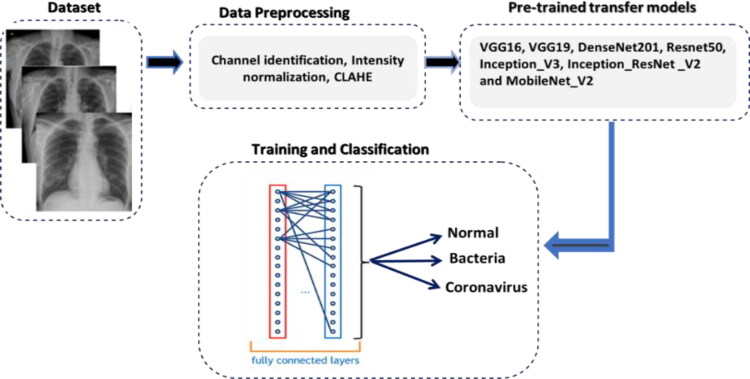
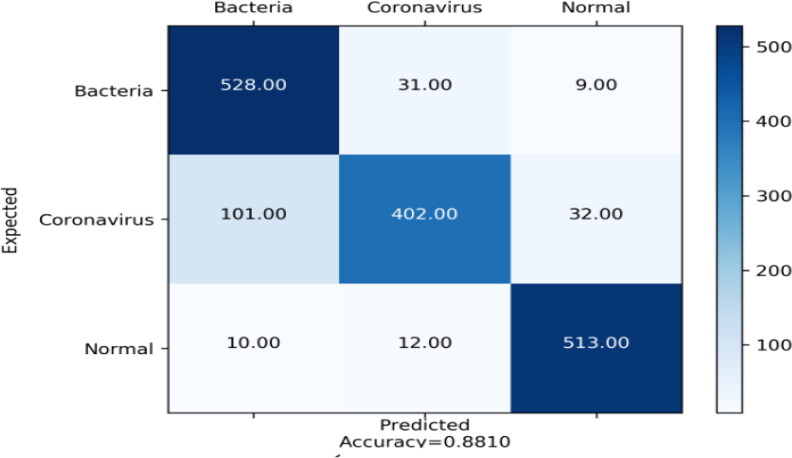
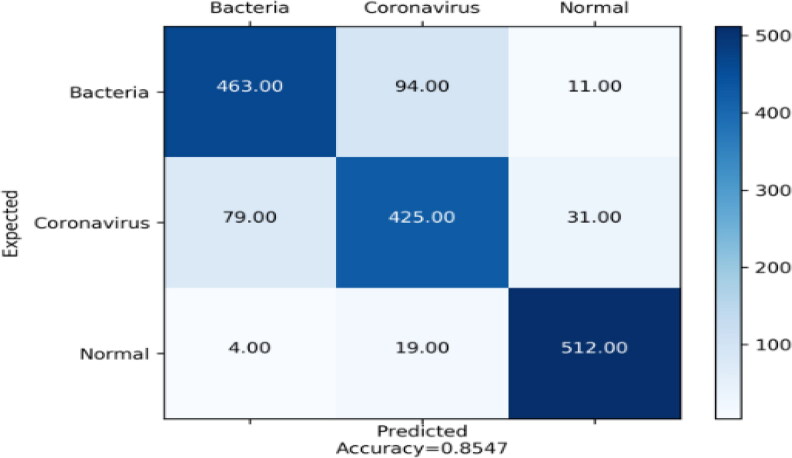
Coronavirus is still the leading cause of death worldwide. There are a set number of COVID-19 test units accessible in emergency clinics because of the expanding cases daily. Therefore, it is important to implement an automatic detection and classification system as a speedy elective finding choice to forestall COVID-19 spreading among individuals. Medical images analysis is one of the most promising research areas, it provides facilities for diagnosis and making decisions of a number of diseases such as Coronavirus. This paper conducts a comparative study of the use of the recent deep learning models (VGG16, VGG19, DenseNet201, Inception_ResNet_V2, Inception_V3, Resnet50, and MobileNet_V2) to deal with detection and classification of coronavirus pneumonia. The experiments were conducted using chest X-ray & CT dataset of 6087 images (2780 images of bacterial pneumonia, 1493 of coronavirus, 231 of Covid19, and 1583 normal) and confusion matrices are used to evaluate model performances. Results found out that the use of inception_Resnet_V2 and Densnet201 provide better results compared to other models used in this work (92.18% accuracy for Inception-ResNetV2 and 88.09% accuracy for Densnet201).Communicated by Ramaswamy H. Sarma.
Keywords: CT and X-ray images; Computer-aided diagnosis; Covid-19; coronavirus automatic detection; deep learning; pneumonia.
Figures





References
-
- Abdelli I., Hassani F., Brikci S. B., & Ghalem S. (2020). In silico study the inhibition of Angiotensin converting enzyme 2 receptor of COVID-19 by Ammoides verticillata components harvested from western Algeria. Journal of Biomolecular Structure and Dynamics. 10.1080/07391102.2020.1763199 - DOI - PMC - PubMed
-
- Al-Masni M. A., Al-Antari M. A., Park J.-M., Gi G., Kim T.-Y., Rivera P., Valarezo E., Choi M.-T., Han S.-M., & Kim T.-S. (2018). Simultaneous detection and classification of breast masses in digital mammograms via a deep learning YOLO-based CAD system. Computer Methods and Programs in Biomedicine, 157, 85–94. 10.1016/j.cmpb.2018.01.017 - DOI - PubMed
-
- Anwarul H., Bilal A. P., Arif H., Fikry A. Q., Farnoosh A., Falah M. A., Majid S., Hossein D., Behnam R., Masoumeh M., Koorosh S., Ali A. S., & Mojtaba F. (2020). A review on the cleavage priming of the spike protein on coronavirus by angiotensin-converting enzyme-2 and furin. Journal of Biomolecular Structure and Dynamics. 10.1080/07391102.2020.1754293 - DOI - PMC - PubMed
-
- Bhandary A., Prabhu G. A., Rajinikanth V., Thanaraj K. P., Satapathy S. C., Robbins D. E., Shasky C., Zhang Y.-D., Tavares J. M. R. S., & Raja N. S. M. (2020). Deep-learning framework to detect lung abnormality—A study with chest X-Ray and lung CT scan images. Pattern Recognition Letters, 129, 271–278. 10.1016/j.patrec.2019.11.013 - DOI
MeSH terms
LinkOut - more resources
Full Text Sources
Medical