


Interventions to support people exposed to adverse childhood experiences: systematic review of systematic reviews
- PMID: 32397975
- PMCID: PMC7216383
- DOI: 10.1186/s12889-020-08789-0
Interventions to support people exposed to adverse childhood experiences: systematic review of systematic reviews
Abstract
Background: Adverse Childhood Experiences (ACEs) such as abuse, neglect or household adversity may have a range of serious negative impacts. There is a need to understand what interventions are effective to improve outcomes for people who have experienced ACEs.
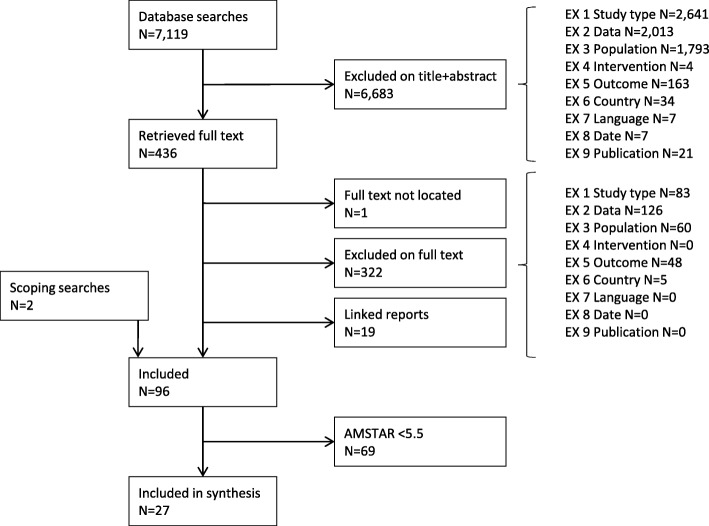
Methods: Systematic review of systematic reviews. We searched 18 database sources from 2007 to 2018 for systematic reviews of effectiveness data on people who experienced ACEs aged 3-18, on any intervention and any outcome except incidence of ACEs. We included reviews with a summary quality score (AMSTAR) of 5.5 or above.
Results: Twenty-five reviews were included. Most reviews focus on psychological interventions and mental health outcomes. The strongest evidence is for cognitive-behavioural therapy for people exposed to abuse. For other interventions - including psychological therapies, parent training, and broader support interventions - the findings overall are inconclusive, although there are some positive results.
Conclusions: There are significant gaps in the evidence on interventions for ACEs. Most approaches focus on mitigating individual psychological harms, and do not address the social pathways which may mediate the negative impacts of ACEs. Many negative impacts of ACEs (e.g. on health behaviours, social relationships and life circumstances) have also not been widely addressed by intervention studies.
Keywords: Adverse childhood experiences; Child abuse; Resilience, psychological; Systematic review.
Conflict of interest statement
The authors declare that they have no competing interests.
Figures
References
-
- Bellis MA, Ashton K, Hughes K, Ford K, Bishop J, Paranjothy S. Adverse childhood experiences and their impact on health-harming behaviours in the welsh adult population. Cardiff: Public Health Wales; 2015.
-
- Allen M, Donkin A. The impact of adverse experiences in the home on the health of children and young people, and inequalities in prevalence and effects. London: UCL Institute of Health Equity; 2015.
-
- Pollock M, Fernandes RM, Becker LA, Pieper D, Hartling L. Chapter V: Overviews of Reviews. In: Higgins JPT, Thomas J, Chandler J, Cumpston M, Li T, Page MJ, Welch VA (editors). Cochrane Handbook for Systematic Reviews of Interventions version 6.0 (updated March 2020). Cochrane, 2020. Available from www.training.cochrane.org/handbook.
Publication types
MeSH terms
Grants and funding
LinkOut - more resources
Full Text Sources
Medical
