. 2020 May 12;20(1):143.
doi: 10.1186/s12906-020-02942-3.

Evaluation of neuroprotective and anti-amnesic effects of Elaeagnus umbellata Thunb. On scopolamine-induced memory impairment in mice

Affiliations

Evaluation of neuroprotective and anti-amnesic effects of Elaeagnus umbellata Thunb. On scopolamine-induced memory impairment in mice

Nausheen Nazir et al. BMC Complement Med Ther. .

Abstract

Background: Elaeagnus umbellata is abundantly found in Himalayan regions of Pakistan which is traditionally used to treat various health disorders. However, the experimental evidence supporting the anti-amnesic effect is limited. Therefore the study was aimed to evaluate the prospective beneficial effect of E. umbellata on learning and memory in mice.

Objectives: To assess neuroprotective and anti-amnesic effects of E. umbellata fruit extracts and isolated compounds on the central nervous system.

Methods: Major phytochemical groups present in methanolic extract of E. umbellata were qualitatively determined. The total phenolic and flavonoid contents were also determined in extract/fractions of E. umbellata. On the basis of in vitro promising anticholinesterases (AChE & BChE) and antioxidant activities observed for CHF. Ext and isolated compound-I (Chlorogenic acid = CGA), they were further evaluated for learning and memory in normal and scopolamine-induced cognitive impairment in mice using memory behavioral tests such as the Y maze and Novel object recognition using standard procedures. The test sample were further assessed for in vivo anticholinesterases (AChE & BChE) and DPPH free radical scavenging activities in mice brain sample and finally validated by molecular docking study using GOLD software.

Results: The extract/fractions and isolated compounds were tested for their anticholinesterase and antioxidant potentials. The CHF. Ext and CGA showed maximum % inhibition of tested cholinesterases and free radicals. The CHF. Ext and CGA reversed the effects of scopolamine in mice. The CHF. Ext and CGA significantly increased the alternate arm returns and % spontaneous alteration performance while escape latency times (second) significantly decreased in Y maze test. The CHF. Ext and CGA significantly increased the time spent with novel object and also increased the discrimination index in the Novel object recognition test. Furthermore, molecular docking was used to validate the mechanism of cholinesterases inhibition of isolated compounds.

Conclusion: The data obtained from behavioral and biochemical studies (AChE/BChE and DPPH/ABTS inhibition) have shown that E. umbellata possessed significant memory enhancing potency. These results suggest that E. umbellata extract possess potential antiamnesic effects and amongst the isolated compounds, compound I could be more effective anti-amnesic therapeutics. However, further studies are needed to identify the exact mechanism of action.

Keywords: Amnesia; Cholinesterases; Elaeagnus umbellata; Molecular docking; Novel object recognition test; Scopolamine; Y-maze test.


Conflict of interest statement

The authors declare that they have no competing interests.

Figures
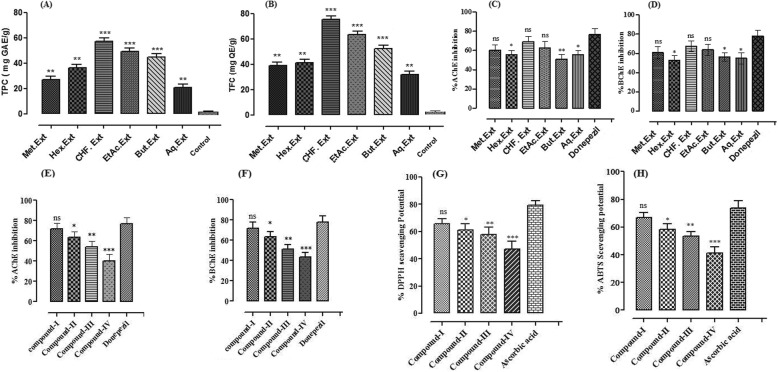
Fig. 1
Fig. 1
Total phenolic/flavonoids contents, anticholinesterase and antioxidant potential of extract/fractions and isolated compound of Elaeagnus umbellata Fruit. {(a) Total phenolic content expressed as gallic acid equivalents (mg GAE)/g dry plant sample; (b) Total flavonoid content expressed as quercetin equivalents (mg QE)/g dry plant sample; (c) %AChE and (d) %BChE inhibition potential of extract/fractions; (e) %AChE and (f) %BChE inhibition potential of isolated compounds; (g) DPPH and (h) ABTS free radical scavenging activity of isolated compounds}
Fig. 2
Fig. 2
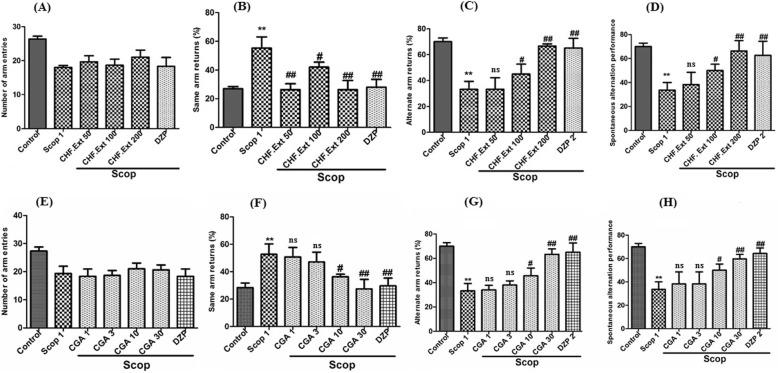
Effect of CHF. Ext and isolated compound chlorogenic acid of Elaeagnus umbellata Thunb. on mice in the behavioural Y-maze test. {(a) number of arm entries (b) Same arm returns (c) alternate arm returns (d) % Spontaneous alteration performance were recorded in CHF. Ext (50, 100 and 200 mg/kg) groups versus scopolamine (Scop. 1 mg/kg) treated group; (e) number of arm entries (f) Same arm returns (g) alternate arm returns (h) % Spontaneous alteration performance were recorded in isolated compound chlorogenic acid (1, 3, 10 and 30 mg/kg) treated groups versus scopolamine (Scop. 1 mg/kg) treated group}
Fig. 3
Fig. 3
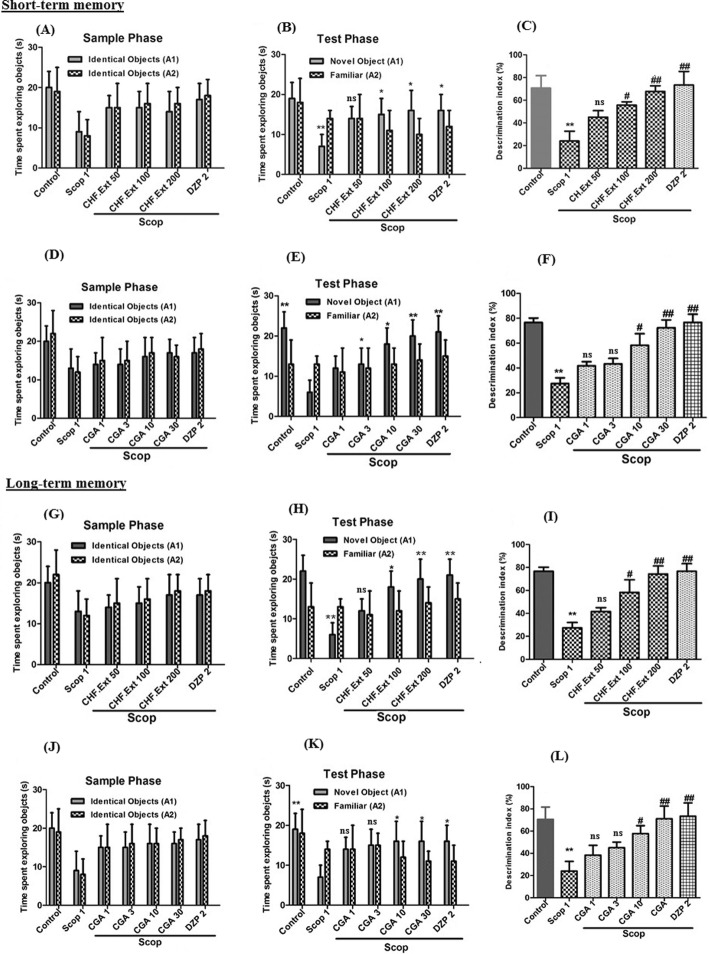
Effect of CHF. Ext and isolated compound (CGA) of E. umbellata Thunb. on mice in behavioural NORT {(a) Time spent in the sample phase (b) Time spent in the test phase (c) % Discrimination index were recorded in CHF. Ext (50, 100 and 200 mg/kg) treated groups versus scopolamine (Scop. 1 mg/kg) treated group and (d) Time spent in the sample phase (e) Time spent in the test phase (f) % Discrimination index were recorded in isolated compound chlorogenic acid (CGA: 1, 3, 10 and 30 mg/kg) treated groups versus scopolamine (Scop. 1 mg/kg) treated group for assessment of short-term memory in mice model in behavioral NORT; (g) Time spent in the sample phase (h) Time spent in the test phase (i) % Discrimination index were recorded in CHF. Ext (50, 100 and 200 mg/kg) treated groups versus scopolamine (Scop. 1 mg/kg) treated group and (j) Time spent in the sample phase (k) Time spent in the test phase (l) % Discrimination index were recorded for isolated compound chlorogenic acid (1, 3, 10 and 30 mg/kg) treated groups versus scopolamine (Scop. 1 mg/kg) treated group for assessment of long-term memory in mice model in behavioral NORT}
Fig. 4
Fig. 4
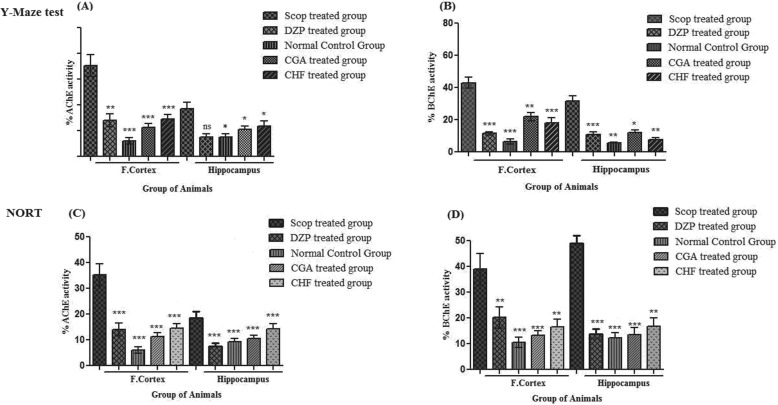
Ex-vivo % AChE and BChE activity in the frontal cortex and hippocampus of different animal groups {(a & b) Different animal groups Scopolamine (Scop. 1 mg/kg) treated group, Donepezil (DZP) treated group, Normal control group, CGA & CHF treated group were used in behavioral Y maze test to assess AChE and BChE activity; while (c & d) has shown AChE and BChE activity in NORT}
Fig. 5
Fig. 5
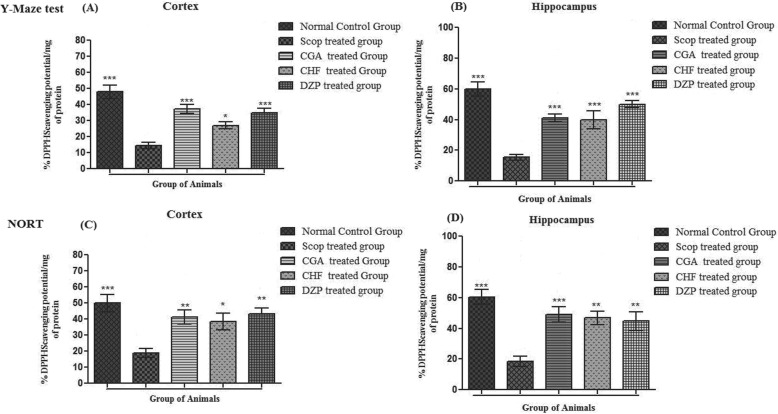
Ex-Vivo %DPPH free radical scavenging effects in frontal cortex and hippocampus of different animal groups {(a & b) Different animal groups (Scopolamine (Scop. 1 mg/kg) treated group, Donepezil (DZP) treated group, Normal control group, CGA & CHF treated group) were used in behavioral Y maze test to assess %DPPH inhibition potential in frontal cortex and hippocampus of different animal groups; while (c & d) has shown %DPPH inhibition in NORT}
Fig. 6
Fig. 6
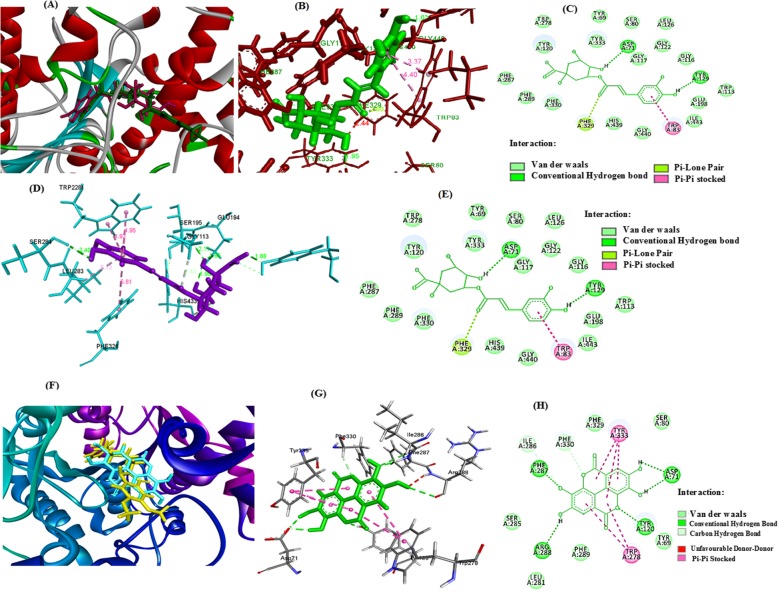
Molecular docking validation of compounds chlorogenic acid and ellagic acid against AChE & BChE {(a) Superimposed ribbon diagram for chlorogenic acid and donepezil (b) Stereo view of the docking posture of chlorogenic acid (green color stick model) in the binding pocket of AChE enzyme (c) 2D interactions of chlorogenic acid. d Stereo view of the docking posture of chlorogenic acid (purple color stick model) in the binding pocket of BChE enzyme (e) 2D interactions of chlorogenic acid (f) Superimposed ribbon diagram for ellagic acid and donepezil (g) Stereo view of the docking posture of ellagic acid (green color stick model) in the binding pocket of AChE enzyme (h) 2D interactions of ellagic acid}

References

    1. Kumar K, Kumar A, Keegan RM, Deshmukh R. Recent advances in the neurobiology and neuropharmacology of Alzheimer’s disease. Biomed Pharmacother. 2018;98:297–307. doi: 10.1016/j.biopha.2017.12.053. - DOI - PubMed
    1. Kuca K, Soukup O, Maresova P, Korabecny J, Nepovimova E, Klimova B, et al. Current approaches against Alzheimer's disease in clinical trials. J Braz Chem Soc. 2016;27(4):641–649.
    1. Gray SL, Anderson ML, Crane PK, Breitner JC, McCormick W, Bowen JD, et al. Antioxidant vitamin supplement use and risk of dementia or Alzheimer’s disease in older adults. J Am Geriatr Soc. 2008;56:291–295. doi: 10.1111/j.1532-5415.2007.01531.x. - DOI - PubMed
    1. Vickers JC, Mitew SA, Woodhouse CM, Fernandez M, Kirkcaldie MT, Canty AJ, et al. Defining the earliest pathological changes of Alzheimer’s disease. Curr Alzheimer Res. 2016;13(3):281–287. doi: 10.2174/1567205013666151218150322. - DOI - PMC - PubMed
    1. Arendt T. Synaptic degeneration in Alzheimer’s disease. Acta Neuropathol. 2009;118:167–179. doi: 10.1007/s00401-009-0536-x. - DOI - PubMed