


Reporting of drug trial funding sources and author financial conflicts of interest in Cochrane and non-Cochrane meta-analyses: a cross-sectional study
- PMID: 32398334
- PMCID: PMC7229983
- DOI: 10.1136/bmjopen-2019-035633
Reporting of drug trial funding sources and author financial conflicts of interest in Cochrane and non-Cochrane meta-analyses: a cross-sectional study
Abstract
Objective: To (1) investigate the extent to which recently published meta-analyses report trial funding, author-industry financial ties and author-industry employment from included randomised controlled trials (RCTs), comparing Cochrane and non-Cochrane meta-analyses; (2) examine characteristics of meta-analyses independently associated with reporting funding sources of included RCTs; and (3) compare reporting among recently published Cochrane meta-analyses to Cochrane reviews published in 2010.
Design: Review of consecutive sample of recently published meta-analyses.
Data sources: MEDLINE database via PubMed searched on 19 October 2018.
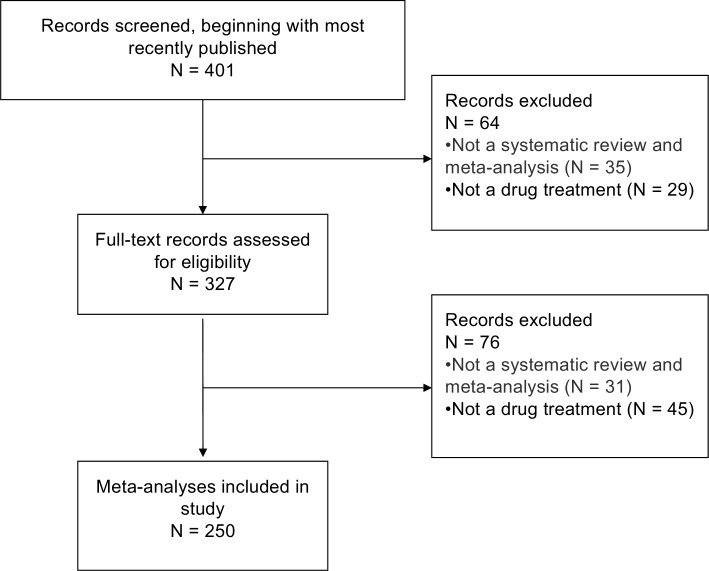
Eligibility criteria for selecting articles: We selected the 250 most recent meta-analyses listed in PubMed that included a documented search of at least one database, statistically combined results from ≥2 RCTs and evaluated the effects of a drug or class of drugs.
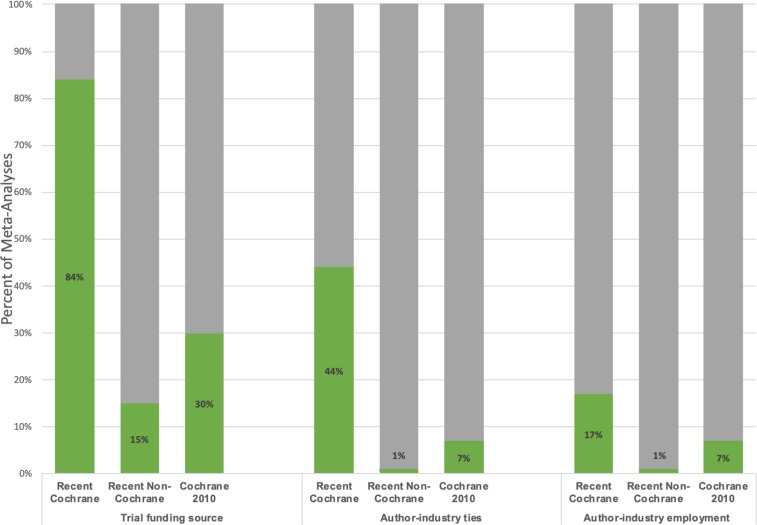
Results: 90 of 107 (84%) Cochrane meta-analyses reported funding sources for some or all included trials compared with 21 of 143 (15%) non-Cochrane meta-analyses, a difference of 69% (95% CI 59% to 77%). Percent reporting was also higher for Cochrane meta-analyses compared with non-Cochrane meta-analyses for trial author-industry financial ties (44% versus 1%; 95% CI for difference 33% to 52%) and employment (17% versus 1%; 95% CI for difference 9% to 24%). In multivariable analysis, compared with Cochrane meta-analyses, the odds ratio (OR) for reporting trial funding was ≤0.11 for all other journal category and impact factor combinations. Compared with Cochrane reviews from 2010, reporting of funding sources of included RCTs among recently published Cochrane meta-analyses improved by 54% (95% CI 42% to 63%), and reporting of trial author-industry financial ties and employment improved by 37% (95% CI 26% to 47%) and 10% (95% CI 2% to 19%).
Conclusions: Reporting of trial funding sources, trial author-industry financial ties and trial author-industry employment in Cochrane meta-analyses has improved since 2010 and is higher than in non-Cochrane meta-analyses.
Keywords: epidemiology; medical ethics; statistics & research methods.
© Author(s) (or their employer(s)) 2020. Re-use permitted under CC BY-NC. No commercial re-use. See rights and permissions. Published by BMJ.
Conflict of interest statement
Competing interests: All authors have completed the ICMJE uniform disclosure form at www.icmje.org/coi_disclosure.pdf. Dr. Bero disclosed that she is Senior Editor, Cochrane Public Health and Health Systems, for which the University of Sydney receives remuneration. Dr. Thombs disclosed that he is a content editor with the Cochrane Common Mental Disorders review group (no remuneration received). All other authors declared: no support from any organisation for the submitted work; no financial relationships with any organisations that might have an interest in the submitted work in the previous three years; no other relationships or activities that could appear to have influenced the submitted work.
Figures
References
MeSH terms
LinkOut - more resources
Full Text Sources
