Review
. 2020 Jul;41(7):902-910.
doi: 10.1038/s41401-020-0417-3. Epub 2020 May 12.

Nanoengineered targeting strategy for cancer immunotherapy

Affiliations
Review

Nanoengineered targeting strategy for cancer immunotherapy

Wei-Min Yin et al. Acta Pharmacol Sin. 2020 Jul.

Abstract

Cancer immunotherapy is rapidly changing the paradigm of cancer care and treatment by evoking host immunity to kill cancer cells. As clinical approval of checkpoint inhibitors (e.g., ipilimumab and pembrolizumab) has been accelerated by a dramatic improvement of long-term survival in a small subset of patients compared to conventional chemotherapy, growing interesting research has focused on immunotherapy. However, majority of patients have not benefited from checkpoint therapies that only partially remove the inhibition of T cell functions. Insufficient systemic T cell responses, low immunogenicity and the immunosuppressive environment of tumors, create great challenges on therapeutic efficiency. Nanotechnology can integrate multiple functions within controlled size and shape, and has been explored as a unique avenue for the development of cancer immunotherapy. In this review, we mainly address how nanoengineered vaccines can induce robust T cell responses against tumors, as well as how nanomedicine can remodel the tumor immunosuppressive microenvironment to boost antitumor immune responses.

Keywords: cancer immunotherapy; cancer vaccine; immune resistance; immunosuppressive microenvironment; nanomedicine; nanovaccine.


Conflict of interest statement

The authors declare no competing interests.

Figures
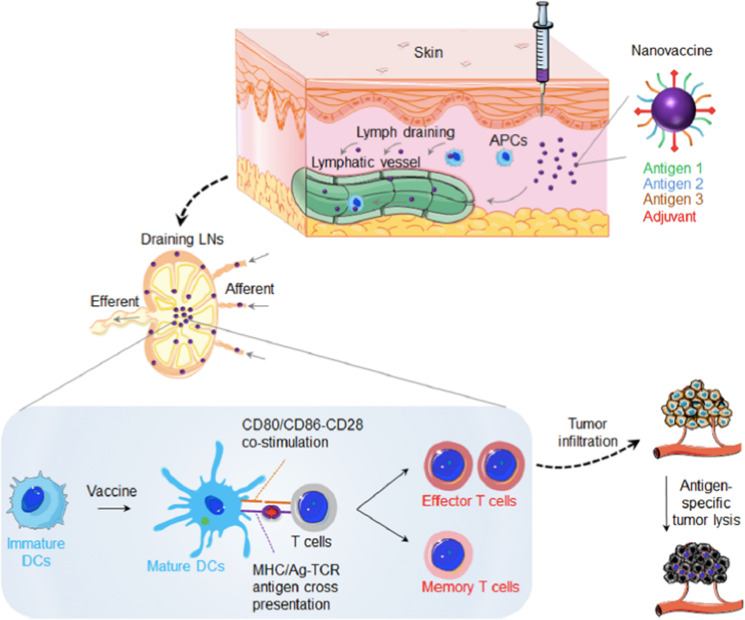
Fig. 1
Fig. 1. Schematic of nanovaccine for cancer immunotherapy.
Nanovaccines can be loaded with both adjuvant and antigens on the surface (as depicted) or inside nanocarrier. Locally administered nanovaccines efficiently codeliver adjuvant and antigens to lymphoid organs for antigen presentation and induction of robust antitumor T-cell responses. Reprinted with permission from ref. [19] (Copyright 2017, American Chemistry Society).
Fig. 2
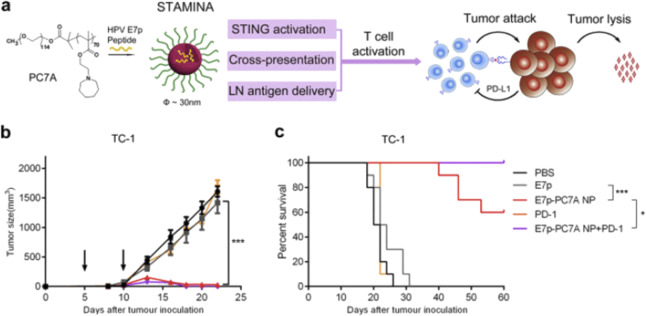
Fig. 2. A STING-activating minimalist nanovaccine (STAMINA) inhibits tumor growth and survival in tumor-bearing mice.
a Schematic of STAMINA to boost tumor-specific T cell immunity. In the HPV tumor model, tumor growth inhibition (b) and survival data (c) in C57BL/6 mice showed strong antitumor immunity after tumor inoculation with TC-1 tumor cells. Reprinted with permission from ref. [3] (Copyright 2017, with permission from Elsevier).
Fig. 3
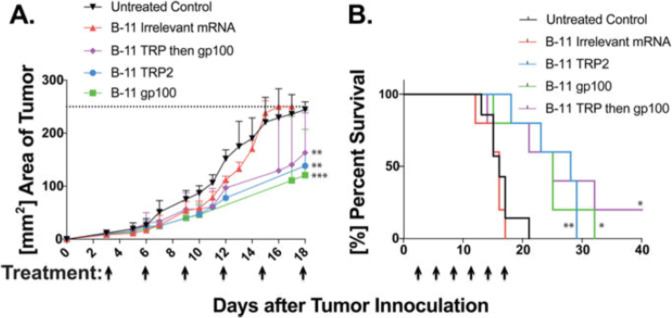
Fig. 3. mRNA LNPs coding for tumor self-antigens, gp100 and TRP2, slow down tumor growth and extend overall survival.
a Tumor areas were measured with a caliper lengths × width. b All three treated groups survived significantly longer the either the untreated control group or mice treated irrelevant mRNA. Reprinted with permission from ref. [47] (Copyright 2017, American Chemistry Society).
Fig. 4
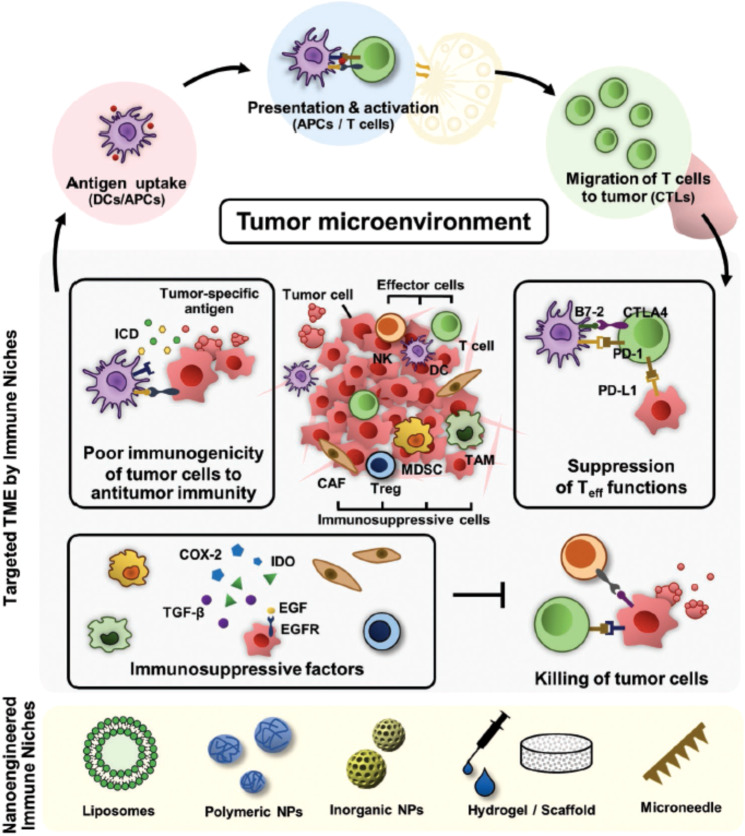
Fig. 4. Schematic of imitation of current cancer immunotherapy, which can be overcome by nanoengineering-based strategies for reprogramming the immunosuppressive TME.
Reprinted with permission from ref. [71] (Copyright 2019, John Wiley and Sons).
Fig. 5
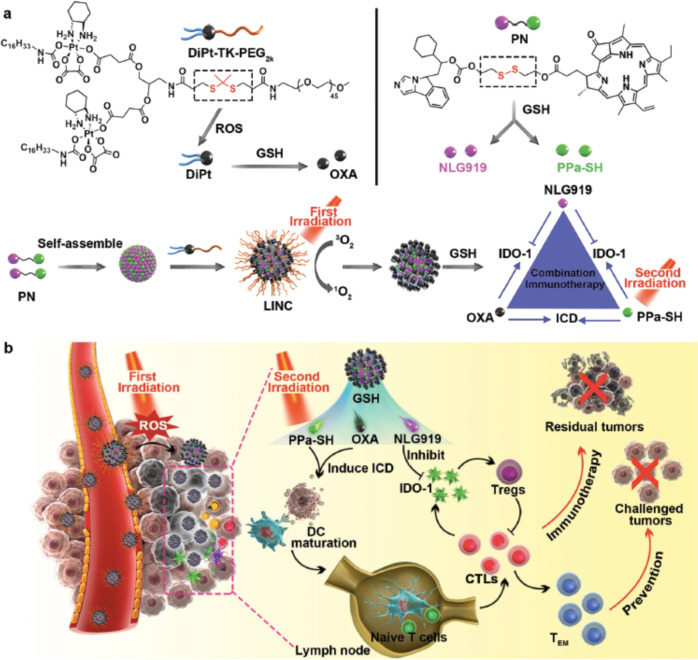
Fig. 5. Schematic illustration of NIR light-inducible LINC (Light-inducible nanocargo) for self-amplified drug delivery and combination immunotherapy.
a Fabrication of the light-inducible prodrug nanocargoes LINC. b Schematic illustration of LINC for improved drug delivery and chemoimmunotherapy by eliciting tumor immunogenicity and overcoming immunosuppressive tumor microenvironment. Reprinted with permission from ref. [88] (Copyright 2019, John Wiley and Sons).
Fig. 6
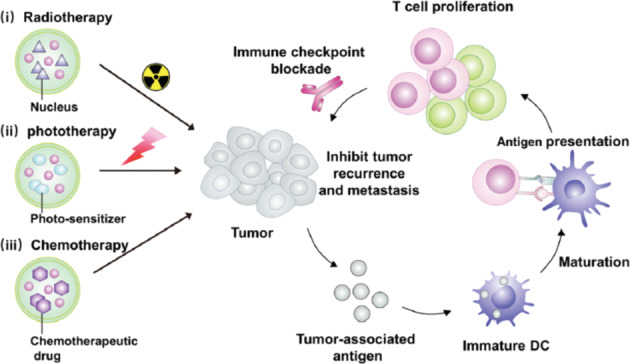
Fig. 6. Local biomaterials-assisted for cancer immunotherapy.
(i) radiotherapy activate the immune system, (ii) phototherapy activate the immune system, (iii) chemotherapy activate the immune system, which in combination with immune checkpoint blockade inhibitors could trigger systemic antitumor immunological responses.

References

    1. Yousefi H, Yuan J, Keshavarz-Fathi M, Murphy JF, Rezaei N. Immunotherapy of cancers comes of age. Expert Rev Clin Immunol. 2017;13:1001–15. - PubMed
    1. Topalian SL, Drake CG, Pardoll DM. Immune checkpoint blockade: a common denominator approach to cancer therapy. Cancer Cell. 2015;27:450–61. - PMC - PubMed
    1. Luo M, Samandi LZ, Wang Z, Chen ZJ, Gao J. Synthetic nanovaccines for immunotherapy. J Control Release. 2017;263:200–10. - PMC - PubMed
    1. Wu X, Gu Z, Chen Y, Chen B, Chen W, Weng L, et al. Application of PD-1 blockade in cancer immunotherapy. Comput Struct Biotechnol J. 2019;17:661–74. - PMC - PubMed
    1. Sharma P, Hu-Lieskovan S, Wargo JA, Ribas A. Primary, adaptive, and acquired resistance to cancer immunotherapy. Cell. 2017;168:707–23. - PMC - PubMed