


Better sleep, better life? How sleep quality influences children's life satisfaction
- PMID: 32399666
- PMCID: PMC7442661
- DOI: 10.1007/s11136-020-02491-9
Better sleep, better life? How sleep quality influences children's life satisfaction
Abstract
Purpose: To assess the association between children's sleep quality and life satisfaction; and to evaluate the underlying mechanisms of this relationship.
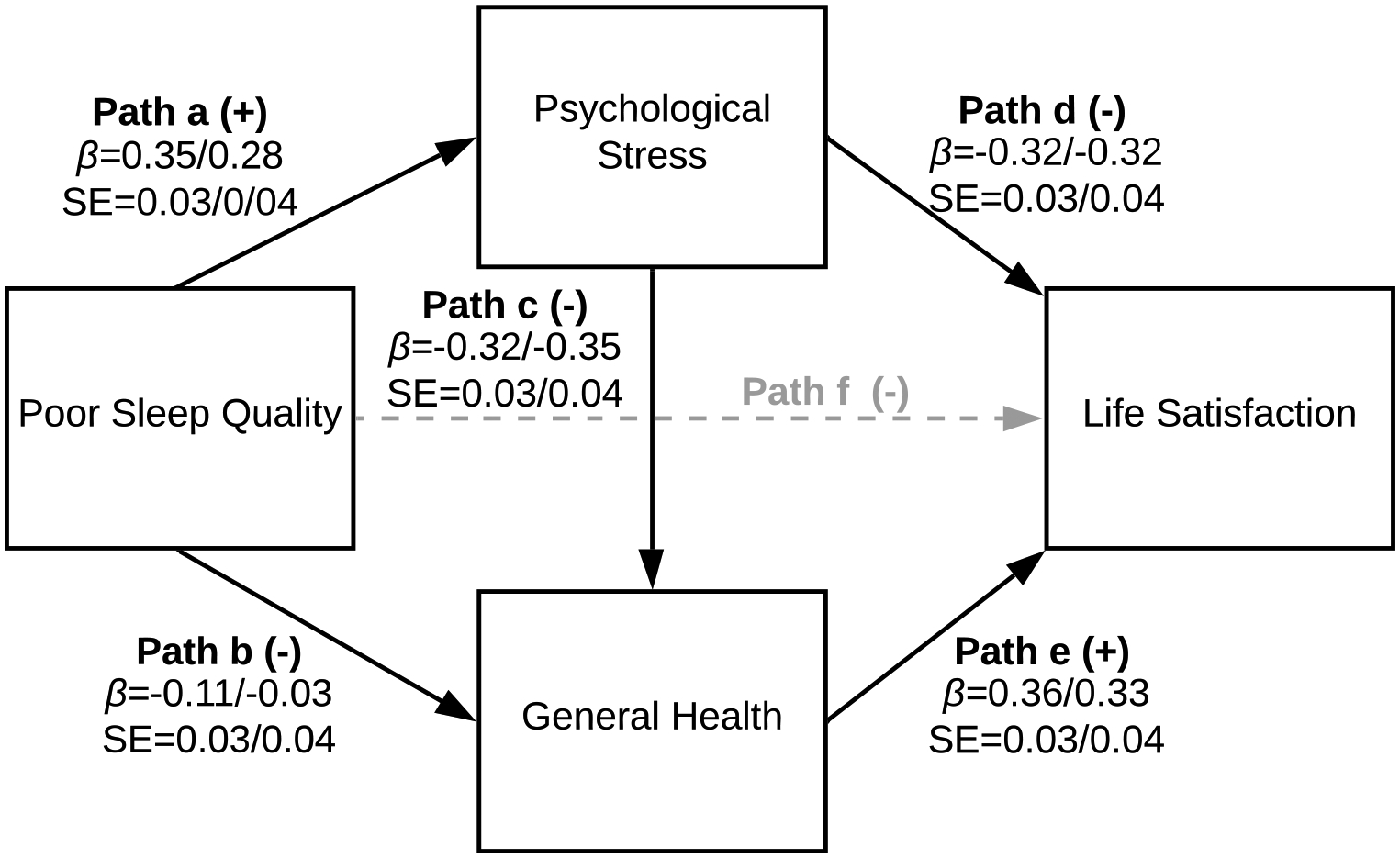
Methods: Three pediatric cohorts in the National Institutes of Health (NIH) Environmental influences on Child Health (ECHO) Research Program administered Patient-Reported Outcome Measurement Information System (PROMIS®) parent-proxy measures to caregivers (n = 1111) who reported on their 5- to 9-year-old children's (n = 1251) sleep quality, psychological stress, general health, and life satisfaction; extant sociodemographic data were harmonized across cohorts. Bootstrapped path modeling of individual patient data meta-analysis was used to determine whether and to what extent stress and general health mediate the relationship between children's sleep quality and life satisfaction.
Results: Nonparametric bootstrapped path analyses with 1000 replications suggested children's sleep quality was associated with lower levels of stress and better general health, which, in turn, predicted higher levels of life satisfaction. Family environmental factors (i.e., income and maternal mental health) moderated these relationships.
Conclusion: Children who sleep well have happier lives than those with more disturbed sleep. Given the modifiable nature of children's sleep quality, this study offers evidence to inform future interventional studies on specific mechanisms to improve children's well-being.
Keywords: ECHO; Life satisfaction; Positive health; Sleep quality; Well-being.
Conflict of interest statement
Figures
References
-
- Ohayon M, et al. , National Sleep Foundation’s sleep quality recommendations: first report. 2017. 3(1): p. 6–19. - PubMed
-
- US Department of Health and Human Services. 2020 Topics & Objectives: Sleep Health. 2014: Washington, DC;.
-
- US Department of Health and Human Services. Secretary’s Advisory Committee on National Health Promotion and Disease Prevention Objectives for 2030 Report #7: Assessment and Recommendations for Proposed Objectives for Healthy People 2030. 2019: Washington, DC;.
MeSH terms
Grants and funding
- UH3 OD023313/OD/NIH HHS/United States
- U24OD023319/NH/NIH HHS/United States
- UH3 OD023389/OD/NIH HHS/United States
- U2C OD023375/OD/NIH HHS/United States
- U24 OD023319/OD/NIH HHS/United States
- UG3/UH3OD023389/NH/NIH HHS/United States
- UG3/UH3OD023313/NH/NIH HHS/United States
- UH3 OD023279/OD/NIH HHS/United States
- UG3 OD023253/OD/NIH HHS/United States
- UG3 OD023316/OD/NIH HHS/United States
- UG3OD023316/NH/NIH HHS/United States
- UG3 OD023279/OD/NIH HHS/United States
- UG3/UH3OD023253/NH/NIH HHS/United States
- U2COD023375/NH/NIH HHS/United States
- UG3/UH3OD023279/NH/NIH HHS/United States
- UG3 OD023389/OD/NIH HHS/United States
- UH3 OD023253/OD/NIH HHS/United States
- UG3 OD023313/OD/NIH HHS/United States
LinkOut - more resources
Full Text Sources
Medical
