


Revenant: a database of resurrected proteins
- PMID: 32400867
- PMCID: PMC7218706
- DOI: 10.1093/database/baaa031
Revenant: a database of resurrected proteins
Abstract
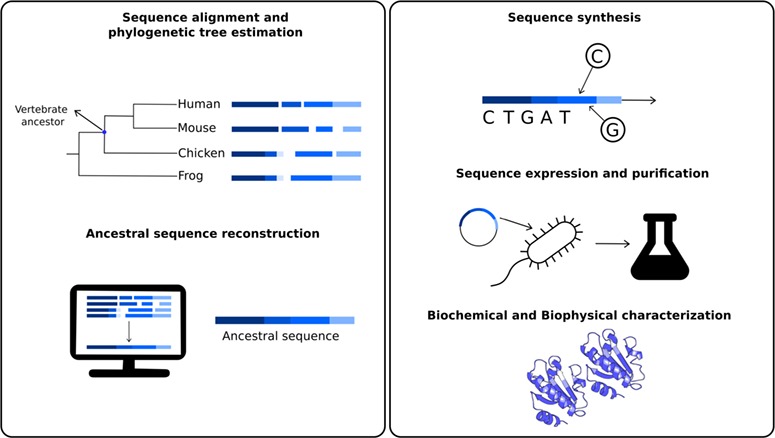
Revenant is a database of resurrected proteins coming from extinct organisms. Currently, it contains a manually curated collection of 84 resurrected proteins derived from bibliographic data. Each protein is extensively annotated, including structural, biochemical and biophysical information. Revenant contains a browse capability designed as a timeline from where the different proteins can be accessed. The oldest Revenant entries are between 4200 and 3500 million years ago, while the younger entries are between 8.8 and 6.3 million years ago. These proteins have been resurrected using computational tools called ancestral sequence reconstruction techniques combined with wet-laboratory synthesis and expression. Resurrected proteins are commonly used, with a noticeable increase during the past years, to explore and test different evolutionary hypotheses such as protein stability, to explore the origin of new functions, to get biochemical insights into past metabolisms and to explore specificity and promiscuous behaviour of ancient proteins.
© The Author(s) 2020. Published by Oxford University Press.
Figures


References
-
- Gumulya Y. and Gillam E.M.J. (2017) Exploring the past and the future of protein evolution with ancestral sequence reconstruction: the “retro” approach to protein engineering. Biochem. J., 474, 1–19. - PubMed
-
- Thornton J.W. (2004) Resurrecting ancient genes: experimental analysis of extinct molecules. Nat. Rev. Genet., 5, 366–375. - PubMed
-
- Merkl R. and Sterner R. (2016) Ancestral protein reconstruction: techniques and applications. Biol. Chem., 397, 1–21. - PubMed
-
- Fitch W.M. (1971) Toward defining the course of evolution: minimum change for a specific tree topology. Syst. Zool., 20, 406.
Publication types
MeSH terms
Substances
LinkOut - more resources
Full Text Sources
Miscellaneous
