Randomized Controlled Trial
. 2020 Sep 1;77(9):915-924.
doi: 10.1001/jamapsychiatry.2020.0940.

Effect of Internet vs Face-to-Face Cognitive Behavior Therapy for Health Anxiety: A Randomized Noninferiority Clinical Trial

Affiliations
Randomized Controlled Trial

Effect of Internet vs Face-to-Face Cognitive Behavior Therapy for Health Anxiety: A Randomized Noninferiority Clinical Trial

Erland Axelsson et al. JAMA Psychiatry. .

Abstract

Importance: Health anxiety is a common and often chronic mental health problem associated with distress, substantial costs, and frequent attendance throughout the health care system. Face-to-face cognitive behavior therapy (CBT) is the criterion standard treatment, but access is limited.

Objective: To test the hypothesis that internet-delivered CBT, which requires relatively little resources, is noninferior to face-to-face CBT in the treatment of health anxiety.

Design, setting, and participants: This randomized noninferiority clinical trial with health economic analysis was based at a primary care clinic and included patients with a principal diagnosis of health anxiety who were self-referred or referred from routine care. Recruitment began in December 10, 2014, and the last treatment ended on July 23, 2017. Follow-up data were collected up to 12 months after treatment. Analysis began October 2017 and ended March 2020.

Interventions: Patients were randomized (1:1) to 12 weeks of internet-delivered CBT or to individual face-to-face CBT.

Main outcomes and measures: Change in health anxiety symptoms from baseline to week 12. Analyses were conducted from intention-to-treat and per-protocol (completers only) perspectives, using the noninferiority margin of 2.25 points on the Health Anxiety Inventory, which has a theoretical range of 0 to 54.

Results: Overall, 204 patients (mean [SD] age, 39 [12] years; 143 women [70%]) contributed with 2386 data points on the Health Anxiety Inventory over the treatment period. Of 204 patients, 102 (50%) were randomized to internet-delivered CBT, and 102 (50%) were randomized to face-to-face CBT. The 1-sided 95% CI upper limits for the internet-delivered CBT vs face-to-face CBT difference in change were within the noninferiority margin in the intention-to-treat analysis (B = 0.00; upper limit: 1.98; Cohen d = 0.00; upper limit: 0.23) and per-protocol analysis (B = 0.01; upper limit: 2.17; Cohen d = 0.00; upper limit: 0.25). The between-group effect was not moderated by initial symptom level, recruitment path, or patient treatment preference. Therapists spent 10.0 minutes per patient per week in the online treatment vs 45.6 minutes for face-to-face CBT. The net societal cost was lower in the online treatment (treatment period point difference: $3854). There was no significant group difference in the number of adverse events, and no serious adverse event was reported.

Conclusions and relevance: In this trial, internet-delivered CBT appeared to be noninferior to face-to-face CBT for health anxiety, while incurring lower net societal costs. The online treatment format has potential to increase access to evidence-based treatment for health anxiety.

Trial registration: ClinicalTrials.gov Identifier: NCT02314065.


Conflict of interest statement

Conflict of Interest Disclosures: Drs Axelsson and E. Hedman-Lagerlöf report grants from Karolinska Institutet and Stockholm County Council (ALF Medicine) during the conduct of the study. Drs Axelsson, Andersson, Ljótsson, and E. Hedman-Lagerlöf have coauthored a self-help book for severe health anxiety available in the public marketplace, published between the start of the trial and the writing of the present manuscript. Drs Ljótsson and E. Hedman-Lagerlöf are shareholders of DahliaQomit Inc, a company specializing in online psychiatric symptom assessment, and Hedman-Lagerlöf och Ljótsson psykologi AB, a company that creates commercialized internet-based cognitive behavior therapy manuals. No other disclosures were reported.

Figures

Figure 1.
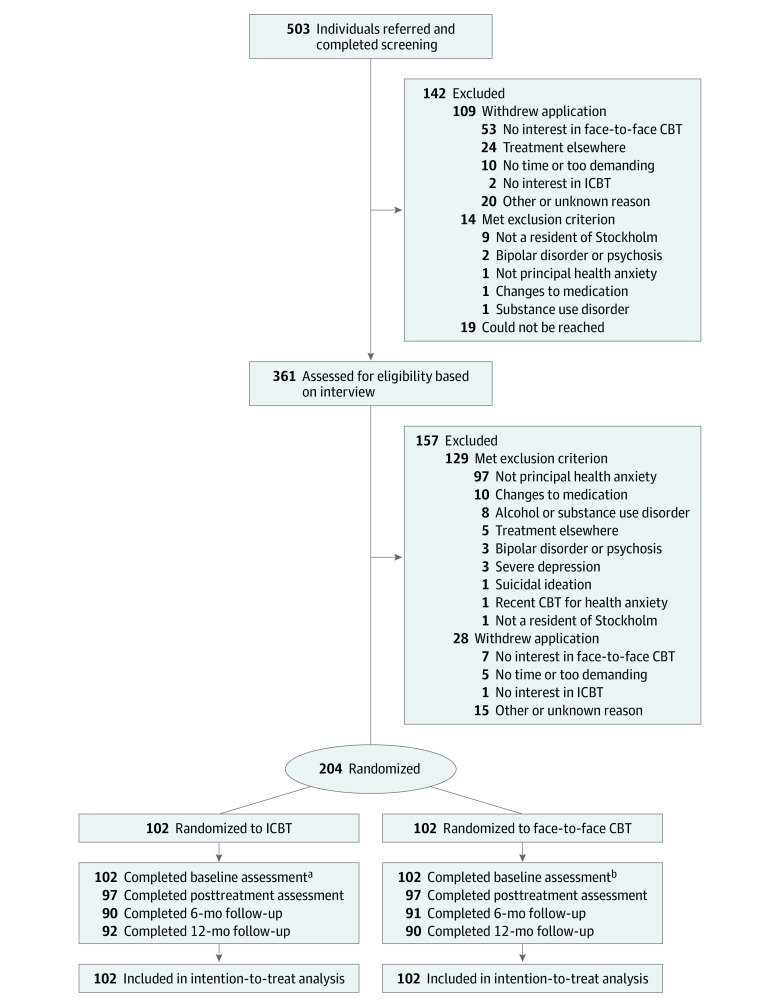
Figure 1.. Flow of Recruitment to Internet-Delivered and Face-to-Face Cognitive Behavior Therapy (CBT)
Study participants were randomized to either individual face-to-face CBT or therapist-guided internet-delivered CBT (ICBT). aA total of 101, 96, 94, 90, 90, 90, 89, 88, 87, 84, and 83 individuals completed assessments at week 1 to 11, respectively. bA total of 95, 97, 90, 94, 93, 89, 87, 85, 88, 89 and 89 individuals completed assessments at week 1 to 11, respectively.
Figure 2.
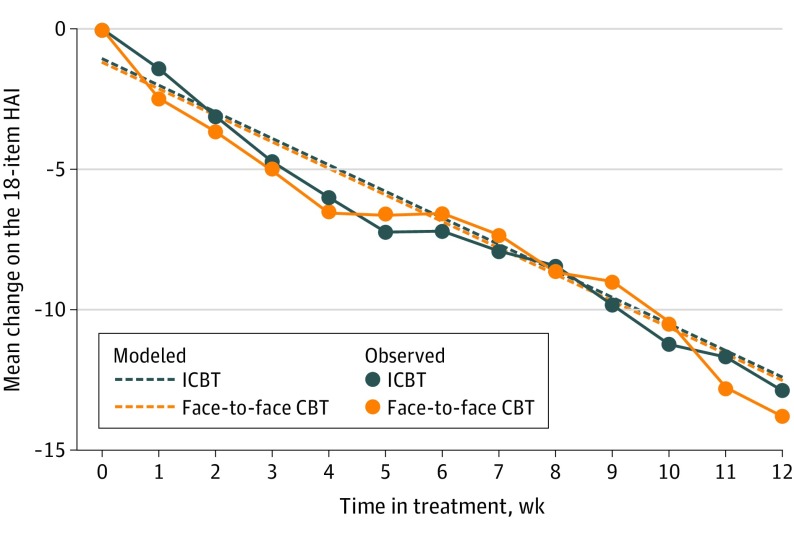
Figure 2.. Observed and Modeled Mean Change in Health Anxiety by Treatment Group
Estimated values are based on the fixed portion of mixed-effects linear regression models and intention-to-treat data (ie, all patients in the study were included). Error bars are omitted for clarity of presentation. Study participants were randomized to either individual face-to-face cognitive behavior therapy (CBT) or therapist-guided internet-delivered CBT (ICBT). HAI indicates Health Anxiety Inventory.
Figure 3.
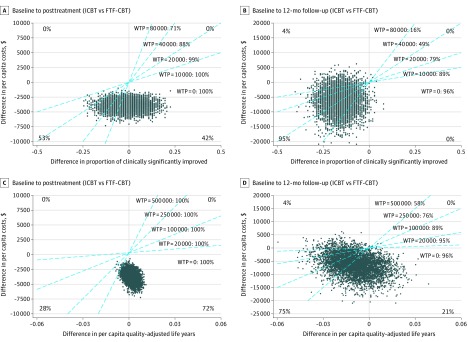
Figure 3.. Cost-Effectiveness and Cost-Utility of Therapist-Guided Internet-Delivered Cognitive Behavior Therapy (ICBT) vs Individual Face-to-Face Cognitive Behavior Therapy (FTF-CBT) for Health Anxiety
Cost-effectiveness analysis (A and B) and cost-utility analysis (C and D). In each of the 4 panels (A, B, C, and D), the cost-effectiveness plane has 4 quadrants. Points in the first (northeast) quadrant are indicative of higher ICBT (vs FTF-CBT) net costs and higher ICBT (vs FTF-CBT) efficacy, points in the second (northwest) quadrant are indicative of higher ICBT (vs FTF-CBT) net costs and lower ICBT (vs FTF-CBT) efficacy, points in the third (southwest) quadrant are indicative of lower ICBT (vs FTF-CBT) net costs and lower ICBT (vs FTF-CBT) efficacy, and points in the fourth (southeast) quadrant are indicative of lower ICBT (vs FTF-CBT) net costs and higher ICBT (vs FTF-CBT) efficacy. Each blue line has a coefficient corresponding to a hypothetical level of societal willingness-to-pay (WTP) per unit of efficacy, ie, additional responder or quality-adjusted life-year. The proportion of incremental cost-effectiveness ratios right of a blue line indicate the probability of ICBT being more cost-effective than FTF-CBT at the corresponding WTP.

References

    1. Barsky AJ. Clinical practice: the patient with hypochondriasis. N Engl J Med. 2001;345(19):1395-1399. doi: 10.1056/NEJMcp002896 - DOI - PubMed
    1. Sunderland M, Newby JM, Andrews G. Health anxiety in Australia: prevalence, comorbidity, disability and service use. Br J Psychiatry. 2013;202(1):56-61. doi: 10.1192/bjp.bp.111.103960 - DOI - PubMed
    1. olde Hartman TC, Borghuis MS, Lucassen PL, van de Laar FA, Speckens AE, van Weel C. Medically unexplained symptoms, somatisation disorder and hypochondriasis: course and prognosis: a systematic review. J Psychosom Res. 2009;66(5):363-377. doi: 10.1016/j.jpsychores.2008.09.018 - DOI - PubMed
    1. Tyrer P, Cooper S, Crawford M, et al. Prevalence of health anxiety problems in medical clinics. J Psychosom Res. 2011;71(6):392-394. doi: 10.1016/j.jpsychores.2011.07.004 - DOI - PubMed
    1. Lucock MP, Morley S, White C, Peake MD. Responses of consecutive patients to reassurance after gastroscopy: results of self administered questionnaire survey. BMJ. 1997;315(7108):572-575. doi: 10.1136/bmj.315.7108.572 - DOI - PMC - PubMed

Publication types

Associated data