


Frailty screening in dermato-oncology practice: a modified Delphi study and a systematic review of the literature
- PMID: 32403174
- PMCID: PMC7818261
- DOI: 10.1111/jdv.16607
Frailty screening in dermato-oncology practice: a modified Delphi study and a systematic review of the literature
Abstract
Background: Appropriate management and prevention of both under- and overtreatment in older skin cancer patients can be challenging. It could be helpful to incorporate frailty screening in dermato-oncology care, since frailty is associated with adverse health outcomes.
Objectives: This study aimed to identify and prioritize the requirements a frailty screening tool (FST) should fulfil in dermato-oncology practice and to select the best existing FST(s) for this purpose.
Methods: A modified two-round Delphi procedure was performed among 50 Italian and Dutch specialists and patients to review and prioritize a list of potential FST requirements, using a 5-point Likert scale. Consensus was defined as a mean score of ≥4.0. A systematic literature search was performed to identify existing multidomain FSTs, which were then assessed on the requirements resulting from the modified Delphi procedure.
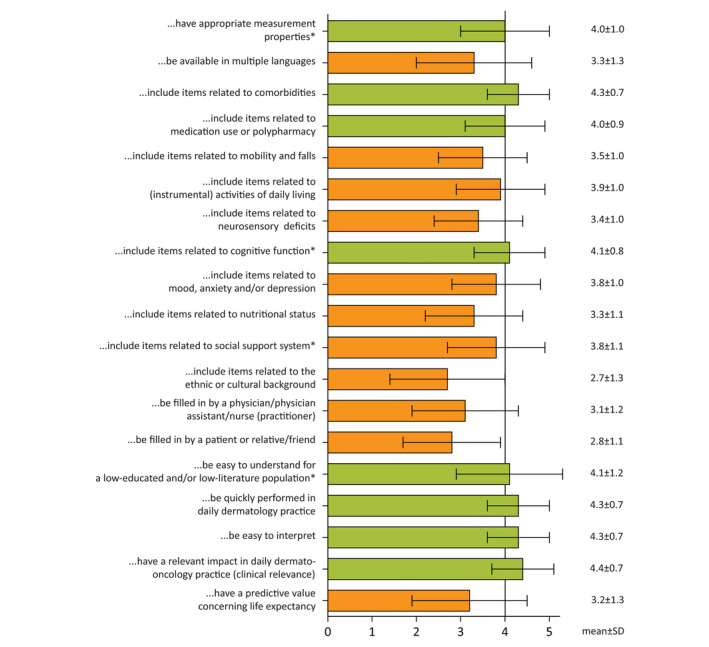
Results: Consensus was achieved on evaluation of comorbidities (4.3 ± 0.7), polypharmacy (4.0 ± 0.9) and cognition (4.1 ± 0.8). The FST should have appropriate measurement properties (4.0 ± 1.0), be quickly executed (4.2 ± 0.7), clinically relevant (4.3 ± 0.7), and both easily understandable (4.1 ± 1.2) and interpretable (4.3 ± 0.7). Of the 26 identified FSTs, four evaluated the content-related domains: the Geriatric-8 (G8), the modified Geriatric-8 (mG8), the Groningen Frailty Indicator (GFI) and the Senior Adult Oncology Program 2 (SAOP2) screening tool. Of these, the G8 was the most extensively studied FST, with the best psychometric properties and execution within 5 min.
Conclusions: The G8 appears the most suitable FST for assessing frailty in older adults with skin cancer, although clinical studies assessing its use in a dermato-oncology population are needed to further assess whether or not frailty in this particular patient group is associated with relevant outcomes (e.g. complications and mortality), as seen in previous studies in other medical fields.
© 2020 The Authors. Journal of the European Academy of Dermatology and Venereology published by John Wiley & Sons Ltd on behalf of European Academy of Dermatology and Venereology.
Figures
References
-
- Lubeek SF, Borgonjen RJ, van Vugt LJ et al Improving the applicability of guidelines on nonmelanoma skin cancer in frail older adults: a multidisciplinary expert consensus and systematic review of current guidelines. Br J Dermatol 2016; 175: 1003–1010. - PubMed
-
- Decoster L, Van Puyvelde K, Mohile S et al Screening tools for multidimensional health problems warranting a geriatric assessment in older cancer patients: an update on SIOG recommendationsdagger. Ann oncol 2015; 26: 288–300. - PubMed
-
- Extermann M, Aapro M, Bernabei R et al Use of comprehensive geriatric assessment in older cancer patients: recommendations from the task force on CGA of the International Society of Geriatric Oncology (SIOG). Crit Rev Oncol Hematol 2005; 55: 241–252. - PubMed
Publication types
MeSH terms
LinkOut - more resources
Full Text Sources
Other Literature Sources
Medical
Miscellaneous
