


Optimisation of Ultrasound Frequency, Extraction Time and Solvent for the Recovery of Polyphenols, Phlorotannins and Associated Antioxidant Activity from Brown Seaweeds
- PMID: 32403273
- PMCID: PMC7281582
- DOI: 10.3390/md18050250
Optimisation of Ultrasound Frequency, Extraction Time and Solvent for the Recovery of Polyphenols, Phlorotannins and Associated Antioxidant Activity from Brown Seaweeds
Abstract
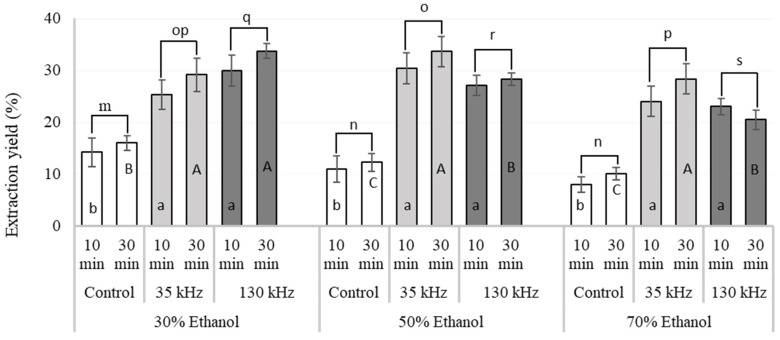
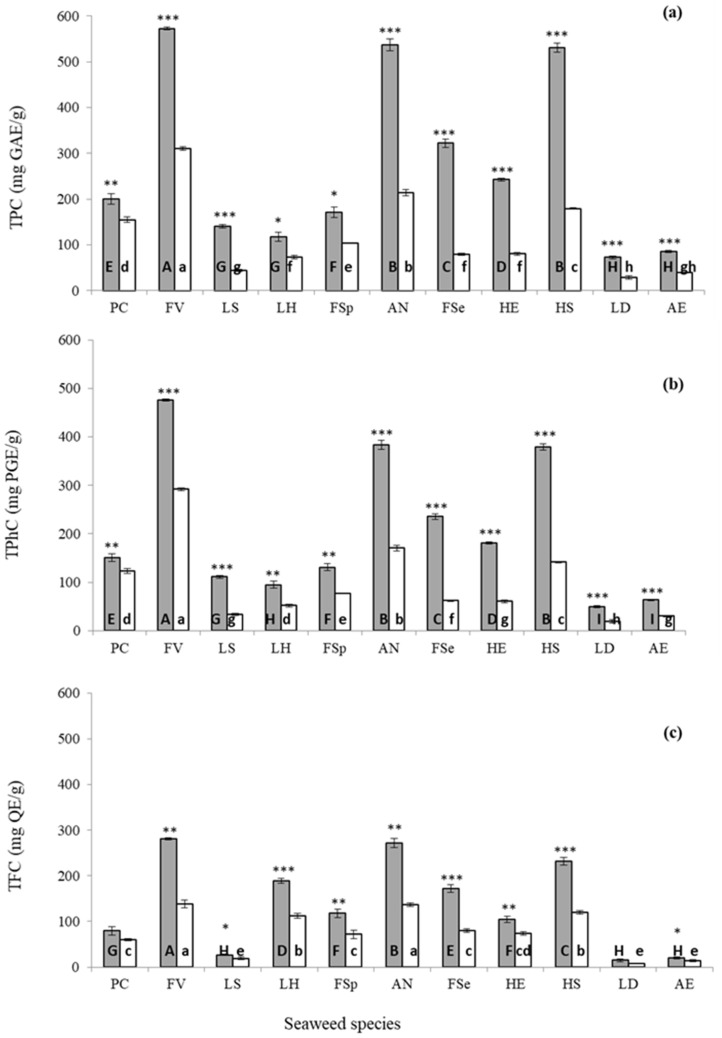
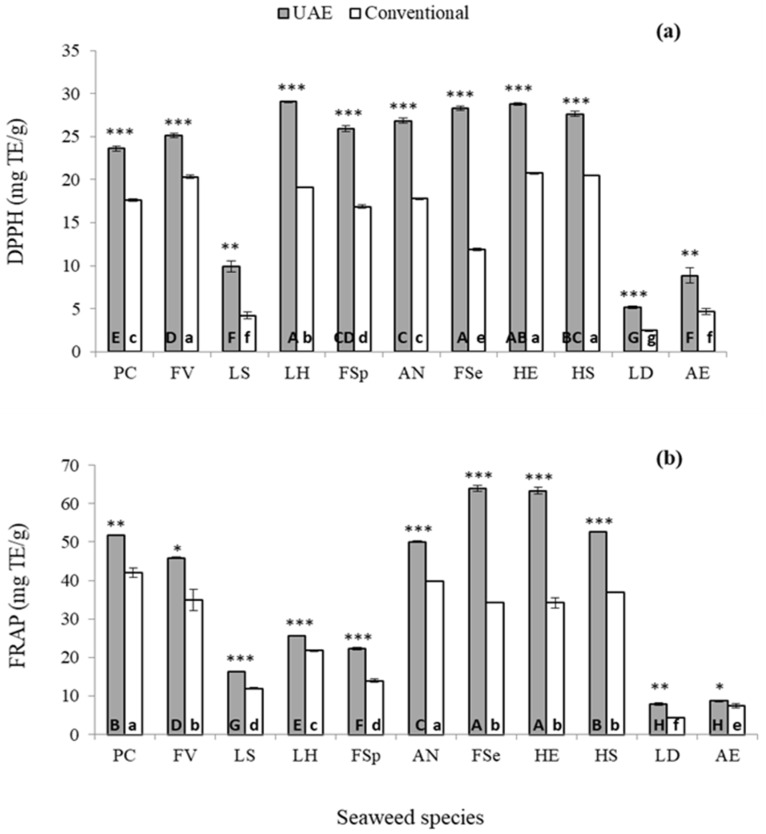
This study investigates ultrasound assisted extraction (UAE) process parameters (time, frequency and solvent) to obtain high yields of phlorotannins, flavonoids, total phenolics and associated antioxidant activities from 11 brown seaweed species. Optimised UAE conditions (35 kHz, 30 min and 50% ethanol) significantly improved the extraction yield from 1.5-fold to 2.2-fold in all seaweeds investigated compared to solvent extraction. Using ultrasound, the highest recovery of total phenolics (TPC: 572.3 ± 3.2 mg gallic acid equivalent/g), total phlorotannins (TPhC: 476.3 ± 2.2 mg phloroglucinol equivalent/g) and total flavonoids (TFC: 281.0 ± 1.7 mg quercetin equivalent/g) was obtained from Fucus vesiculosus seaweed. While the lowest recovery of TPC (72.6 ± 2.9 mg GAE/g), TPhC (50.3 ± 2.0 mg PGE/g) and TFC (15.2 ± 3.3 mg QE/g) was obtained from Laminaria digitata seaweed. However, extracts from Fucus serratus obtained by UAE exhibited the strongest 1,1-diphenyl-2-picryl-hydrazyl (DPPH) scavenging activity (29.1 ± 0.25 mg trolox equivalent/g) and ferric reducing antioxidant power (FRAP) value (63.9 ± 0.74 mg trolox equivalent/g). UAE under optimised conditions was an effective, low-cost and eco-friendly technique to recover biologically active polyphenols from 11 brown seaweed species.
Keywords: antioxidant capacity; conventional extraction; macroalgae; phlorotannin; polyphenols; ultrasound assisted extraction.
Conflict of interest statement
The authors declare no conflicts of interest.
Figures
References
-
- Mouritsen O.G., Dawczynski C., Duelund L., Jahreis G., Vetter W., Schröder M. On the human consumption of the red seaweed dulse (Palmaria palmata (L.) Weber & Mohr) J. Appl. Phycol. 2013;25:1777–1791.
-
- Holdt S.L., Kraan S. Bioactive compounds in seaweed: Functional food applications and legislation. J. Appl. Phycol. 2011;23:543–597. doi: 10.1007/s10811-010-9632-5. - DOI
-
- Wang L., Park Y.J., Jeon Y.J., Ryu B. Bioactivities of the edible brown seaweed, Undaria pinnatifida: A review. Aquaculture. 2018;495:873–880. doi: 10.1016/j.aquaculture.2018.06.079. - DOI
-
- Bordoloi A., Goosen N. Green and integrated processing approaches for the recovery of high-value compounds from brown seaweeds. Adv. Bot. Res. 2019 doi: 10.1016/bs.abr.2019.11.011. - DOI
Publication types
MeSH terms
Substances
Grants and funding
LinkOut - more resources
Full Text Sources
Medical
Miscellaneous
