


Risk factors of malnutrition in Chinese children with congenital heart defect
- PMID: 32404077
- PMCID: PMC7218652
- DOI: 10.1186/s12887-020-02124-7
Risk factors of malnutrition in Chinese children with congenital heart defect
Abstract
Background: The study aimed to investigate the risk factors of malnutrition in children with congenital heart defect (CHD) in China.
Methods: This cohort study was performed at the biggest pediatric heart center in China; 3252 patients with CHD who underwent cardiac surgeries in 2013 were included. Anthropometric measurements included weight for age Z score (WAZ), weight for height Z score (WHZ), and height for age Z score (HAZ). The patients were classified as normal nutritional status and malnutrition, based on a cut-off Z score of <- 2. Factors associated with malnutrition were determined using logistic regression analysis.
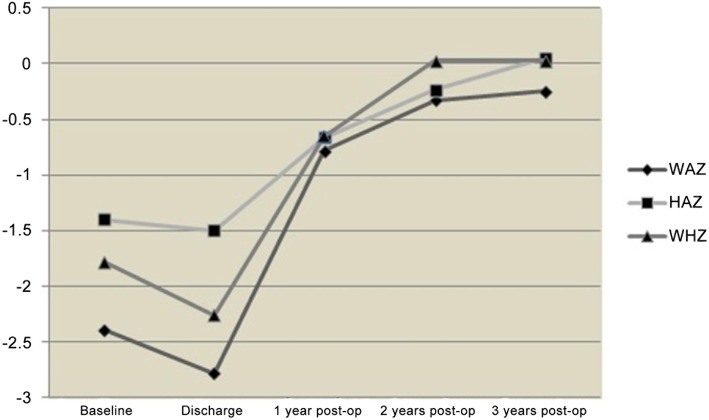
Results: The prevalence of preoperative WAZ < -2 (underweight), HAZ < -2 (stunting), and WHZ < -2 (wasting) was 23.3, 23.3, and 14.3%, respectively. The multivariable analysis of preoperative malnutrition showed that hospitalization, age at surgery, risk adjustment for congenital heart surgery-1 > 3, mechanical ventilation, pulmonary hypertension, and acyanotic heart disease were associated with underweight. Parents' height, single ventricle, and cyanotic heart disease were associated with stunting. Hospitalization and pulmonary hypertension were associated with wasting. After surgery, the patients presented a significant improvement in growth within the first year in all three parameters and grew to the normal range of WAZ (- 0.3 ± 0.9, P < 0.001), HAZ (0.2 ± 0.8, P = 0.001), and WHZ (0.03 ± 0.6, P < 0.001) at 2 years after surgery. The prevalence of underweight, stunted, and wasting declined to 3.2, 2.7, and 1.9% 3 years after surgery. Malnutrition after surgery was associated with cardiac residual cardiac abnormalities (OR = 35.3, p < 0.0001), high Ross classification of heart function (OR = 27.1, p < 0.0001), and long-term taking oral diuretics (OR = 20.5, P = 0.001).
Conclusions: Malnutrition is still a problem in children with CHD in China, especially before the surgery. There is need to strengthen the nutrition support for children with CHD before surgery. Hemodynamic factors were found to be the risk factors associated with malnutrition after operation.
Keywords: Cardiac surgery; Children; Congenital heart disease; Malnutrition.
Conflict of interest statement
The authors declare that they have no competing interests.
Figures
References
-
- Radman M, Mack R, Barnoya J, et al. The effect of preoperative nutritional status on postoperative outcomes in children undergoing surgery for congenital heart defects in San Francisco (UCSF) and Guatemala City (UNICAR) J Thorac Cardiovasc Surg. 2014;147:442–450. doi: 10.1016/j.jtcvs.2013.03.023. - DOI - PMC - PubMed
MeSH terms
LinkOut - more resources
Full Text Sources
Medical
