Progression to type 2 diabetes in women with a known history of gestational diabetes: systematic review and meta-analysis
- PMID: 32404325
- PMCID: PMC7218708
- DOI: 10.1136/bmj.m1361
Progression to type 2 diabetes in women with a known history of gestational diabetes: systematic review and meta-analysis
Abstract
Objective: To estimate and compare progression rates to type 2 diabetes mellitus (T2DM) in women with gestational diabetes mellitus (GDM) and healthy controls.
Design: Systematic review and meta-analysis.
Data sources: Medline and Embase between January 2000 and December 2019, studies published in English and conducted on humans.
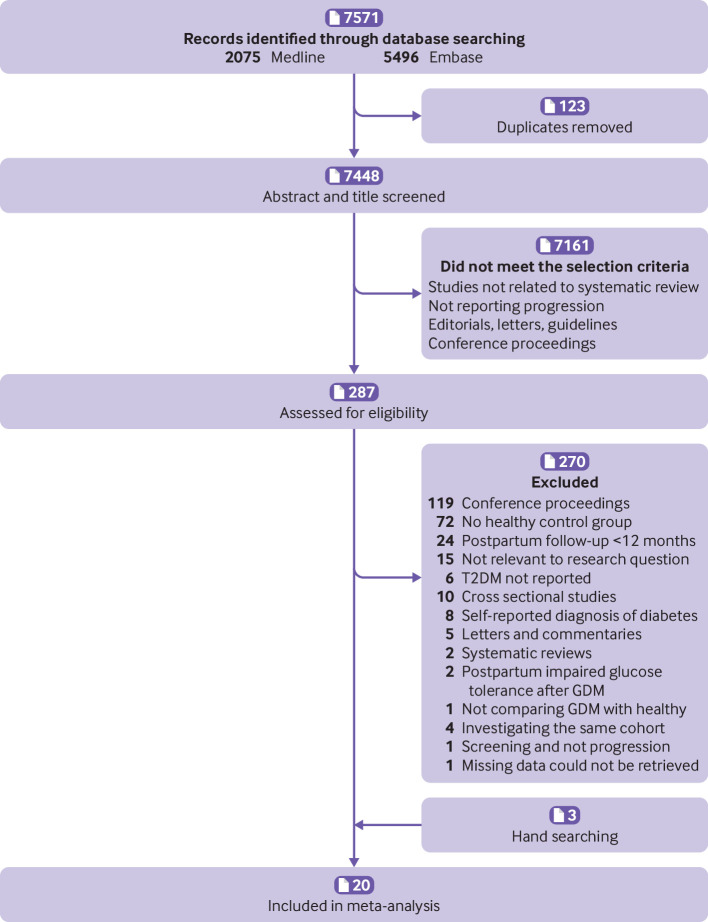
Eligibility criteria for selecting studies: Observational studies investigating progression to T2DM. Inclusion criteria were postpartum follow-up for at least 12 months, incident physician based diagnosis of diabetes, T2DM reported as a separate outcome rather than combined with impaired fasting glucose or impaired glucose tolerance, and studies with both a group of patients with GDM and a control group.
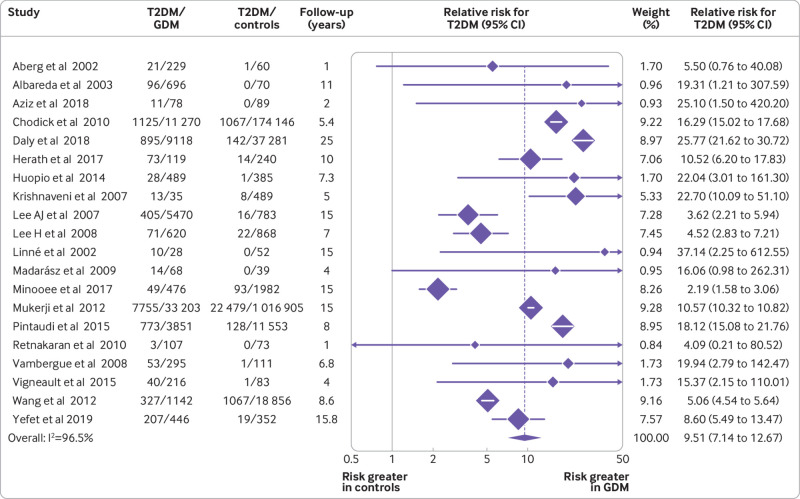
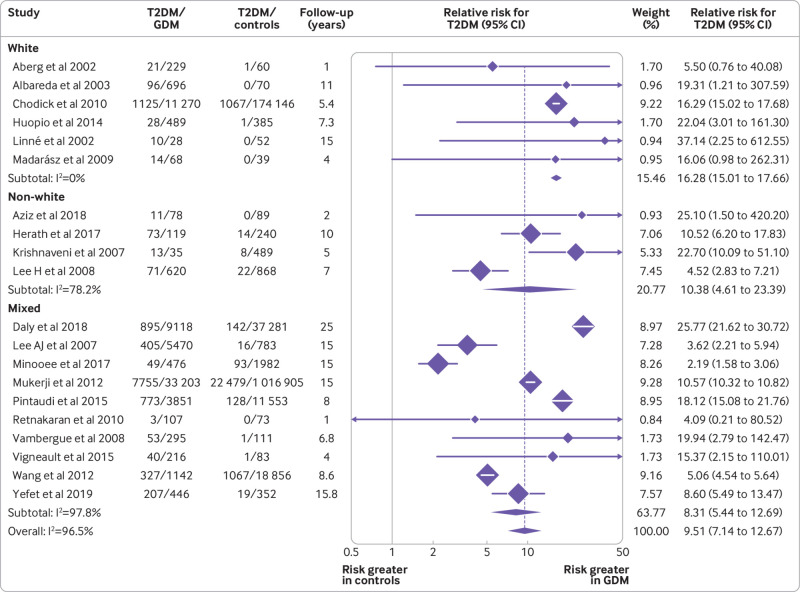
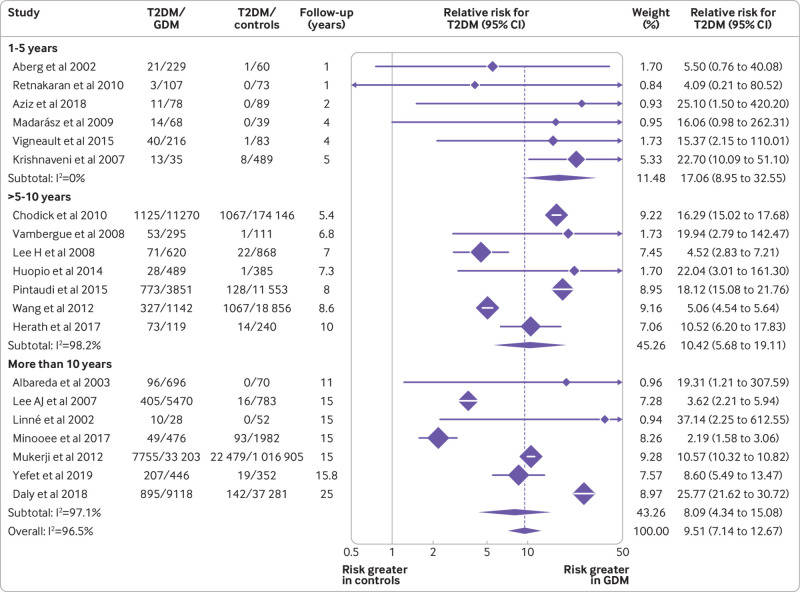
Results: This meta-analysis of 20 studies assessed a total of 1 332 373 individuals (67 956 women with GDM and 1 264 417 controls). Data were pooled by random effects meta-analysis models, and heterogeneity was assessed by use of the I2 statistic. The pooled relative risk for the incidence of T2DM between participants with GDM and controls was estimated. Reasons for heterogeneity between studies were investigated by prespecified subgroup and meta-regression analyses. Publication bias was assessed by funnel plots and, overall, studies were deemed to have a low risk of bias (P=0.58 and P=0.90). The overall relative risk for T2DM was almost 10 times higher in women with previous GDM than in healthy controls (9.51, 95% confidence interval 7.14 to 12.67, P<0.001). In populations of women with previous GDM, the cumulative incidence of T2DM was 16.46% (95% confidence interval 16.16% to 16.77%) in women of mixed ethnicity, 15.58% (13.30% to 17.86%) in a predominantly non-white population, and 9.91% (9.39% to 10.42%) in a white population. These differences were not statistically significant between subgroups (white v mixed populations, P=0.26; white v non-white populations, P=0.54). Meta-regression analyses showed that the study effect size was not significantly associated with mean study age, body mass index, publication year, and length of follow-up.
Conclusions: Women with a history of GDM appear to have a nearly 10-fold higher risk of developing T2DM than those with a normoglycaemic pregnancy. The magnitude of this risk highlights the importance of intervening to prevent the onset of T2DM, particularly in the early years after pregnancy.
Systematic review registration: PROSPERO CRD42019123079.
© Author(s) (or their employer(s)) 2019. Re-use permitted under CC BY-NC. No commercial re-use. See rights and permissions. Published by BMJ.
Conflict of interest statement
Competing interests: All authors have completed the ICMJE uniform disclosure form at www.icmje.org/coi_disclosure.pdf and declare: support from the NIHR Applied Research Collaboration East Midlands and NIHR Leicester Biomedical Research Centre for the submitted work. KK has acted as a consultant and speaker for Novartis, Novo Nordisk, Sanofi-Aventis, Lilly, Servier, and Merck Sharp and Dohme; has received grants in support of investigator and investigator initiated trials from Novartis, Novo Nordisk, Sanofi-Aventis, Lilly, Pfizer, Boehringer Ingelheim, and Merck Sharp and Dohme; and has received funds for research, honoraria for speaking at meetings and has served on advisory boards for Lilly, Sanofi-Aventis, Merck Sharp and Dohme, and Novo Nordisk. MJD has acted as consultant, advisory board member and speaker for Novo Nordisk, Sanofi-Aventis, Lilly, Merck Sharp and Dohme, Boehringer Ingelheim, AstraZeneca, and Janssen; as a speaker for Mitsubishi Tanabe Pharma Corporation; and has received grants in support of investigator and investigator initiated trials from Novo Nordisk, Sanofi-Aventis, and Lilly. All other authors declare no competing interests, or activities that could appear to have influenced the submitted work.
Figures
Comment in
-
Enhancing postnatal care of women with gestational diabetes.BMJ. 2020 Jun 23;369:m2414. doi: 10.1136/bmj.m2414. BMJ. 2020. PMID: 32576556 No abstract available.
References
-
- International Diabetes Federation IDF Diabetes Atlas - 2019. International Diabetes Federation, 2019. - PubMed
Publication types
MeSH terms
Grants and funding
LinkOut - more resources
Full Text Sources
Medical