. 2020 May 13;10(1):7929.
doi: 10.1038/s41598-020-64886-5.

Tracing the composition of single e-cigarette aerosol droplets in situ by laser-trapping and Raman scattering

Affiliations

Tracing the composition of single e-cigarette aerosol droplets in situ by laser-trapping and Raman scattering

Grégory David et al. Sci Rep. .

Abstract

The partitioning of components between droplets and the gas phase in e-cigarette aerosols has a significant impact on deposition within the respiratory tract. However, exclusive detection of droplet composition has, so far, been elusive. Consequently, the dynamics of partitioning between droplets and the gas phase remains unknown. Here, we combine optical trapping of single droplets with in situ Raman scattering for destruction-free monitoring of e-cigarette droplet composition with a time resolution of seconds. We find that the initial droplet composition is very close to the composition of the e-liquid. Upon dilution with air, the droplet composition changes exponentially on a time scale of seconds, mainly because of evaporation of propylene glycol. The nicotine content in the droplet is controlled by the pH. Nicotine evaporates from the droplets under basic conditions, but remains in the liquid under acidic conditions. These results are crucial for advancing e-liquid research and manufacturing.


Conflict of interest statement

The authors declare no competing interests.

Figures
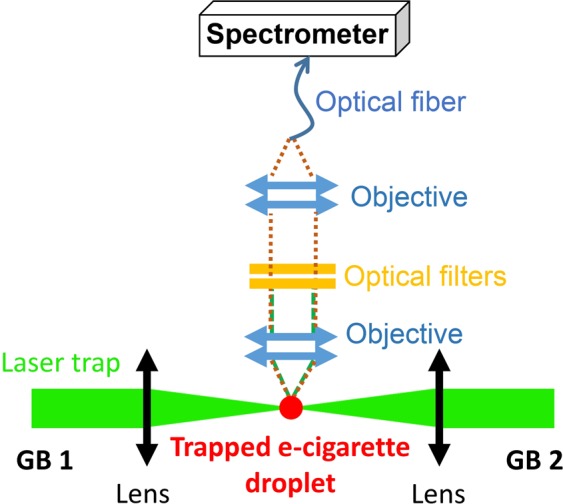
Figure 1
Figure 1
Sketch of the experimental setup. It consists of an optical trap (counter-propagating optical tweezers; CPT) and a Raman spectrometer. The CPT trap is formed by two focused counter-propagating Gaussian beams (GB 1 and GB 2). The e-cigarette aerosol droplet is trapped in the common focus of GB 1 and GB 2. The Raman scattering of the droplet is collected and filtered by the collection optics (objectives and optical filters) and detected in a fiber-coupled spectrometer.
Figure 2
Figure 2
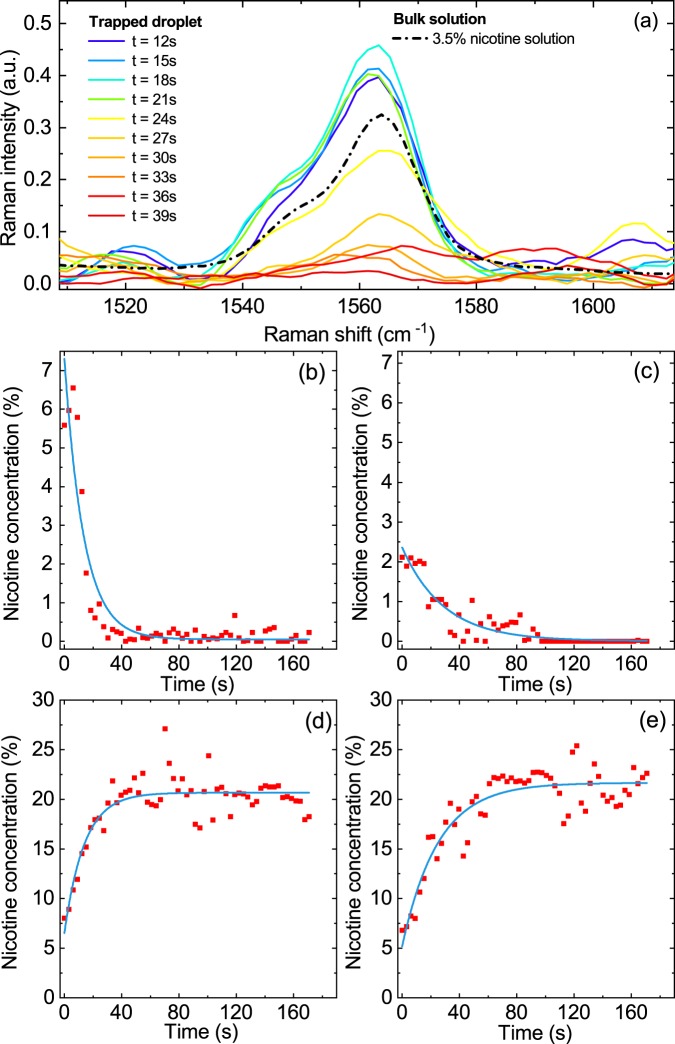
Time-dependence of the nicotine content in e-cigarette aerosol droplets. (a) Typical time evolution of the nicotine Raman band recorded for a droplet generated from an e-liquid with 5% nicotine and pH 9.9 (colored lines). The dashed-dotted black line is a Raman spectrum of a bulk liquid with 3.5% nicotine. (b–e) Time-dependence of the nicotine concentration in droplets generated from different e-liquids: (b) 5% nicotine at pH 9.9; (c) 2% nicotine at pH 9.9; (d) 5% nicotine at pH 6.5; and (e) 5% nicotine at pH 3.4. The light blue lines represent exponential fits to the time evolution of the experimental nicotine concentration (Methods and Table 1).
Figure 3
Figure 3
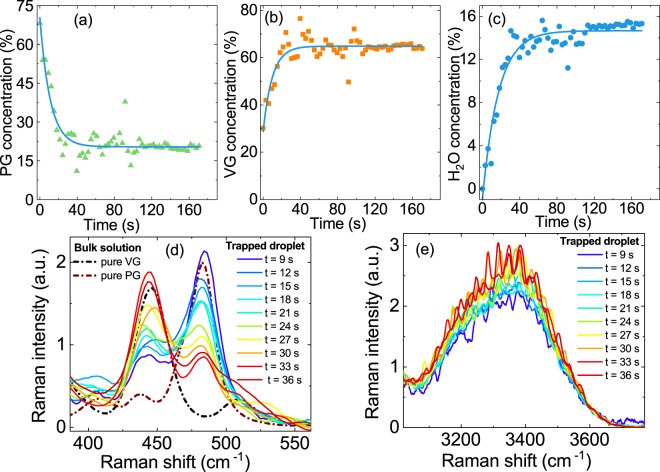
Time-dependence of the PG, VG, and H2O content in e-cigarette aerosol droplets. Time-dependence of the concentration of (a) PG, (b) VG, and (c) H2O for an example of a droplet generated from an e-liquid with 2% nicotine and pH 9.9. Light blue lines: Exponential fits to the experimental concentrations (Methods and Table 1).Time-evolution of the corresponding Raman spectra in the region of the (d) VG and PG band and (e) OH-stretch band. Measurements for pure VG and pure PG bulk solutions are shown as references.
Figure 4
Figure 4
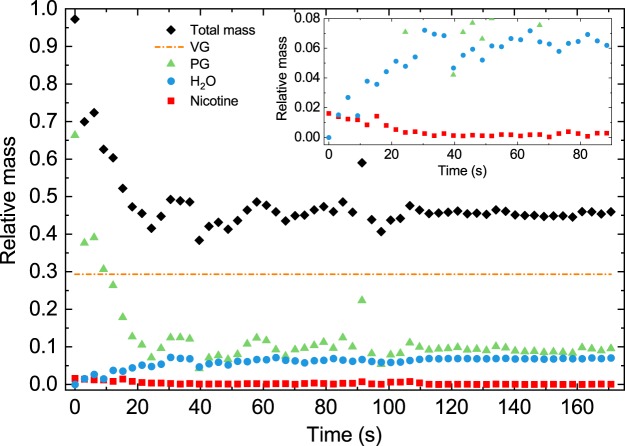
Temporal mass changes of an e-cigarette aerosol droplet. Total mass change of a droplet (black diamonds) over time relative to the initial droplet mass (2% nicotine at pH 9.9). Mass changes of the different components over time, relative to the initial mass: VG (orange, dash dotted line), PG (green triangles), nicotine (red squares), and H2O (blue dots). The VG mass is assumed to be constant. The inset shows the nicotine and H2O mass changes in more detail.

References

    1. Strongin RM. E-Cigarette Chemistry and Analytical Detection. Annu. Rev. Anal. Chem. 2019;12:23–39. doi: 10.1146/annurev-anchem-061318-115329. - DOI - PMC - PubMed
    1. Kaisar MA, Prasad S, Liles T, Cucullo L. A decade of e-cigarettes: Limited research & unresolved safety concerns. Toxicology. 2016;365:67–75. doi: 10.1016/j.tox.2016.07.020. - DOI - PMC - PubMed
    1. Kousta S. E-cigarettes for smoking cessation. Nature Human Behaviour. 2019;3:322–322. doi: 10.1038/s41562-019-0575-9. - DOI - PubMed
    1. Enlighten e-cigarettes. Nat. Med. 25, 531–531 (2019). - PubMed
    1. Tang M-S. Reply to Queimado et al.: E-cigarettes induce DNA damage and inhibit DNA repair in mice and human cells. Proc. Natl. Acad. Sci. USA. 2018;115:E5439–E5439. doi: 10.1073/pnas.1807971115. - DOI - PMC - PubMed

Publication types