


New Criteria for Lupus
- PMID: 32405775
- PMCID: PMC7220972
- DOI: 10.1007/s11926-020-00896-6
New Criteria for Lupus
Abstract
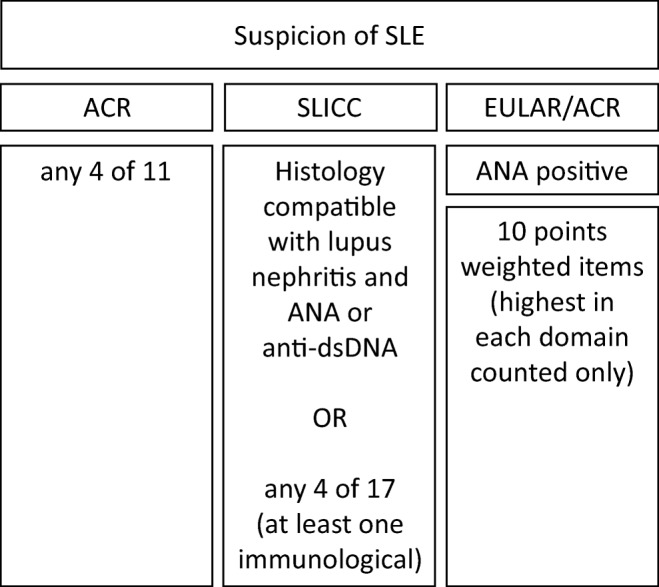
Purpose of the review: Classification criteria define the patient population for clinical trials and translational studies, but also influence current understanding of the disease. This review attempts to delineate the development from the American College of Rheumatology (ACR) 1982 to the European League Against Rheumatism (EULAR)/ACR 2019 classification criteria for systemic lupus erythematosus (SLE).
Recent findings: The new EULAR/ACR classification criteria use antinuclear antibodies (ANA) as an entry criterion. (Non-infectious) fever is the one new criterion. All criteria items now have individual weights (from 2 to 10) and are structured in domains, within which only the highest item is counted. There is one common attribution rule, counting criteria only if there is no more likely alternative explanation. Ten points are sufficient for classification. The new criteria have reached a sensitivity of 96.1% and a specificity of 93.4%. The new EULAR/ACR 2019 classification criteria for SLE build on the previous criteria sets, adding fever only as a new criteria item. The new structure is reflective of the current diagnostic approach and has led to improved statistical performance.
Keywords: Antinuclear antibodies; Arthritis; Classification criteria; Cutaneous lupus erythematosus; Nephritis; Systemic lupus erythematosus.
Conflict of interest statement
The authors declare that they have no conflicts of interest.
Figures
References
-
- Cervera R, Khamashta MA, Font J, Sebastiani GD, Gil A, Lavilla P, Doménech I, Aydintug AO, Jedryka-Góral A, de Ramón E. Systemic lupus erythematosus: clinical and immunologic patterns of disease expression in a cohort of 1,000 patients. The European working party on systemic lupus Erythematosus. Medicine (Baltimore) 1993;72(2):113–124. doi: 10.1097/00005792-199303000-00005. - DOI - PubMed
Publication types
MeSH terms
Substances
LinkOut - more resources
Full Text Sources
Medical
Research Materials
